
St. Petersburg · 1908–1960s
The City That Ran on Green Benches— and Why They Vanished
Downtown St. Pete once had thousands of benches on the sidewalks. What emptied them is the reason our whole trade exists.
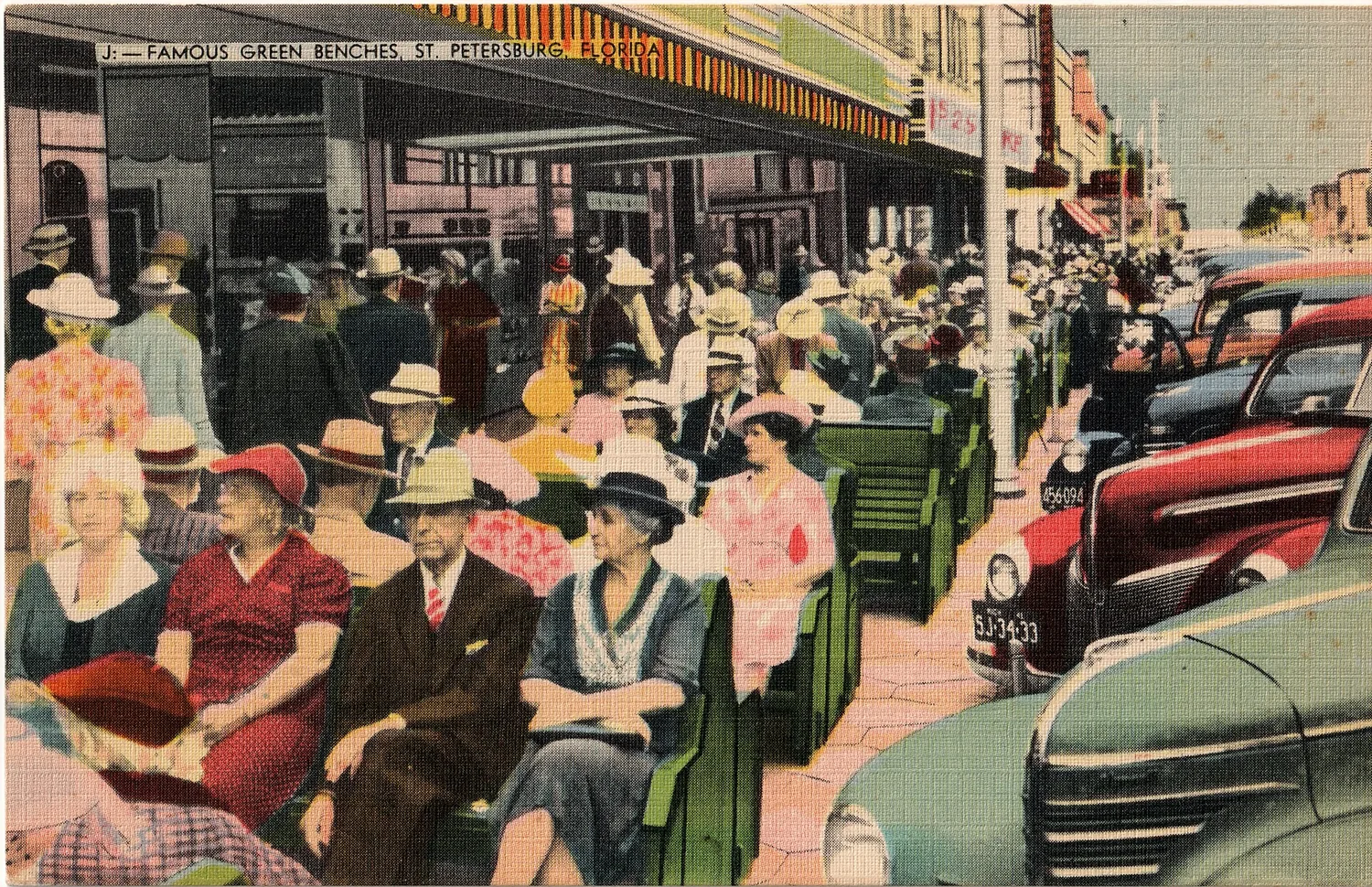
Walk through downtown St. Petersburg seventy years ago and you'd have struggled to find a stretch of sidewalk without a bench on it. Not a few benches. Thousands. All painted the same shade of green, all full of people just sitting there, watching the street go by for hours.
It's a strange thing to picture now: a whole downtown built around sitting outside. Which raises a fair question — why would a city this hot line its sidewalks with benches and expect people to fill them all day?
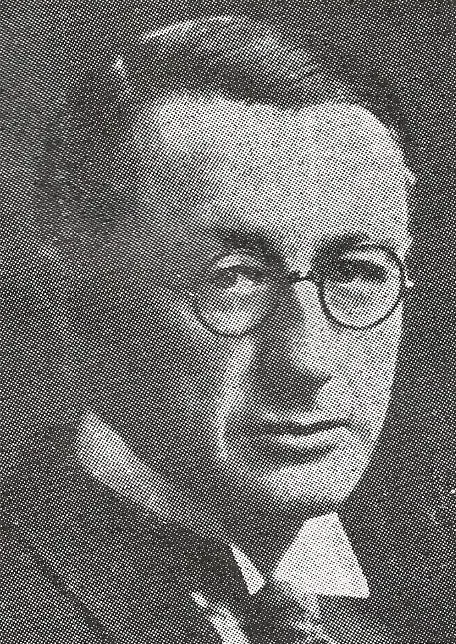
Noel Mitchell — started it with orange benches
Noel A. Mitchell, from Karl H. Grismer’s history of St. Petersburg, c. 1920s. Public domain, via Wikimedia Commons.
It started with one salesman and some orange benches
The whole thing began around 1908 with a real-estate man named Noel Mitchell. He set a run of benches out in front of his office on Central Avenue — and, being a salesman, he painted them a loud bright orange so nobody could miss where his door was.
It worked a little too well. Other merchants wanted the same foot traffic, so they put out benches too, in whatever color they liked. Before long downtown was a mismatched jumble of orange and green and purple seats.
Around 1916, Mayor Al Lang put an end to the circus with a city ordinance: every bench the same size, every bench the same green. At the peak there were something like seven thousand of them lining the streets.
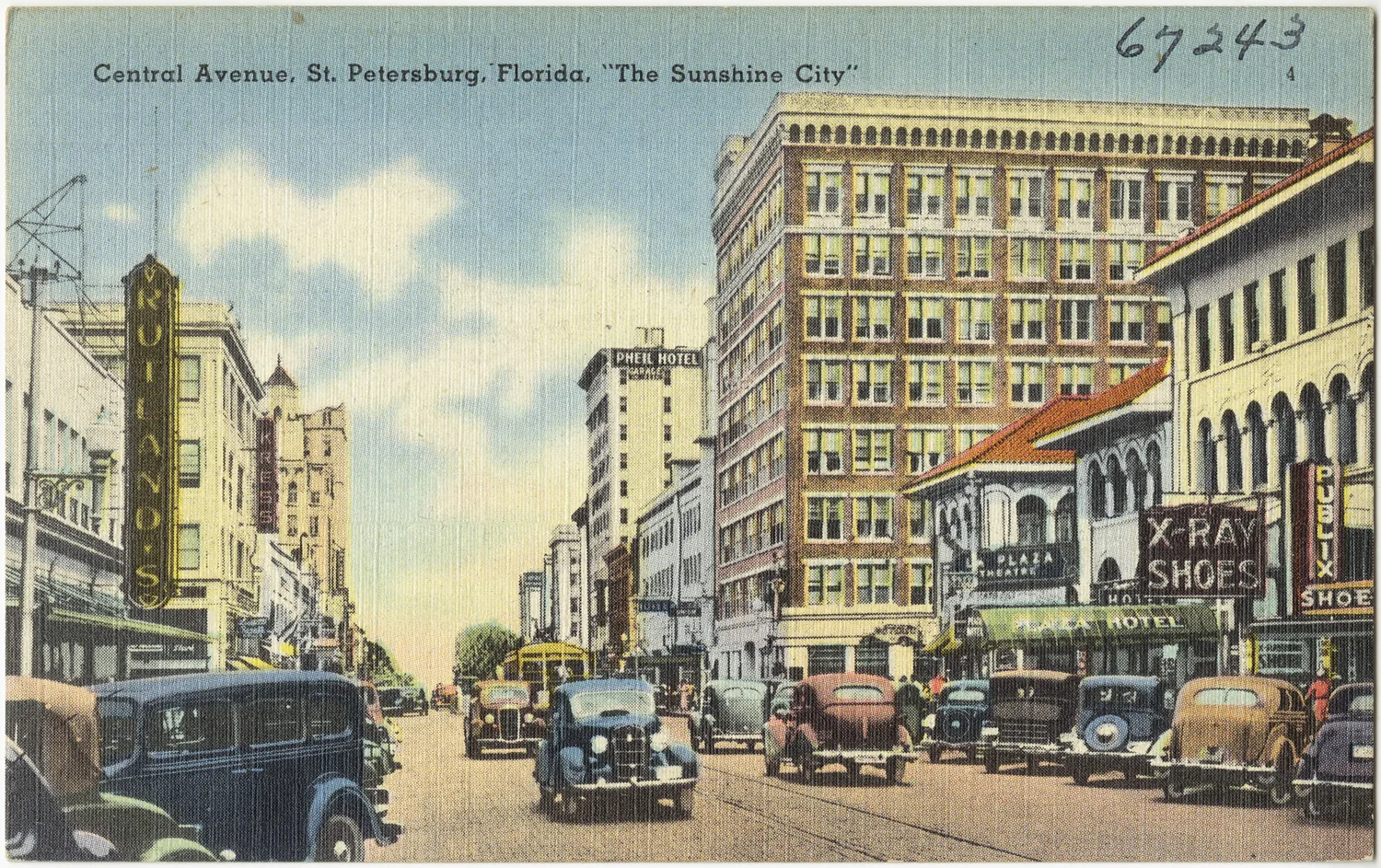
Central Avenue — “The Sunshine City”
“Central Avenue, St. Petersburg — The Sunshine City,” Tichnor Bros. postcard, c. 1940s. Boston Public Library, CC BY 2.0, via Wikimedia Commons.
A city that bet on the sun
The benches fit a town that was selling one thing above all else: sunshine. St. Petersburg called itself the Sunshine City and meant it as a promise.
The local paper, the Evening Independent, made that promise into a stunt in 1910 — it vowed to give the paper away free on any day the sun didn't shine on St. Pete. Over the next seventy-six years, it had to give the paper away exactly 296 times. That's the pitch the green benches were built for: come sit in the warm, and stay.
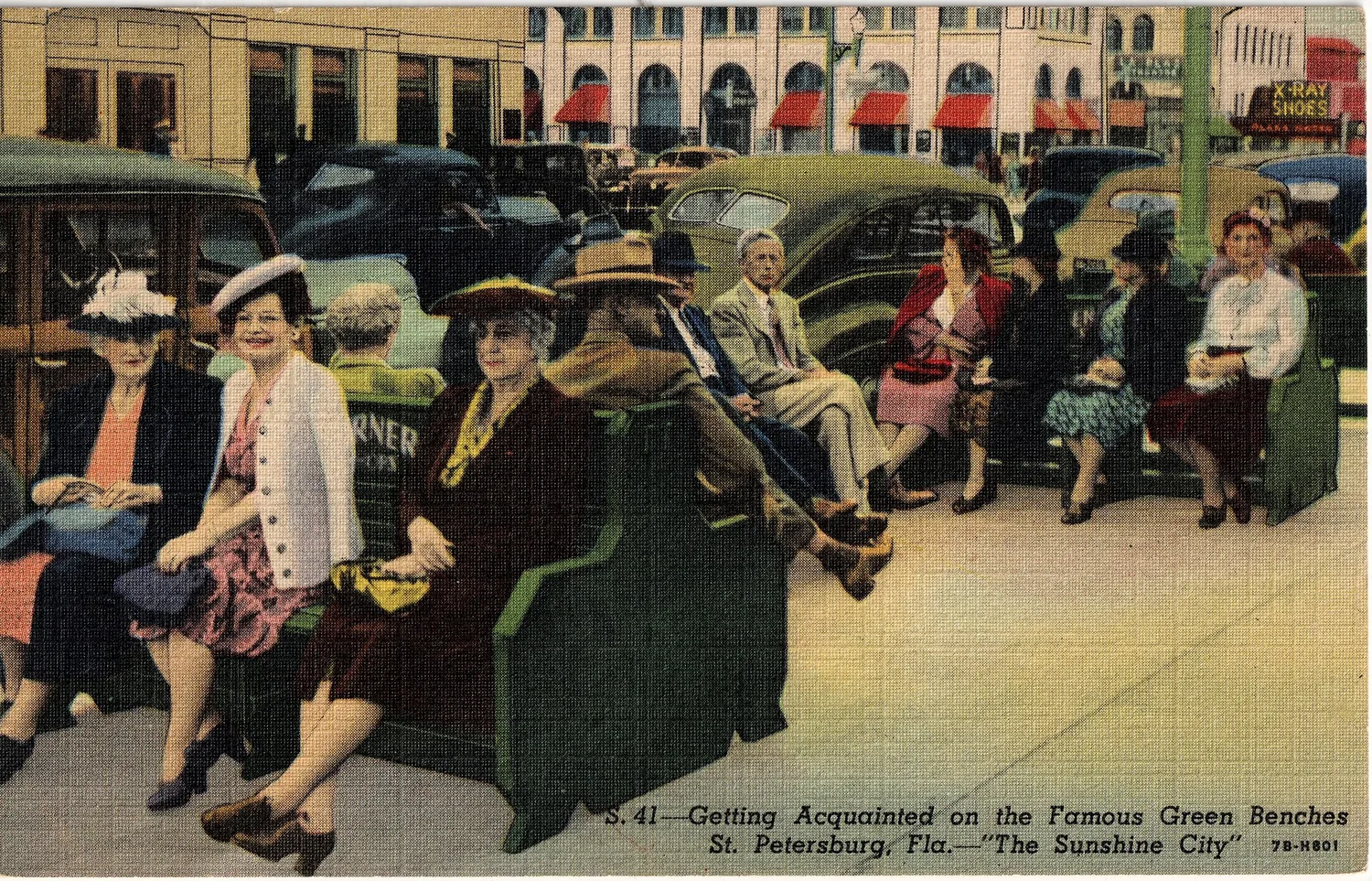
The town’s living room, outdoors
“Getting Acquainted on the Famous Green Benches, St. Petersburg,” postcard, c. 1940. Public domain, via Wikimedia Commons.
The bench was the coolest seat in town
Here's the part that never made the postcards. People didn't sit outside for hours because they were charmed by street life. They sat outside because, before air conditioning, the sidewalk was the more comfortable place to be.
Picture a Florida house in July with no AC. The sun had baked the roof and walls all day, and by evening the inside held that heat like an oven switched off but never opened. Out front, under a storefront awning, there was at least a chance of a breeze off the bay.
So that's where everyone went. The green bench wasn't really street furniture. It was a cooling strategy — the best one most people had.
A whole downtown designed around one problem: how to be anywhere but inside your own hot house.
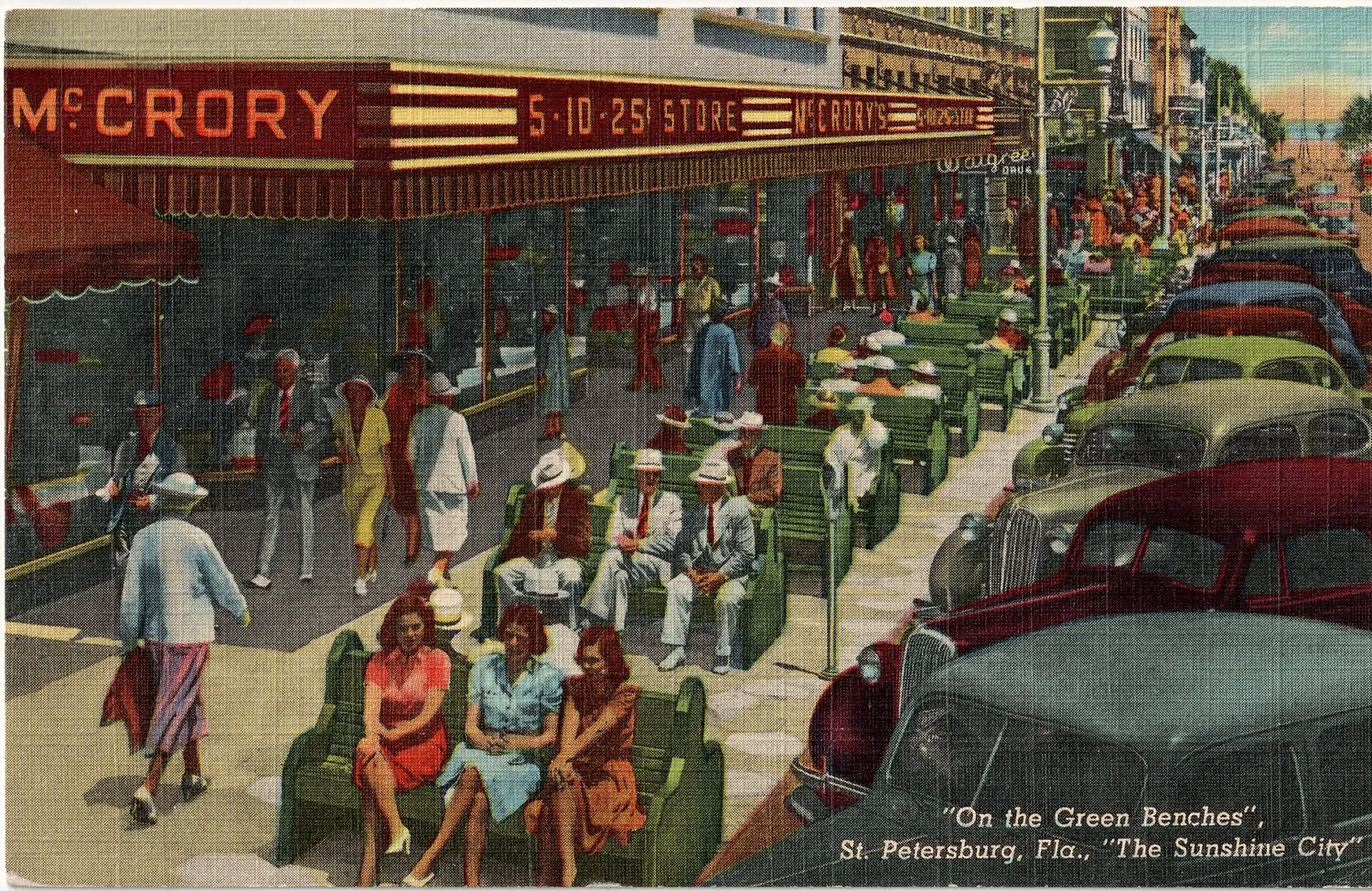
Every storefront had a row
“On the Green Benches, St. Petersburg — The Sunshine City” postcard, c. 1940s. Public domain, via Wikimedia Commons.
Not everyone was allowed to sit
It's worth being straight about who the benches were really for. They sat on public sidewalks, but they weren't public to everyone. Through their heyday the police kept them for white residents; a Black St. Petersburgian could sit on one while minding a white family's children, and otherwise was moved along.
The cheerful Sunshine City postcard and that harder fact shared the very same sidewalk. Both are part of the real story.
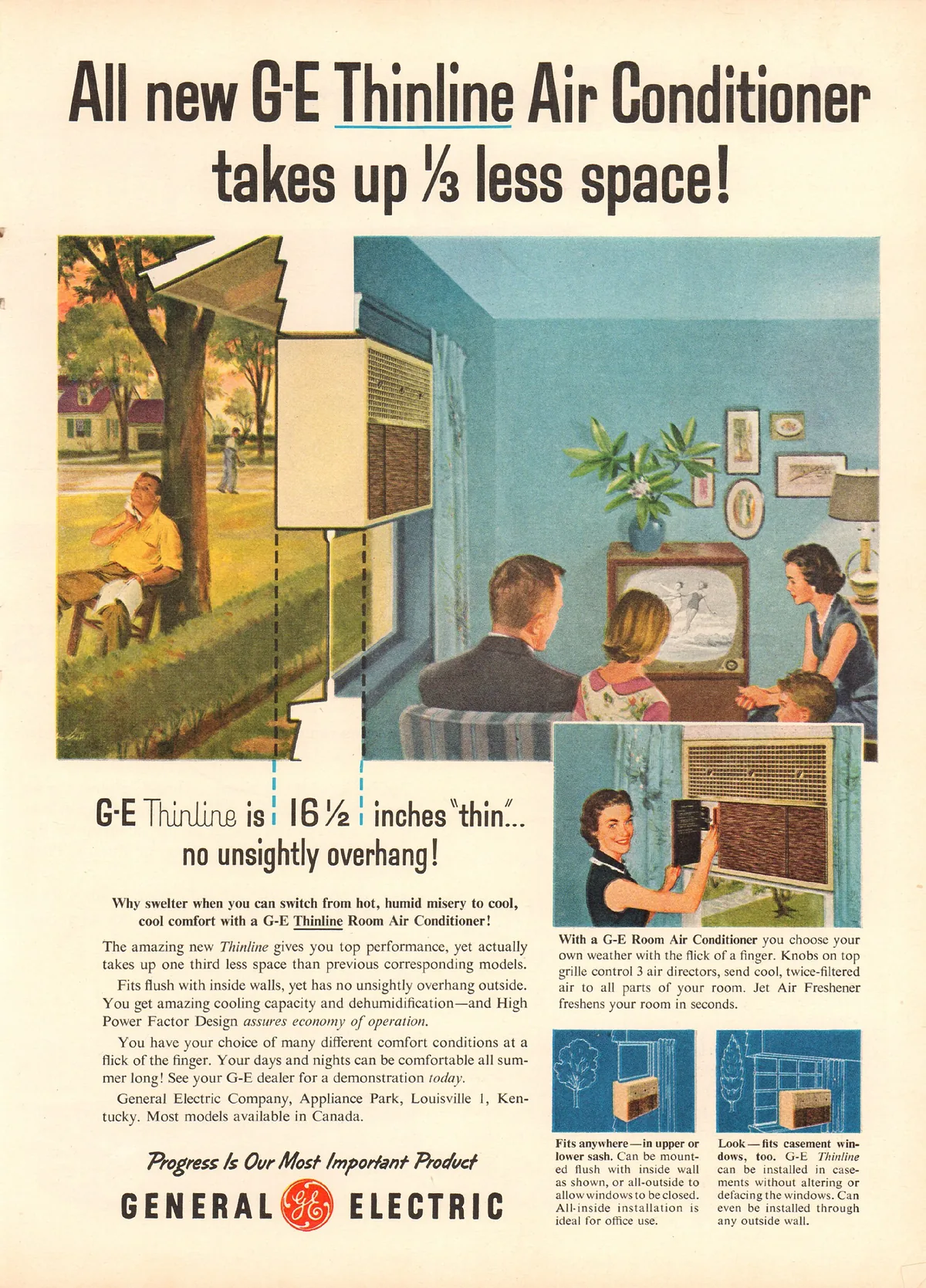
1956 — cool air moves indoors
General Electric “Thinline” room air conditioner ad, Time magazine, 1956. Public domain, via Wikimedia Commons.
Then somebody put the cool air inside the house
Look closely at that 1956 magazine ad. On one side a man sweats under a tree with a towel around his neck. On the other, his family sits in a cool living room watching television. The pitch is right in the headline — why swelter outside when you can flip a switch and be comfortable indoors?
That's the moment the benches were doomed, though nobody knew it yet. Through the 1950s and '60s the window air conditioner went from luxury to something a normal family could buy. Once your own living room was the coolest room around, the reason to walk downtown and sit in the heat quietly evaporated.
Television arrived in the same years and didn't help. Now the coolest seat in town and the evening's entertainment were both in your own house.
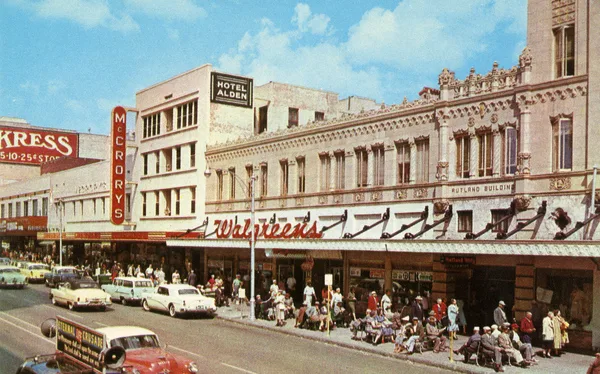
Central Avenue — the 1950s
State Archives of Florida, Florida Memory.
The benches quietly disappeared
The crowds thinned first. Then, in the 1960s, the city itself started pulling the benches out — not because anyone hated them, but because they'd come to read as old. St. Pete had a reputation as a place people went to retire, and officials wanted a younger, newer image. The benches, packed with folks who had nowhere cooler to be, were the first thing to go.
There's a real irony in it. The city spent fifty years designing a downtown around escaping the indoor heat. Then air conditioning fixed the indoor heat, the crowds went home to enjoy it, and the benches lost the whole reason they existed.
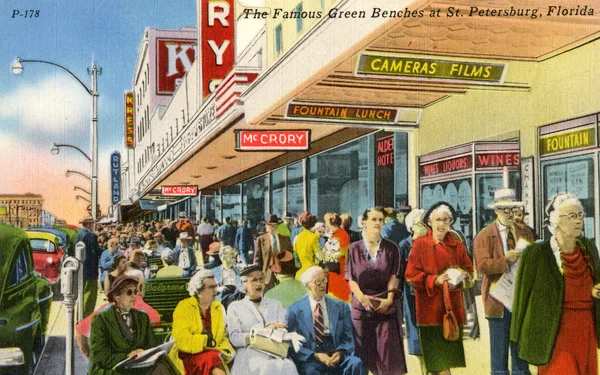
The end of an era
State Archives of Florida, Florida Memory.
Sources & photo credits
Facts
- Green benches began c. 1908 with real-estate man Noel Mitchell, whose first benches were painted bright orange; other merchants added benches in mixed colors — The Gabber, "St. Petersburg's Green Bench Mystique"; Washington Times, "St. Petersburg's green benches evoke history, mixed legacy" (2017). Accessed Aug 4, 2026.
- Mayor Al Lang's ordinance (c. 1916) standardized every bench to one size and hunter green; ~7,000 at their peak — Wikipedia, "St. Petersburg green benches"; The Gabber. Accessed Aug 4, 2026.
- The Evening Independent began its "Sunshine Offer" in 1910 (free paper on any sunless day); over 76 years it gave the paper away only 296 times — St. Petersburg Museum of History, "Betting on the Sunshine." Accessed Aug 4, 2026.
- The benches were kept for white residents in practice; Black residents were permitted to sit only while caring for white children — Wikipedia, "St. Petersburg green benches" (citing local histories). Accessed Aug 4, 2026.
- The benches were removed in the 1960s as the city sought a younger, less "elderly" image; their social heyday faded as home air conditioning and television kept people indoors — Wikipedia, "St. Petersburg green benches"; The Gabber. Accessed Aug 4, 2026.
- General Electric introduced the "Thinline" room air conditioner in a 1956 Time magazine ad, selling comfortable cool air for the home — General Electric, 1956.
Photographs
- "Famous Green Benches, St. Petersburg" — color postcard, c. 1940. Public domain, via Wikimedia Commons.
- Noel A. Mitchell — from Karl H. Grismer's history of St. Petersburg, c. 1920s. Public domain, via Wikimedia Commons.
- "Central Avenue, St. Petersburg — The Sunshine City" — Tichnor Bros. linen postcard, c. 1940s. Boston Public Library, CC BY 2.0, via Wikimedia Commons.
- "Getting Acquainted on the Famous Green Benches" and "On the Green Benches — The Sunshine City" — color postcards, c. 1940. Public domain, via Wikimedia Commons.
- Green benches on Central Avenue, 1950s, and the "Sunshine City" street postcard — State Archives of Florida, Florida Memory.
- General Electric "Thinline" room air conditioner — Time magazine, 1956. Public domain, via Wikimedia Commons.
Handwriting font: Caveat (SIL Open Font License), self-hosted. Additional period St. Petersburg images (e.g. the Evening Independent free-paper carrier on a rainy day, Florida Memory item 245092) sit behind an archive bot-wall and would enrich this page via a browser session later; noted in source-record-green-benches.md.