
Davis Islands, Tampa · a true story
The Man Who Sold Cool
Before air conditioning, comfort in Florida was something you sold with a breeze. Then, in one week of October 1926, the salesman, the boom, and the future of staying cool all collided.
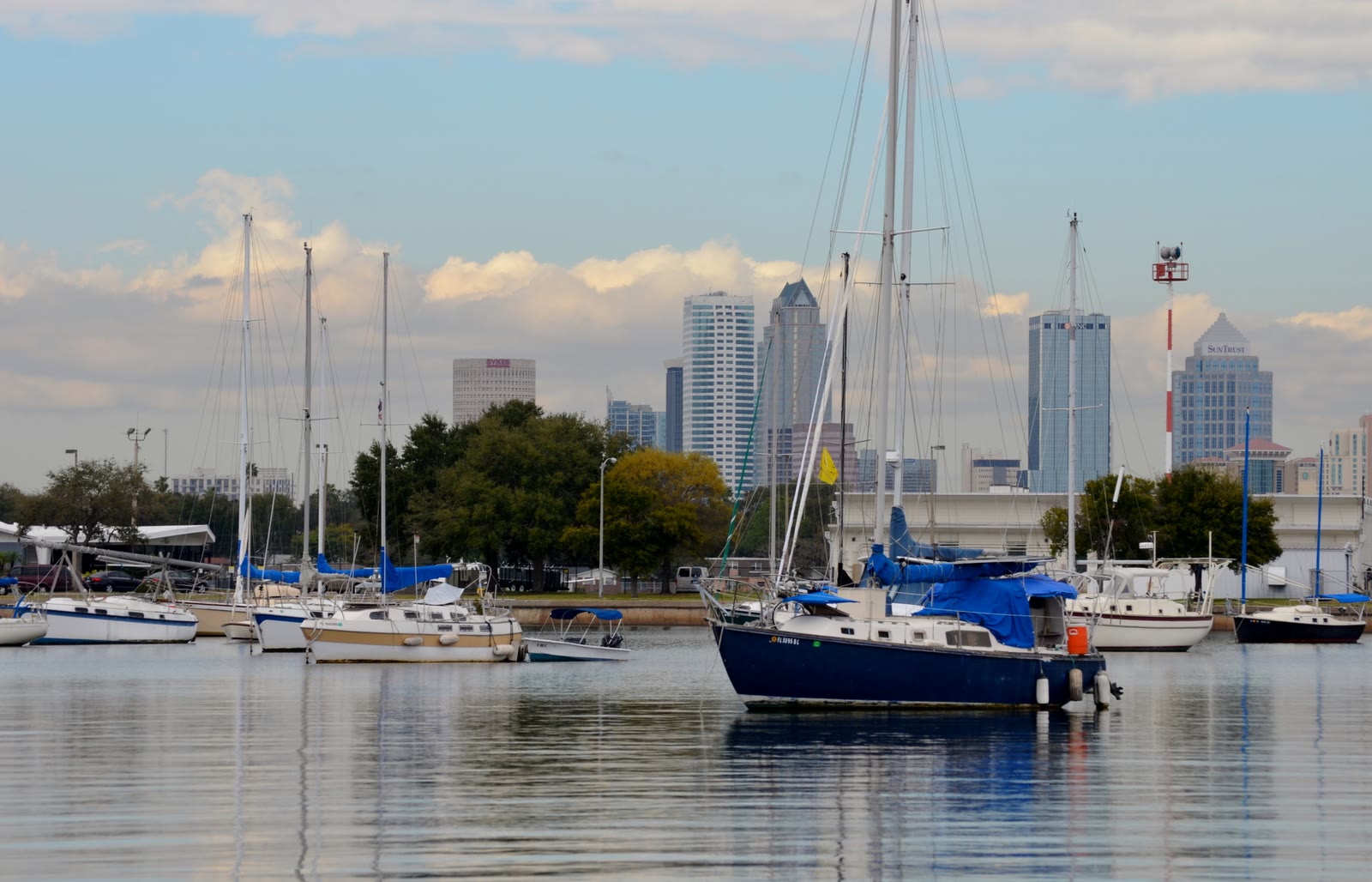
Stand on Davis Boulevard today, in the shade of the palms and the seven-figure houses, and you are standing on the bottom of Tampa Bay. Not beside it. On it. Every inch of ground under Davis Islands was open water a hundred years ago.
In February 1925, a Tampa photographer leaned out of an airplane and took a picture of what used to be there. It's a photograph of almost nothing — two low smudges of grass and mud in the middle of the bay, the kind of shoal you'd run a boat aground on and never think about again. They were called Big Grassy and Little Grassy.
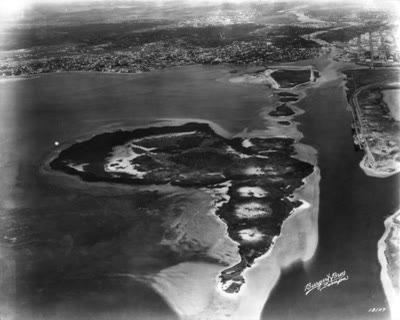
Big Grassy & Little Grassy — before the dredges. Feb. 1925
Aerial before dredging began for Davis Islands, February 4, 1925. Burgert Brothers Collection, USF Libraries — no known copyright.
Four months before that picture was taken, a man had already sold them.
Not the islands as they were. The islands as he promised they'd be. On the first day he opened the books — October 4, 1924 — buyers handed over $1,683,582 for 306 lots on land that was, at that moment, still underwater. Most of it sold the same day.
His name was David Paul Davis, and the thing he was really selling wasn't land. It was cool.
A paradise you could feel on your skin
In 1924 Florida was in the middle of the loudest real-estate boom the country had ever seen. Trains ran south packed with people who'd never owned anything and were about to own a piece of the sun. But here's what's easy to forget from an air-conditioned living room: they were pouring into a state that, for half the year, was hard to stand.
There was no air conditioning. Not in the houses, not in the offices, not anywhere an ordinary person lived, worked, or slept. So Florida sold the only cooling it had — the weather itself. Shade. Water. A porch where the evening air finally moved.
Davis understood that better than any developer of his day. He didn't just buy a corner of Tampa and subdivide it. He built an island — wrapped on every side by cool bay water — and stocked it with the whole nineteenth-century idea of comfort: a yacht basin, canals to bring the breeze inland, tennis courts, a golf course, and a grand open-air "Roman Pool" he sold, in his own advertising copy, as "an admirable touch of Mediterranean grandeur… to furnish an advanced degree of comfort."
Comfort. That was the word he kept reaching for. He was selling the feeling of cool before anyone in Tampa could manufacture it.
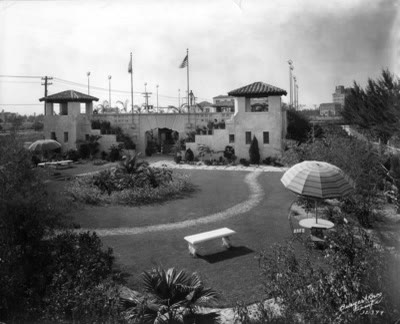
The pool he described but never swam in. Opened 1929
Davis Island Pool and Garden, October 10, 1930. Burgert Brothers Collection, USF Libraries — no known copyright.
How you sell land that isn't there yet
Davis had done this before, on a smaller scale, and had made and lost money doing it. Back in Tampa in 1924, he heard what Carl Fisher was pulling off down in Miami — dredging islands out of Biscayne Bay and selling them — and he decided he could do it bigger.
He bought the rights to the submerged land from the city for $350,000. Then he set dredges chugging out in Hillsborough Bay, sucking sand and muck up off the bottom through long pipes and spraying it into the shape of his islands. The ground rose out of the water while buyers watched. That was the whole magic trick, done in daylight: he was manufacturing Florida in real time, and letting the crowd see it happen.
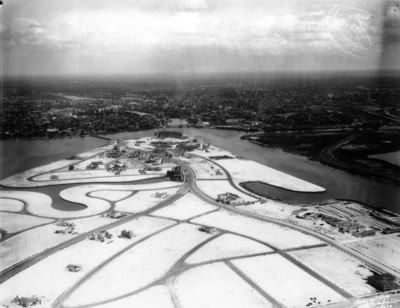
Rising out of the bay — looking back at Tampa. 1927
Partially-developed Davis Islands looking north toward downtown Tampa, June 12, 1927. Burgert Brothers Collection, USF Libraries — no known copyright.
And it worked spectacularly. The lots that sold that first afternoon changed hands again and again, each time for more. He kept the crowd looking, too — running photographers over the bay so buyers back home could watch Tampa's newest ground climb out of the water, month by month, with the downtown skyline sitting right there across the channel as proof it was real.
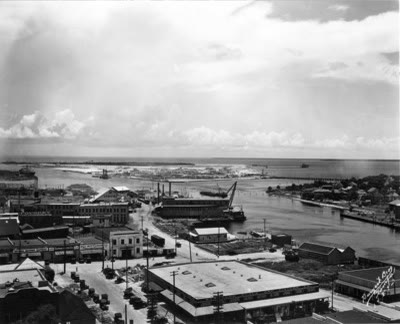
Downtown Tampa — the skyline he sold across the water
Downtown Tampa, Hyde Park, and Davis Islands from a rooftop, 1920s. Burgert Brothers Collection, USF Libraries — no known copyright.
You can't dredge a boom forever
For about eighteen months, David Paul Davis was one of the richest and most famous men in Florida — a poor kid from Green Cove Springs whose family had come to Tampa after the killing freeze of the 1890s, now selling the rest of the country its escape from the cold.
Then, by early 1926, the music stopped. The boom that had made Davis had been running on people buying to sell to the next person buying to sell — and one winter, the next person didn't show up. Banks tightened. Lots that had traded three times in a week suddenly wouldn't move once.
Davis was overextended, with a second dredged-island project going up at St. Augustine. To stay ahead of what he owed, in August 1926 he sold off most of his stake in the Tampa islands — the thing that had made his name — and gambled everything on finishing the new one. He had built an entire city on the promise of natural cooling, at the exact moment the money that floated it went under.
One night in the middle of the Atlantic
In October 1926, Davis boarded the White Star liner Majestic — then the largest ship in the world — bound for Europe. His ten-year-old son George was asleep in the next cabin. A young woman named Lucille Zehring, a former Mack Sennett bathing-beauty, was traveling with him.
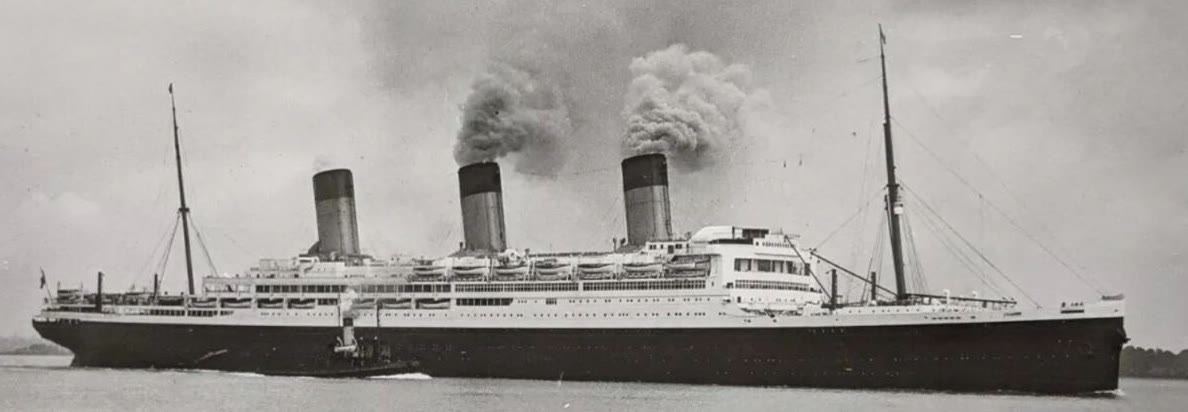
The Majestic — the biggest ship afloat. October 1926
The White Star liner Majestic (formerly Bismarck), the largest ship in the world in the 1920s. Public domain, via Wikimedia Commons.
On the night of October 12, David Paul Davis went out through a porthole into the ocean and was never seen again. He was 41.
What actually happened has never been settled. Zehring first said he'd been sitting in the open porthole during a storm and was pulled out by a wave. A steward claimed he'd overheard Davis, that same night, say something like "I can go on living or end it" — followed by a splash. There was talk of debts, and of a $300,000 life-insurance policy he'd taken out only months before. An investigator eventually satisfied the insurer enough to pay the claim. The mystery itself was never paid off.
Three days later, just across the water
Here's the part that stops you cold.
Three days after Davis disappeared into the Atlantic — on October 15, 1926 — a new building opened its doors just across the water in downtown Tampa. The Tampa Theatre. The same dreamed-up Mediterranean architecture Davis had been selling on his islands. And it had something no building in the city had ever had before: air conditioning.
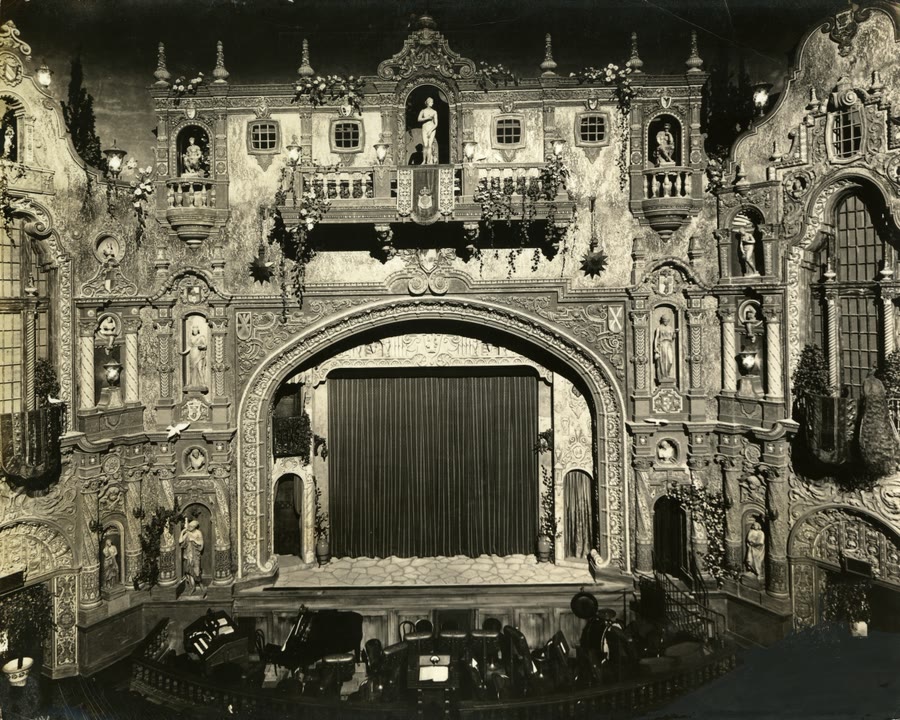
“Come feel the man-made air.” Tampa Theatre
Interior of the Tampa Theatre, which opened October 15, 1926 as the first air-conditioned commercial building in Tampa. Photograph by Stetson Kennedy. Public domain, via Wikimedia Commons.
The theatre didn't advertise the movie. It advertised the temperature. The signs outside told sweltering Tampa to come feel the man-made air — and people lined up in the heat to sit in a cold room for the novelty of it.
For two years Davis had sold cool the only way it could be sold — breeze, bay water, a bathing pool. In the very week his dream and his life went under, the real future of Florida comfort switched on down the road.
The islands he made outlived the man
The strange thing is that the islands were never the failure. Davis was. The land he pumped out of the bay was real, and it stayed. Over the next decades Davis Islands filled in and became one of the most sought-after neighborhoods in Tampa — Tampa General Hospital on the north tip, a small airport on the south, streets of the same tile-roofed Mediterranean houses and apartments he'd started.
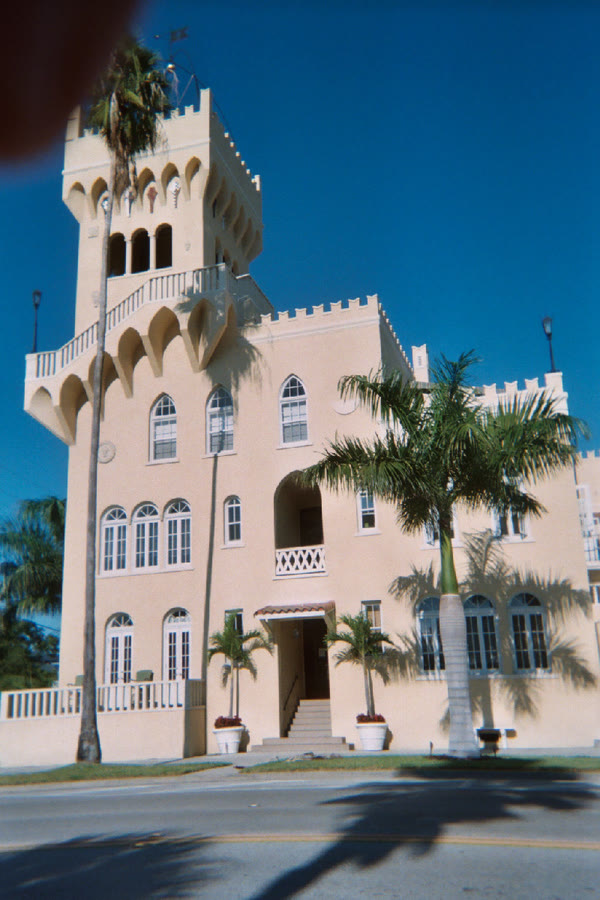
Still standing — one of Davis's originals
The Palace of Florence apartments, one of Davis's 1920s Mediterranean Revival buildings (present day). Photo: Ebyabe, CC BY 2.5, via Wikimedia Commons.
His Roman Pool — the one he wrote all that flowery copy about — finally opened in 1929, three years after he drowned. It's still there, still full of kids every summer, now named the Roy Jenkins Pool. And the Tampa Theatre still runs too, still cool inside, its original 1926 equipment long since replaced but its one big promise unbroken.
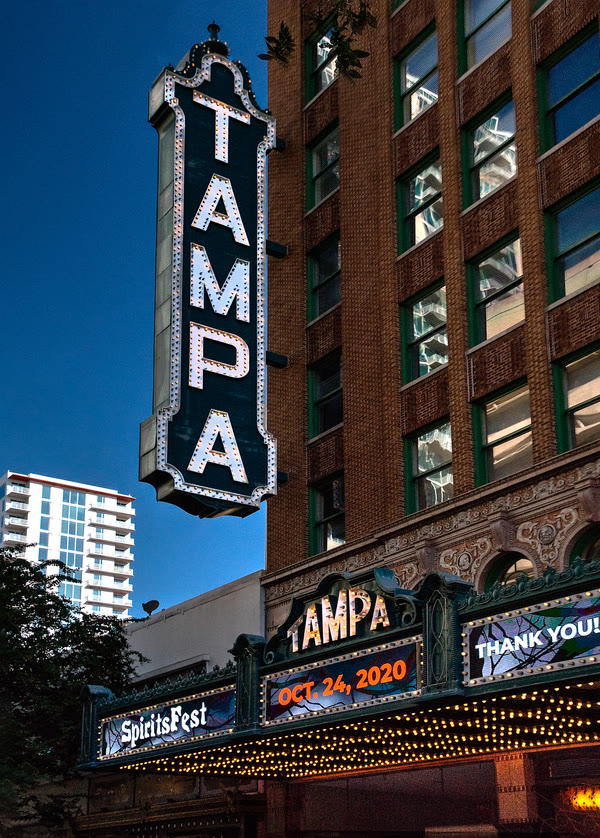
Ninety-plus years on — still cooling the crowd
The Tampa Theatre's vertical sign (present day). Photo: Bbphotos, CC BY-SA 4.0, via Wikimedia Commons.
Davis sold cool before anyone could make it. He sold the breeze, the water, the shaded veranda — the old idea that comfort was something you found, or moved toward, or bought a lot beside. He built a whole island on that idea, and it left him broke and gone at 41.
What finally made Florida livable — what let thousands of people move onto his islands and actually stay through August — arrived three days after he drowned, humming quietly under a movie palace downtown. Every cooled house on Davis Islands today runs on that machine, not the breeze.
Davis had the right dream. He just sold it about a decade too early to be true.
- 1924 · Oct 4 — 306 lots sell for $1,683,582, on the first day
- 1925 — dredges pump the islands up out of Hillsborough Bay
- 1926 · Aug — Davis sells his stake to cover his debts
- 1926 · Oct 12 — lost through a porthole on the Majestic
- 1926 · Oct 15 — Tampa Theatre opens the city's first A/C
Sources & photo credits
Facts
- First-day sale of 306 lots for $1,683,582 on October 4, 1924 — "The History of Davis Islands," Tampa Magazine (tampamagazines.com); Rodney Kite-Powell, History of Davis Islands (The History Press) and "In Search of David Paul Davis," USF thesis (digitalcommons.usf.edu/etd/1409). Accessed Aug 4, 2026.
- The islands were dredged from the submerged Little Grassy / Big Grassy keys; Davis bought the land rights for $350,000; present-day facilities (Tampa General Hospital, Peter O. Knight Airport) — Wikipedia, "Davis Islands (Tampa)"; Tampa Bay History Center. Accessed Aug 4, 2026.
- D.P. Davis's death aboard the Majestic (Oct 12, 1926), the porthole, Lucille Zehring, and the $300,000 life-insurance policy — Tampa Bay Times / TampaPix (tampapix.com/dpdavis3.htm); Mark Chirnside, "Man Overboard: Majestic, October 1926" (markchirnside.co.uk). Accounts conflict; told here as unsettled. Accessed Aug 4, 2026.
- The "Roman Pool" ("an advanced degree of comfort"), opened 1929, now the Roy Jenkins Pool — Davis Islands Civic Association (dicivic.org); Old Tampa Photos (oldtampaphotos.com). Accessed Aug 4, 2026.
- The Tampa Theatre opened October 15, 1926 as the first air-conditioned commercial building in Tampa ("come feel the man-made air") — Wikipedia, "Tampa Theatre"; FOX 13 Tampa Bay (fox13news.com). Accessed Aug 4, 2026.
Photographs
- Before dredging (Feb 4, 1925), the pool & garden (1930), the partially-developed islands (1927), and downtown Tampa from a rooftop (1920s) — Burgert Brothers Collection, University of South Florida Libraries. Rights: No Copyright – United States.
- Davis Islands aerial (present day) — Roman Eugeniusz, CC BY-SA 3.0, via Wikimedia Commons. The Palace of Florence apartments (present day) — Ebyabe, CC BY 2.5. The Tampa Theatre sign (present day) — Bbphotos, CC BY-SA 4.0.
- The RMS Majestic and the Tampa Theatre interior (photograph by Stetson Kennedy) — public domain, via Wikimedia Commons.
Handwriting font: Caveat (SIL Open Font License), self-hosted. Where the record of Davis's final night conflicts, this story says so rather than choosing the most dramatic version. Untouched originals of every archival image are preserved in the project archive.