Walk a few blocks of Virginia Park — the shady grid of South Tampa tucked under the oaks between Bay to Bay and Euclid — and you pass street signs that read like a map of somewhere else. Barcelona. Leona. Corona. Covadonga, before they changed it. These are the names of streets in Old Havana, lettered onto green signs in Tampa, Florida. And most of the houses sitting under them are low, shut-up ranch homes from the 1950s, with a box humming quietly on one side.
Which is a strange thing to find on one block. The street names come from a world that had one answer to the heat. The houses come from the world that invented a different one. You can stand on a single corner of Virginia Park with a foot in each.
So how did that happen? Start with the heat, because in Florida everything does.
Before the machine, cool was a place
Picture a Tampa summer with no air conditioning anywhere. Not in a house, not in a store, not in one single room in the whole city. It comes down wet and heavy in May and more or less sits on you until October. That was ordinary life here for generations, and people got good at the only trick that worked.
You didn’t make cool air. You went and found it. You found shade, and you found moving air, and you built your porch to face the water so you could sit out in the evening when the breeze finally came up off the bay. Cool wasn’t a setting on a wall. It was a place you went, or a direction you faced, or a thing the sky did for you around six o’clock.

Why a Tampa street is named Barcelona
So when Tampa’s developers went looking for a feeling to sell in the 1910s and ’20s, they reached for a city that already knew the trick cold: Havana, ninety miles south, all shade and sea air and tall shuttered rooms.
The man who laid out this corner of South Tampa was Thomas Palmer, whose Tampa Bay Land Company platted the neighborhood right next door, Palma Ceia. The story usually told is that a Tampa cigar man — Angel Cuesta, of the Cuesta-Rey company — spread a map of Havana across a table one afternoon, and the street names came straight off it. Nobody can quite prove that part. What’s certain is that almost every east-west street in the area has a twin on a map of Old Havana.
When Virginia Park was platted just to the east, around 1912, the surveyors simply ran most of those same streets on through and kept the names. One they didn’t keep: a street called Covadonga got renamed, for a reason nobody wrote down, to the plain and literal Bay to Bay Boulevard. The romance and the road directions, one block apart, which is more or less the whole neighborhood in a sentence.

The house that was a machine for catching wind
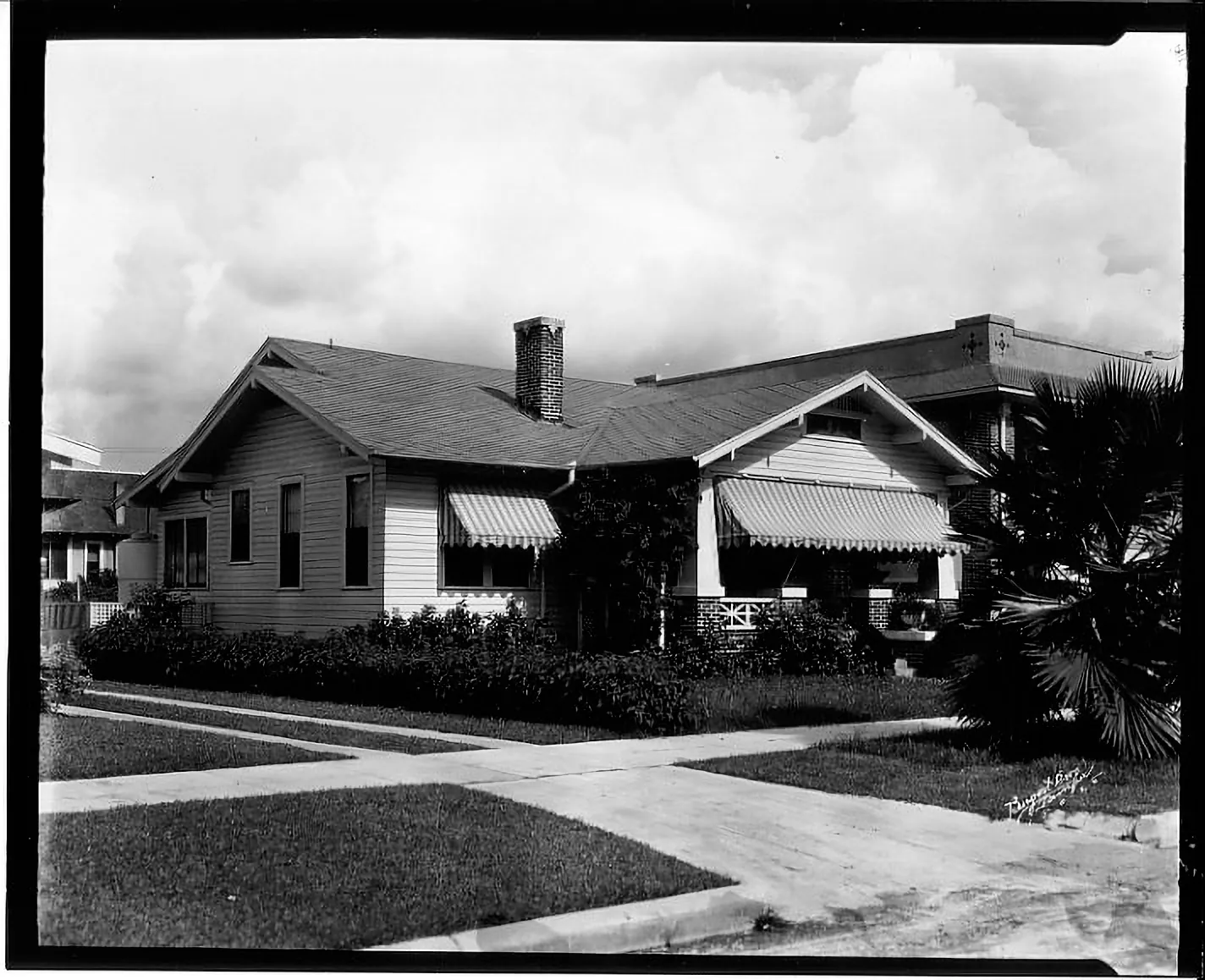
The first houses that went up on those streets were built for the only cooling anyone had. The Tampa bungalow is a wind-catcher, if you look at it right. A deep porch to throw shade on the walls before the sun could reach them. Windows tall enough to walk through, set across from each other so a draft could run clean through the middle of the house. High ceilings to let the hot air climb up and off of you. Awnings over every opening. A whole design built around the hope of a breeze.

They drew the streets before they could fill them
Here’s the thing about Virginia Park, though. They drew the streets long before they filled them.
The 1920s were the years Florida lost its mind over real estate. Trains came south packed with people buying lots they’d never laid eyes on, in neighborhoods that were mostly lines on a plat map and a nice-sounding name. Virginia Park was one of those names — surveyed, Havana streets and all, and waiting. Then, in the back half of 1926, the boom just stopped. The buyers quit coming, the banks pulled back, and three years later the whole country fell into the Depression behind them. A lot of those pretty platted lots in South Tampa simply sat there, empty, year after year. A grid of Cuban street names with the grass growing up through it.

Then the machine arrived — and not off the bay
What finally filled those lots in showed up after the next war, and it didn’t come up off the water.
Air conditioning climbed down out of the movie theaters and the department stores — where it had been a novelty people paid a dime to go sit inside of — and into the window of an ordinary house. By the 1950s a family on a regular Tampa street could buy a unit, set it in the wall, close the windows, and be cooler on a July afternoon than the finest shaded porch on the bay had ever managed. The cool stopped being a place you went. It came to you, and it waited there in the room whether you were home or not.

And that is just about exactly when Virginia Park got built. Most of its houses went up in the stretch of years around the arrival of home air conditioning — lot by lot, through the 1940s, ’50s and ’60s — which means the neighborhood is full of the kind of house you build when you no longer need a breeze.
The house built for the box
The low mid-century ranch is the breeze-bungalow’s opposite, and you can read the difference right off the curb. The porch shrinks to a step. The ceilings come down. The windows get smaller, because now you want to keep the cool air in, not coax a draft through. The house turns its back on the wind and faces the carport instead.
And somewhere on the side of almost every one of them, then as now, sits the compressor that made the whole arrangement possible — ticking away like a second, smaller heart the house can’t live without.

A neighborhood you can read like tree rings
Walk it now and the place reads like a cross-section. A 1925 bungalow with its deep porch and its awnings, built to pull in a wind — and right next door a 1955 ranch built to shut one out, both of them on a street named for a city in Cuba. The old breeze-houses are still here, plenty of them, restored and loved, their porches lovely and mostly empty in August, because nobody has to sit out there to breathe anymore.

What stayed
The names stayed. That’s the part that gets me. Nearly everything about how this neighborhood beats the heat has changed — the porches, the windows, the direction the houses face, the fact that the cool now comes out of a machine instead of out of the sky. But the signs on the corners still carry the words somebody copied off a map of Old Havana a hundred years ago, back when a breeze and a good Spanish name were the best cooling a Florida developer had to sell.

They just don’t do the job anymore. The job belongs to the box on the side of the house now — and in a Florida summer, it never really gets a day off.