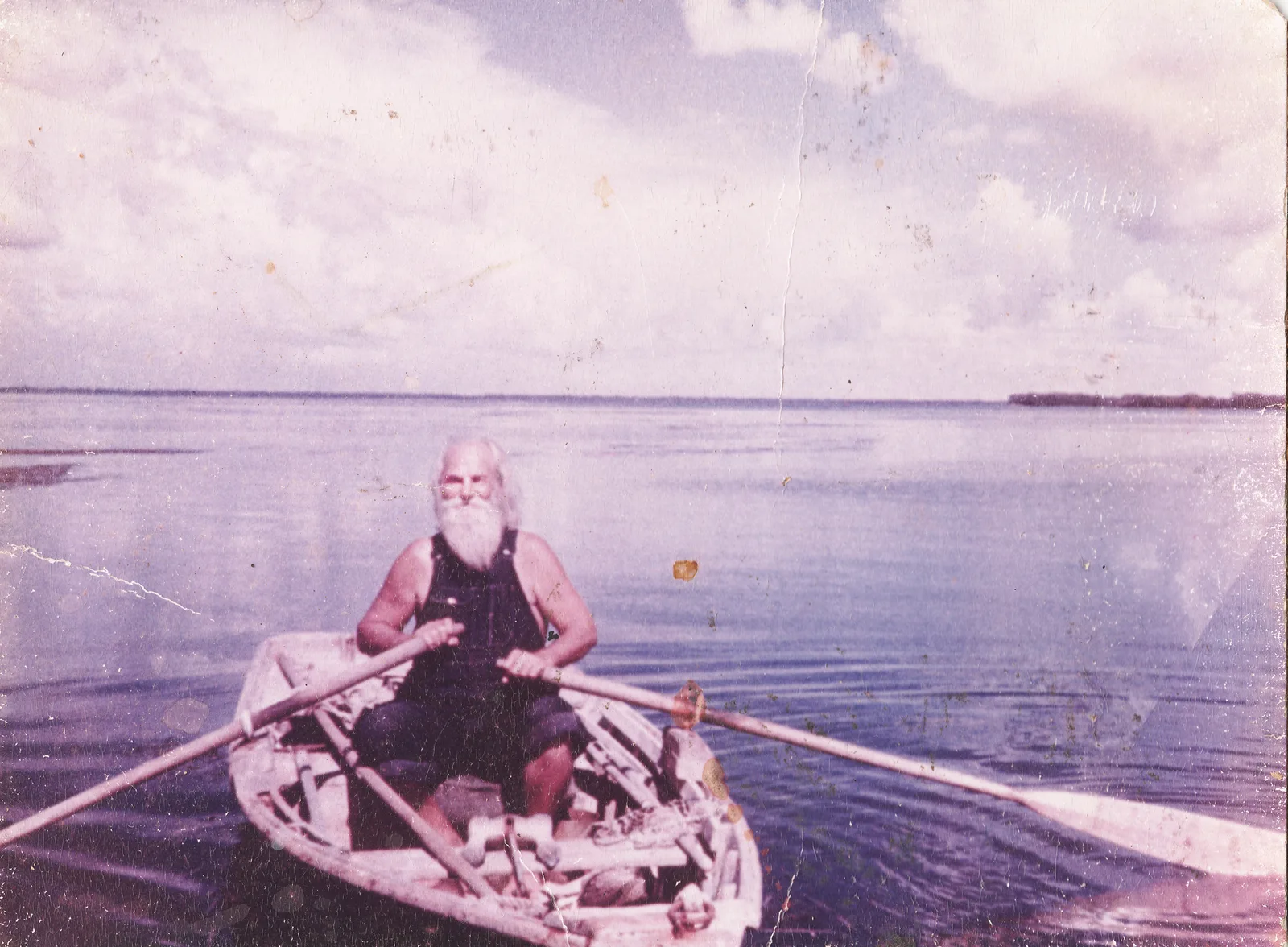
For the better part of fifty years, the coolest man in Pinellas County had no electricity, no fan, and no idea he was missing anything. His name was Silas Dent, and he lived by himself on a little island off Pass-a-Grille in a hut he thatched out of palm fronds. No power line ran to it. No machine of any kind hummed inside it. And somehow, through one Florida summer after another, the barefoot old man with the white beard stayed comfortable on an island with no way to make a single degree of cool air.
People knew him. In 1948 Life magazine came down to the island and put him in the pages, and a columnist took one look at the beard and called him “Santa Claus gone to seed.” The name fit in more ways than one — at Christmas he'd row to the mainland loaded with little toys he'd made from shells and driftwood and hand them out to kids who didn't have any. The Happy Hermit of Cabbage Key, people called him. He sold fish off the pier, kept cats to fight the rats, and wore no shoes.

Here's the part that stops you. You can't go visit Cabbage Key. Not because it's private, or overgrown, or hard to reach by boat. Because it isn't there. The island Silas Dent lived on for most of his life was pumped up, pushed around, and built over so completely that there's no longer a place on the map where you could stand and say: here, this was it.
How do you stay cool on an island with nothing?
The way he did it was the same way everyone on this coast did it before about 1960, because it was the only way there was. You read the wind. Dent's hut barely had walls — it was built to let the Gulf breeze walk straight through and out the other side. You kept to the shade in the worst of the heat, did your work in the cool of the morning, and waited out the dead middle of the day. Toward evening the wind comes up off the water, and that was the payoff. A thatched roof, a deep porch, an open window pointed at the Gulf. For the whole long history of Florida, that was air conditioning.

And the people who fished and lived on these keys for thousands of years before Dent had done the exact same thing, with open-sided shelters that caught the exact same breeze. He wasn't doing anything new. He was just the last one still doing it, alone, long after the mainland had strung up power lines and plugged in.
It worked, mostly. It worked best in winter — which is the quiet secret under this whole story. Winter in Florida is a gift. Summer, before the machine, was something you got through. Dent got through it alone, every year, until 1952, when he died on his island at seventy-six. Still barefoot. Still off the grid. Having never once in his life flipped a switch to make a room cooler.
Then somebody decided the bay should be land
A few years after the old man was gone, people looked at the shallow water around his island and saw real estate. So they went and got it — out of the bottom of the bay.
In the late 1950s the dredges came. They dropped their pipes down into Boca Ciega Bay and started pumping the bottom of it up — the sand, the shell, the bay floor itself — and spraying it out across the shallows to dry in the sun. Little by little the water became ground.

They pumped up something close to nine million cubic yards of it. Picture the whole island as the floor of the bay stood on end and left in the sun to dry, and you're not far off. Cabbage Key and fourteen of its low mangrove neighbors stopped being separate islands and became one big new one, stitched together out of ground that used to be underwater. The hermit's island didn't get developed. It got erased and replaced.

They gave the new ground a prettier name than Cabbage Key. They called it Tierra Verde — green land — and a bridge and causeway reached out to it from the mainland by the end of 1962, so you could finally drive where Dent used to paddle.
A space-age island, cooled to order
What they planned to put on that new ground was about as far from a palm-thatch hut as you can get. The brochures sold a modern dream. The power and phone lines would run underground, so there'd be no ugly antennas on the skyline. Music piped into every house around the clock. And one line in the plans that would've meant nothing at all to the old hermit, printed right there as a selling point: central air conditioning in all the homes and buildings.
The island was built to sell the one thing Silas Dent lived his whole life without, and never once asked for — a cool room on a hot afternoon, made by a machine.
To sell it they hired a face the whole country knew: Guy Lombardo, the bandleader whose orchestra played America into every New Year with “Auld Lang Syne.” He fronted the development as its celebrity partner, and his Port O'Call resort threw open its doors in January 1963 with the kind of party the old hermit, two decades in his grave, would not have recognized as the same stretch of coast. From the air at night, one pitch went, the island would glow like a diamond necklace laid on blue velvet.


It was the full 1960s fantasy of Florida: you didn't have to make peace with the heat anymore, or wait for the evening wind, or leave before July. You could simply buy your way out of all of it, and own the cool the way you owned the house.
The dream went down over Lake Okeechobee
It did not go to plan. In August 1963 the two men running the build, a New York developer named Louis Berlanti and his son Fred, were flying home from Miami at night when their plane caught fire and went down into Lake Okeechobee. Both were killed. There were dark rumors the crash was no accident — Berlanti had gotten himself tangled in the fight against Castro's Cuba — but what's certain is that the men steering the project were suddenly gone.
Within two years the company admitted it couldn't pay what it owed. Lombardo came back for a single season and then never again. The diamond necklace sat half-finished on its blue velvet, its builders dead or broke, and for a while it looked like the hermit's island had taken its revenge for being erased.
What the machine finally made possible

But the island didn't vanish this time. It just filled in slowly, over the decades, house by house, the way Florida usually happens. Today Tierra Verde is a quiet green neighborhood of a few thousand people — tile roofs, boats in the backyard, about as pleasant a patch of the bay as there is to live on. And nearly every house out there runs, all year, on the exact thing the island was built to sell, and the hermit never had.

Think about what that machine actually did. Dent could live out here without it because he only needed his trick to work in the months it worked, and he was willing to be hot and alone the rest of the year for the privilege of being left alone. Air conditioning took that whole bargain off the table. It cooled the worst two o'clock in July as easily as a morning in January. It made the island livable in the half of the year the breeze could never save — which is the only reason a few thousand people can wake up out there every August, instead of one stubborn old man.
So you still can't go visit Cabbage Key. But you can stand on Tierra Verde, on ground that used to be the bottom of the bay, inside a house kept cool by a machine Dent would have squinted at, and be almost exactly where the barefoot old man once sat in the evening shade, waiting for the wind. He did by hand, and by doing without, the one thing this island has always been about. It just does it differently now. It doesn't wait for the breeze anymore. It makes its own.