Snell Isle · St. Petersburg, Florida  ·  A Local History

The Island That Cooled Itself


St. Petersburg sold the Florida sun like it was the whole point. Then a druggist named Perry Snell pumped an island up out of the bay and built it to beat the heat with water, shade, and stone — a few years before a box in a window made all of it optional.

Most Florida towns spent their early years quietly apologizing for summer. St. Petersburg did the opposite. It took the one thing that made the place hard to live in for half the year — the sun that parks overhead from May to October and leans on everything under it — and put it on the letterhead. The Sunshine City. Not a nickname the town fell into. A sales pitch, said on purpose.

And the town backed it up. In 1910 the editor of the local evening paper made a standing promise: any day the sun didn’t show itself by mid-afternoon, he’d hand that day’s paper out for nothing. He kept the offer alive for seventy-six years — and in all that time only had to make good on it 296 times. Word traveled. People up north started asking about “that place where you don’t pay for the paper when the sun doesn’t shine.”
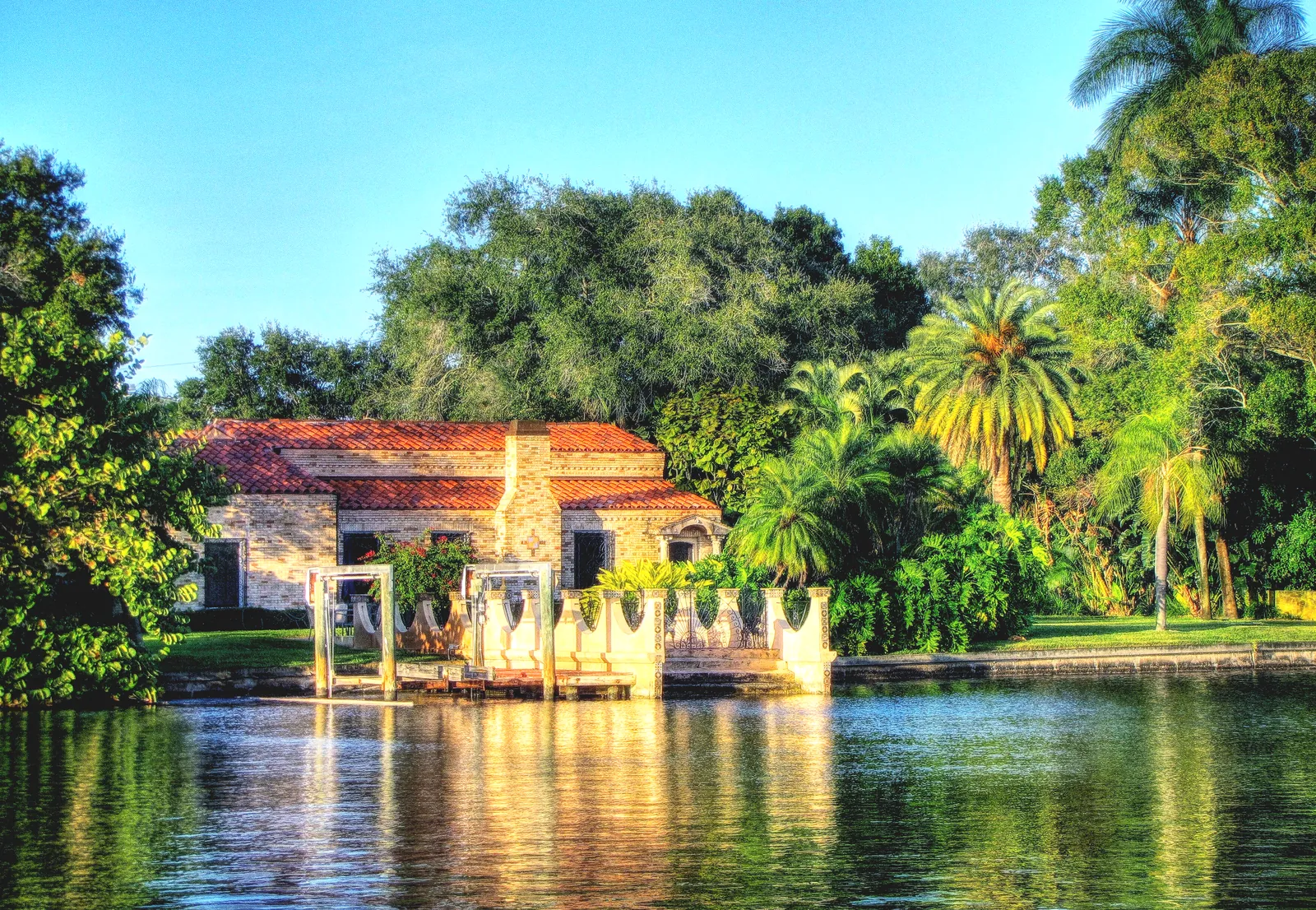
A waterfront Mediterranean-style home on Snell Isle, St. Petersburg, seen across Coffee Pot Bayou on a late afternoon, palms along the seawall and open bay water in front.
Snell Isle today — wrapped on every side by water
Snell Isle, St. Petersburg, seen from across the water (present-day photograph). The whole neighborhood sits on ground pumped up out of Coffee Pot Bayou in the 1920s. Photo: Calmuziclover, 2020 (CC BY 2.0), via Wikimedia Commons.

The living room was outdoors

Here’s the part that’s easy to forget from inside a cooled room: selling the sun meant selling a place that, for months at a stretch, was genuinely hard to sit still in. There was no air conditioning — not in the houses, not in the shops, not anywhere a regular person spent a day. So the whole town cooled itself the only way it could. Outside, in the shade, where the breeze off the bay actually moved.

Rows of people sitting shoulder to shoulder on long downtown benches in St. Petersburg, dressed in light summer clothes and hats, in a vintage photograph.
The benches were the living room
The famous green benches, St. Petersburg (circa 1940). Sitting out to catch the breeze was the whole downtown pastime before air conditioning. Photographer unknown; public domain, via Wikimedia Commons.

That’s where the green benches came from. By the city’s own count there were something like seven thousand of them lining the downtown sidewalks, all painted the same regulation green after a 1916 ordinance settled the color once and for all. People sat on them for hours — not waiting for anything, just being somewhere the air stirred. The bench was the living room, because the living room back home was an oven.

A vintage postcard view of Central Avenue in St. Petersburg, lined with low storefronts, awnings, parked cars and pedestrians under a wide bright sky.
Central Avenue — “the Sunshine City”
Central Avenue, St. Petersburg — a vintage “Sunshine City” postcard view of the downtown that lived on its sidewalks. Boston Public Library postcard collection (CC BY 2.0), via Wikimedia Commons.

Then a druggist decided to build an island

Into this city of people chasing shade walked C. Perry Snell — a Kentucky druggist who’d come down in 1900, done well, and caught the one fever nobody in 1920s Florida was immune to: the certainty that he could turn open water into dry land and sell it for a fortune.

Years earlier he’d started buying mud and mangrove along Coffee Pot Bayou, the kind of ground you couldn’t give away because half of it vanished at high tide. He kept at it until he held close to three hundred acres of the stuff. Then he set dredges to work, sucking sand off the bottom of the bay and spraying it into the shape of a neighborhood while the buyers watched the land come up out of the water.

A large dredge machine at work in shallow water in 1920s Florida, pumping sand and fill to build up new land.
How you make land where there wasn’t any
A dredge at work, Florida, 1921 — the same machinery that pumped Snell Isle up out of the bay (this one on the Tamiami Trail, not the island itself). State Library & Archives of Florida; no known copyright, via Wikimedia Commons / Florida Memory.

When Snell Isle officially opened in October 1925, only 39 of its 275 acres sat above the high-tide line. The rest was still a promise, and in places still bay. It didn’t slow anyone down. Buyers handed over more than seven million dollars for lots on an island that hadn’t entirely finished being an island.

A whole island, engineered to stay cool with nothing but water, shade, and stone — finished just in time to be made optional.

The island was the air conditioner

And here’s what Snell understood that makes this more than one more boom-and-bust story. He wasn’t only selling lots. He was selling a way to stay cool without a machine — because the machine didn’t exist yet — and he built the whole island to do the job.

Start with the shape of it. An island is wrapped by water on every side, and water means a breeze; Snell ran that water up into the land with bayous and inlets so the moving air reached the back porches too. Then came the houses. Mediterranean Revival was the look of 1920s Florida, and it happened to double as a catalog of answers to heat: pale stucco that threw the sun back instead of soaking it, deep eaves and barrel-tile roofs that kept the walls in shade, ceilings high enough to let the hot air climb away from you, windows set across from each other so a cross-breeze had somewhere to go, and shaded loggias and sleeping porches for the nights when indoors was hopeless.

A large pink Mediterranean Revival hotel with arched windows, a barrel-tile roof and a tower, set behind palms under a blue sky.
Mediterranean Revival — shade built in
The Vinoy, the grand Mediterranean Revival hotel that opened across the water in St. Petersburg in 1925 (photograph, early 2000s). The same style — pale walls, deep eaves, tile roofs — shaped Snell Isle. Public domain, via Wikimedia Commons.
An ornate 1920s Mediterranean Revival commercial building on a downtown corner, with decorative stonework, arched detailing and a tiled parapet, present day.
Snell’s hand, still on Central Avenue
The Snell Arcade, 405 Central Avenue, St. Petersburg (present-day photograph) — one of Perry Snell’s surviving downtown buildings, its ornament straight off the islands he was selling. Via Wikimedia Commons.

Snell layered beauty on top of all of it. He sailed to Europe and shipped home a fortune in marble statues, urns, and tile, and stood them along his new boulevards — a small-town druggist’s idea of what paradise ought to look like. Some of those figures are still out there on the medians, keeping an eye on the traffic. But under the marble, the island was a cooling machine made of water, shade, and stone.

The box in the window

Snell didn’t get to keep it. The boom broke, took most of his fortune with it, and he died in 1942 with the island still filling in around him.

What finally finished off his whole idea came along about fifteen years later, and it was small enough to carry in from the truck. By the early 1950s you could buy a box that sat in a window and made cold air on demand — more than a hundred and fifty models to choose from by 1953 — and within a few years the entire country was sealing its windows and humming.

You can watch it quietly undo everything the town had organized its life around. The green benches emptied out; nobody needed to come downtown to find moving air when it was waiting in the bedroom. The sleeping porches got glassed in and cooled. The cross-breeze windows got shut so the cold wouldn’t leak away. The island built to breathe learned, like everywhere else, to seal itself shut.

What the breeze left behind

A quiet present-day Snell Isle boulevard lined with palms and mature trees, large Mediterranean-style homes set back behind green lawns.
The boulevards he dredged — still here
Snell Isle Boulevard today (present-day photograph). The island became one of St. Petersburg’s most sought-after addresses; the tile roofs, the statuary and the water all remain. Via Wikimedia Commons (panoramio).

Snell Isle came out the far side as one of the most wanted addresses in St. Petersburg — the tile roofs and arched windows still there, the statues still on the medians, the bayous still bright with boats. The water still wraps the whole place, and the breeze still comes off it every afternoon, exactly the way Perry Snell was counting on.

The houses just don’t need it anymore. Behind the pretty shutters, every one of them is cooled by the same quiet machine as the plainest house across town — the thing that let a whole city stop selling its weather and start stepping indoors to get away from it. Snell built an island to catch the breeze. The breeze still blows across it, every day, for nobody in particular, and everybody inside is comfortable without it.

A present-day note · I Know A Guy AC

The island still catches the breeze. Your house, thankfully, doesn’t have to live on it.

Perry Snell built a whole island to run a few degrees cooler than the mainland, because in his day that was the only tool anyone had. It was a clever trick. It was also never quite enough — which is exactly why those window units sold out the moment they showed up, and why not one house on Snell Isle leans on the bay breeze today.

We’re the machine that replaced it. A hundred years on, keeping a St. Petersburg house cool through August is still the whole job — we just do it with real equipment instead of architecture, sized and set up so you never have to think about the heat the way Snell’s buyers did every single afternoon.

So when the system that’s been doing that quietly for years finally picks the hottest day to quit — and that’s the day it picks — you’ve got an easier move than anyone on that island ever had. You don’t have to chase the shade or drag a bed out to the porch. You make one call, because for keeping a St. Pete home cool the modern way… we know a guy.

See what a new system costs→
Sources & Photo Credits

On the history

Photographs & postcards

  1. Snell Isle, from across the water (present day) — a waterfront home seen across Coffee Pot Bayou; photograph by Calmuziclover, 2020 (CC BY 2.0), via Wikimedia Commons. Clearly a modern image. File: snell-isle-aerial-today.
  2. The famous green benches, St. Petersburg (circa 1940) — photographer unknown; public domain, via Wikimedia Commons. File: green-benches-sunshine-city.
  3. Central Avenue, “the Sunshine City” — vintage postcard, Boston Public Library postcard collection (CC BY 2.0), via Wikimedia Commons. File: central-avenue-sunshine-city.
  4. The Vinoy hotel (early-2000s photograph) — a surviving 1925 Mediterranean Revival landmark in downtown St. Petersburg, representative of the style used on Snell Isle; across the water, not on the island itself. Public domain, via Wikimedia Commons. File: vinoy-hotel.
  5. The Snell Arcade, 405 Central Avenue (present-day photograph) — one of C. Perry Snell’s surviving downtown buildings. Via Wikimedia Commons. File: snell-arcade-central-avenue.
  6. Snell Isle Boulevard (present-day photograph) — the modern neighborhood. Via Wikimedia Commons (panoramio). File: snell-isle-blvd-today.

Modern photographs are identified as modern. Original downloads and a full research record are kept alongside this page in assets/images/originals/ and source-record.md. No image’s factual content was altered; the print frames and handwritten notes are CSS added around the photographs, never onto them. Any owner who would like an image removed need only ask.