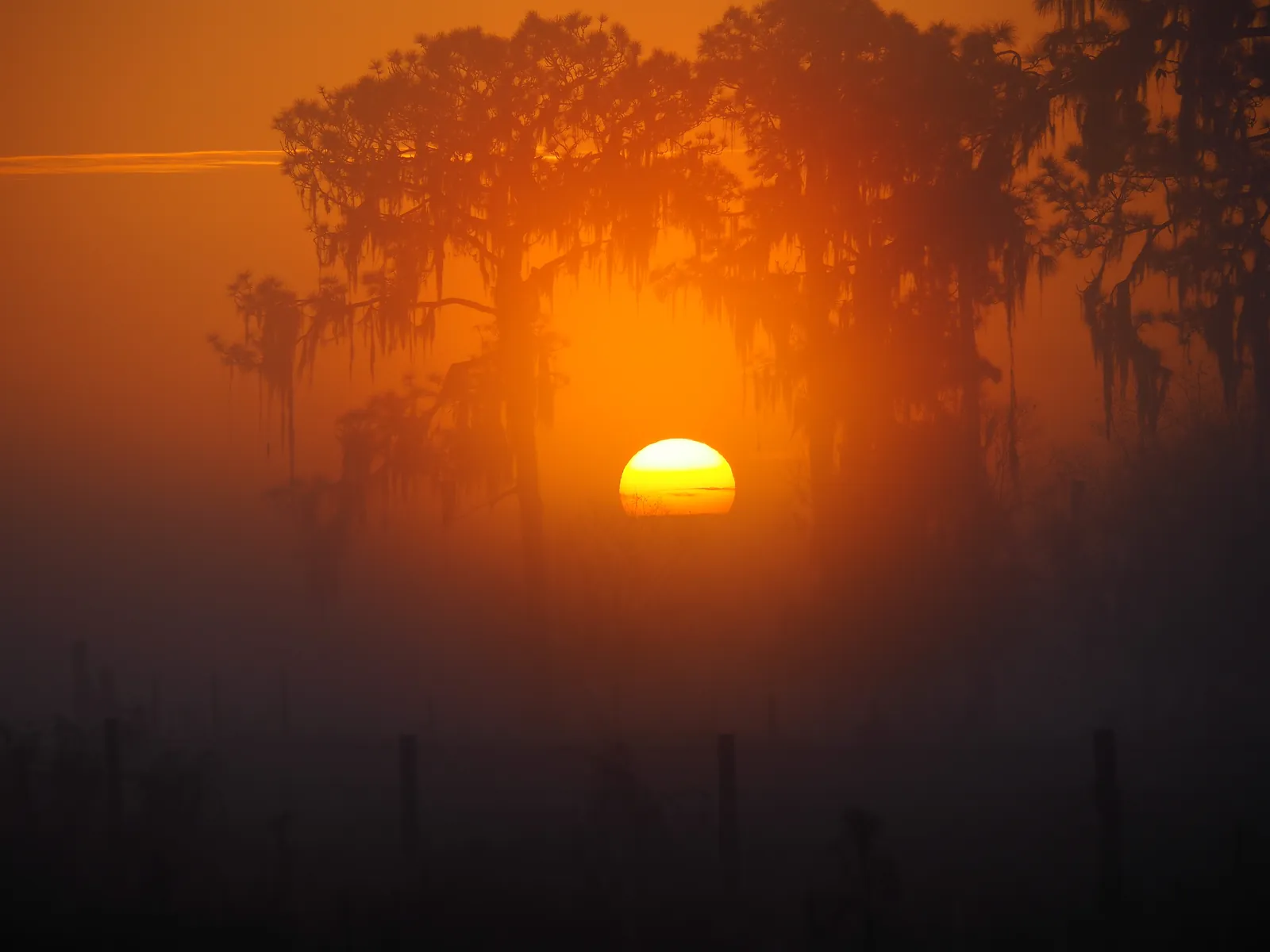
On a February morning in 1882, two men on foot came up over the top of a pine-covered hill in the middle of Florida and stopped. Below them was a lake nobody had bothered to put on a map — water so clear you could see the bottom — and all around it, rolling ground that rose and fell like country a thousand miles north of here. One of them, a former frontier judge named Edmund Dunne, had come to build a town, and he had just found the spot.
Here is the strange part. The State of Florida had sold this exact land as “swamp and overflowed” — the junk category, the stuff nobody wanted. And it was nothing of the kind. It was high and it was dry, about as high and dry as the peninsula gets.
Which raises a question worth sitting with. Why would a patch of dry Florida hilltop be worth more than almost anything around it?
Because of the air.
Before the machine, you went to the cool
Try to picture a Florida summer with no air conditioning anywhere. None. Not in a single house, church, store, or schoolroom in the entire state. The heat comes down wet and heavy in May and basically doesn’t let up until October, day and night, and there is nothing you can flip on to make it stop.
So people did the only thing there was to do. They didn’t make cool air — they couldn’t — they went and found it. And the whole state had quietly worked out where the better air was. Not down in the low wet ground along the rivers and the coast, where the heat pooled and the mosquitoes bred and every summer carried a real fear of fever. The better air was up. High, dry, sandy, pine-covered ground, where the land drained fast after a rain and a breeze could actually reach you.

By the 1880s, doctors were actively sending people here for it. A traveler’s health guide from 1885 told sick northerners to skip the famous riverboat resorts and head instead for the pine plateau running across the middle of the state, between Sanford and Tampa — praising its dry soil, its clear atmosphere, its daily trade wind off the Gulf, and “no malaria.” That plateau is exactly where Dunne was standing. In a Florida people were half-afraid of, the high dry ridge wasn’t just pleasant. It was the cure.
The judge kept the hilltop for himself
Dunne wasn’t advertising air. On paper he was building something else entirely — a Catholic colony, a refuge in a state that was then overwhelmingly Protestant. He’d earned an option on a hundred thousand acres as his fee for legal work on an enormous Florida land deal, and he meant to fill it with Irish and German Catholic families and call it San Antonio, after the saint he’d prayed to years earlier when he was lost and nearly died of thirst in the Arizona desert.
But watch what a man does, not what he says. His own cousin’s place down near the coast had flooded. So when Dunne went looking for his town, he went up, on foot, into the hills — and the one piece of ground he quietly reserved for himself was the highest hilltop of all, the one looking down over that clear lake he named Lake Jovita. He gave away the farmland. He kept the air.

The town filled in fast. Within a year there were stores, a priest, a schoolroom where one woman taught a handful of children in her home. The colony’s own doctor built himself a big three-story house right on the shore of the lake — which tells you something, when the physician of a health colony picks the breeziest lot in town.

Families came, mostly Irish at first, then a wave of German Catholics, and they built the kind of houses that make sense when the house itself is your only defense against the heat: deep porches, tall windows, rooms you could open end to end and let the evening air walk straight through.

The railroad, the strawberries, and the freeze
In 1888 the Orange Belt Railway finally reached the town, and that changed the math. Now the hilltop wasn’t just comfortable, it was connected — crops could ship north, supplies could come straight in, and for a while San Antonio turned itself into a little citrus and strawberry center, growing the kind of fruit the high dry ground was perfect for.

Then the thing the high ground couldn’t save them from arrived anyway. Two winters, back to back. A hard freeze in December 1894 stripped the leaves and the fruit. And then, in February 1895, came the one the old-timers just called the killer. The trees had started growing again, warm and full of rising sap, when the cold slammed down a second time — and the sap froze inside the trunks and split the trees open where they stood. Groves that were a family’s whole living were gone in a night.
A lot of people lost everything and went back north. The ones who stayed rebuilt, and quietly learned the lesson every Floridian eventually learns: the climate you moved here for is also the climate that can turn on you.
A monastery on the judge’s hill
The highest piece — Dunne’s own reserved hilltop — ended up with the most lasting tenant of all. In 1889 he deeded that ground to an order of Benedictine monks, who built a monastery and a little college on it. The college became St. Leo, the monastery became an abbey, and they’re both still up there today, sitting on what is, by Florida’s modest standards, a genuine mountaintop — a shade under two hundred feet above the sea.

When the great Florida land boom came roaring through in the 1920s, the town leaned even harder into its one asset. For a few years it actually renamed itself after the lake — the City of Lake Jovita — hoping the name would sell the cool blue water and the breeze to boom-era buyers. The name didn’t stick past the Depression, but the churches and the stout native-stone buildings that went up in those years did, and they’re the town you drive through now.

Then the machine came, and the hill stopped mattering
Somewhere after the Second World War, the thing that undid the entire logic of the place arrived — quietly, in a box in a window. Air conditioning climbed down out of the movie theaters and the big stores and into ordinary houses, and once it did, the whole careful calculation that built San Antonio simply dissolved.
Think about what the machine actually did. For sixty years, where you lived decided how you lived. The hilltop family on the breeze was comfortable; the lowland family in the still air suffered. Good air was a place, and you either got to it or you didn’t. Then a compressor and a few feet of copper made it so a plain house on the flattest, lowest, most still-aired lot in the county could be cooler in August than the finest porch St. Leo ever had. The one advantage the whole town was built on — its height, its dryness, its breeze — got unbundled from the dirt and sold by the pound to anybody, anywhere.
You didn’t have to climb to the cool anymore. The cool came to you.
What’s still up there
The hill is all still there, of course — you can’t unbuild a ridge. The stone church, the old school, the native-rock city hall, the abbey on the high point, the deep-porched houses: a whole town that was laid out, every lot of it, around the idea that a few dozen feet of elevation and a lake breeze were worth crossing a state for.

And people are still out on that high ground every day — at the church, at the university, at the Rattlesnake Festival the town has thrown every October since the 1960s. But not one of them is up there for the reason the town exists. They come for the view, the quiet, the hills that don’t feel like Florida. The air that two men climbed a hill to find, back in 1882, now follows everybody home and waits for them inside, humming behind a wall, on the lowest lot in town.