The Pink Streets · Pinellas Point, St. Petersburg, Florida  ·  A Local History

The Healthiest Spot on Earth


A hundred years ago a developer paved the far south point of St. Petersburg pink and sold it as the healthiest, coolest place in America. Miles of pink road, almost no houses. The thing that finally made the point livable wasn't its famous air — it was the machine.

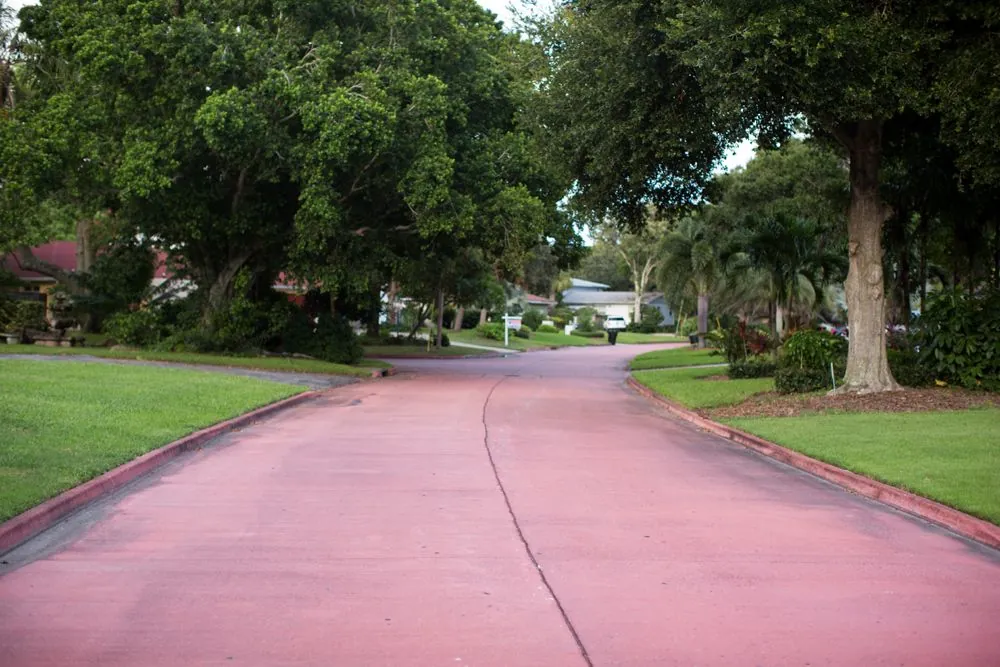
A present-day residential street in St. Petersburg paved in a soft rose-pink concrete, curving away under big shade trees past tidy homes and green lawns.
Yes, the street really is pink — and on purpose
A Pink Street today, Pinellas Point (present-day photograph). The pink pavement has been a deliberate choice here for a century. Photo via Liane Jamason / lianejamason.com.

Drive to the far south end of St. Petersburg, where the land runs out into Tampa Bay, and the streets turn pink. Not faded, not stained by accident — pink on purpose, poured that color a hundred years ago and kept that way ever since by the people who live on them.

They're some of the strangest streets in Florida. And they were laid down to sell something nobody had yet figured out how to make: a cool place to live.

A doctor's strange prescription

The sales pitch was already about forty years old by the time the pink showed up. Back in 1885, a Baltimore doctor stood in front of a national medical convention down in New Orleans and read a paper with a bold argument: the single healthiest place in the entire country to build a city — the best air, the best climate anywhere — was a remote, half-empty point of Florida scrubland almost nobody had heard of. He called it the spot for a future "Health City." The point he was pointing at is this one.

A color postcard titled 'Tropical Palms at Point Pinellas' showing tall palm trees and a figure resting by still water at sunset, near St. Petersburg.
Point Pinellas — the “healthiest air in America,” 1913
“Tropical Palms at Point Pinellas, near St. Petersburg” (postcard; a handwritten note on the back is dated 1913). Hampton Dunn Collection of Florida Postcards, University of South Florida Libraries.

And then, basically, nothing happened. For decades the idea just sat there. Which raises the obvious question — if a respected doctor tells the country a place has the healthiest air in America, why doesn't everybody pack up and move there?

Because in 1885 you couldn't actually live on it. Not through a Florida summer. The healthiest air in the country, from about June to September, was also some of the hardest to stand — wet, heavy heat sitting down on a treeless point, the mosquitoes, and not one way on earth to cool a room once the sun was up. The climate was the product and the problem at the same time.

The point that sat empty

So the point stayed mostly wild. A St. Petersburg developer had quietly bought up big pieces of it back in 1906 and then, strangely, just held it — undeveloped, year after year — waiting for the rest of the city to grow down toward the water.

A 1920s black-and-white aerial photograph taken from a small airplane, showing open water and flat, undeveloped Florida land with scattered trees and marsh at the edge of St. Petersburg.
Open water and empty land — the point before the streets, 1920s
Aerial view of water and undeveloped land, St. Petersburg (circa 1920s). Francis G. Wagner Photographs, University of South Florida Libraries.

When the developer finally moved, in the middle of the roaring 1920s land boom, the plan was to carve the point into a whole new neighborhood — and the sales team reached straight back for the old doctor's line. They marketed the place as "The Healthiest Spot on Earth." They handed investors copies of the original Health City papers. They ran cars down from downtown to show off a view of palms and open bay. They were selling, almost literally, the air.

So they paved the roads pink

But a buyer standing on a flat, sunbaked point needs to feel the paradise, not just read about it in a pamphlet. So the company did a thing no other developer in the area had done. It ordered the roads poured pink.

In its own 1925 newspaper ad, the company explained why — and the reason is a tiny window into how completely the heat ran everything down here:

From the developer's advertisement

“We are coloring it red … because … the red clay streets up there reflected no glare into the eyes and that the color blended beautifully into the landscape.”

— Murok Corp. ad, Tampa Morning Tribune, May 29, 1925

Read that again. They chose the color of the pavement so it wouldn't throw the Florida sun back up into your face. Even the streets were a comfort feature. Everything on this point, right down to the ground you drove on, was arranged around the heat — because out-thinking the heat was the entire job of living here.

The boom, and then the quiet

For a moment it worked like a dream. There was a tea room out on the point serving refreshments to day-trippers who came only to see the miles of brand-new red concrete. The ads promised dredged islands and canals and a beach casino. And you took a ferry across the water to get down there — the point was still that cut off from everything — and for a while the ferry ran crowded.

A vintage color postcard of the Bee Line Ferry landing at Pinellas Point, with 1940s automobiles lined up to board, a Coca-Cola sign, and the covered ferry dock.
You had to ferry across the bay to even get there
The Bee Line Ferry, Pinellas Point (postcard). From the mid-1920s until the first Sunshine Skyway opened in 1954, the ferry carried cars across the bay to the point. Hampton Dunn Collection, University of South Florida Libraries.

And then the boom stopped, the way every boom eventually does, and the dream just emptied back out.

Here's the number that tells the whole story. By 1929, after all the pink pavement and all the Healthiest-Spot-on-Earth advertising, roughly fifteen houses stood along those streets. Fifteen. Miles of pink road running through palmetto and sand toward a grand neighborhood that never arrived — and for decades, that's how it stayed.

The thing that was missing

The streets sat half-empty like that through the Depression and the war. And the reason is the same reason the doctor's pitch fell flat back in 1885: the one thing that would let an ordinary family move onto that hot point and actually stay, all year, simply wasn't in their houses yet.

Then, in the years after the war, it was. Air conditioning came down out of the movie palaces and the big downtown stores and landed in the window of a regular house — a box you could buy and switch on.

A black-and-white photograph from around 1960 of an early air-conditioning unit mounted on the flat roof of a low Tampa Bay building.
Cool stopped being a place and became a machine, c. 1960
An early air-conditioning unit, Tampa Bay (circa 1960). Once cool air came from a machine, you no longer had to move toward a better climate. Gandy Photographs, University of South Florida Libraries.

And that quietly knocked the legs out from under the whole pitch. The entire premise of the Healthiest Spot on Earth — move to the point, because the climate here is better than wherever you're sweating now — stopped meaning much the day you could buy the exact same cool air for a living room anywhere in the country. You didn't have to go find the healthiest spot. You could make one, in any room you liked.

What the point did with its second life

Here's the turn. Once air conditioning made the point genuinely livable, people finally came — and the pink streets filled in with the houses that were always supposed to be there. The pink could easily have vanished right then. By the 1980s the old concrete was cracked and warping, and the city floated the sensible fix: pave the whole thing over in ordinary black asphalt.

The neighborhood refused. After a long fight, in 1989 the city agreed to keep the streets pink — and the residents agreed to help pay for it themselves. Nearly five miles of road got rebuilt, pink, on purpose, all over again. There's even still a street down there named Murok, after the long-gone company that poured the first of it.

A present-day pink-paved boulevard in Pinellas Point with a landscaped palm median down the center, running toward the bay.
Rebuilt pink, on purpose, again
A Pink Street boulevard today (present-day photograph). Residents fought to keep the pink and helped pay to restore it. Photo via Liane Jamason / lianejamason.com.

Go all the way down now, to the foot of 14th Street South, where the pink finally runs out at a small park on the edge of the bay. The water is right there. In the evening the breeze still comes up off it, the same breeze a doctor stood up and praised to a room full of physicians a hundred and forty years ago.

A wooden park sign reading 'Katherine B. Tippetts Park, City of St. Petersburg, 14th St. S. to Serene Ways' on a green lawn at the bayfront end of the Pink Streets.
Where the pink runs out — the bay, and the breeze, still here
The bayfront park at the foot of 14th Street South (present-day photograph). The Pink Streets end here, at the open water of Tampa Bay. Photo: St. Pete Catalyst.

He wasn't wrong about the breeze. He was just a lifetime too early — selling a cool place to live before anyone on earth could keep one cool. The streets stayed pink. The sales pitch didn't. And the families who live on them through August today are comfortable for a reason that has almost nothing to do with the famous air off the bay, and almost everything to do with the quiet machine humming behind the wall.

A present-day view from the Pinellas Point bayfront: a palm and a small covered pier at the water's edge, with the Sunshine Skyway bridge spanning the bay in the distance.
The same water, the same breeze the doctor sold in 1885
The bay off Pinellas Point (present-day photograph), with the Sunshine Skyway beyond. Photo via Liane Jamason / lianejamason.com.

A present-day note · I Know A Guy AC

They sold this point as the coolest spot in America. Today the cool comes from behind your wall.

That old pitch was half right. The point really does catch a good breeze off the bay, and the shade really is a few degrees kinder than the open street. It was never quite enough to get a family through a St. Petersburg August — which is exactly why those pink streets sat nearly empty for thirty years, waiting on the one thing that could finish the job.

Keeping a home down here cool is still the whole job, the same as it was for the people who first drove onto that fresh pink concrete. We just do it with real equipment now — a system sized and set up for your house, so the heat outside stays a thing you only notice the second you step out into it. The machine that replaced the breeze is quiet, and it's easy to forget it's even there — right up until the afternoon it quits.

And when it does — on the hottest day, because that's always the day it picks — you've got an easier move than any of those first Pinellas Point families reaching for the wind off the water ever had. You don't chase the shade or wait on the bay. You make one call, because for keeping a St. Petersburg home cool the modern way… we know a guy.

See what a new system costs→
Sources & Photo Credits

On the history

Photographs

  1. A Pink Street today, Pinellas Point (present day, HERO) — via Liane Jamason, lianejamason.com ("The Pink Streets & Pinellas Point"). File: pink-street-today-hero.
  2. "Tropical Palms at Point Pinellas, near St. Petersburg" (postcard; reverse dated 1913) — Hampton Dunn Collection of Florida Postcards, University of South Florida Libraries (No Copyright – United States). File: point-pinellas-palms-1913.
  3. Aerial view of water and undeveloped land, St. Petersburg (circa 1920s) — Francis G. Wagner Photographs, University of South Florida Libraries. File: undeveloped-point-aerial-c1920.
  4. The Bee Line Ferry, Pinellas Point (postcard; ferry operated 1920s–1954) — Hampton Dunn Collection of Florida Postcards, University of South Florida Libraries (No Copyright – United States). File: bee-line-ferry-pinellas-point.
  5. An early air-conditioning unit, Tampa Bay (circa 1960) — Gandy Photographs, University of South Florida Libraries. File: ac-unit-tampa-bay-c1960.
  6. A Pink Street boulevard today (present day) — via Liane Jamason, lianejamason.com. File: pink-boulevard-median-today.
  7. Katherine B. Tippetts Park, foot of 14th Street South (present day) — St. Pete Catalyst. File: katherine-tippetts-park-today.
  8. The bay off Pinellas Point, with the Sunshine Skyway (present day) — via Liane Jamason, lianejamason.com. File: pinellas-point-bayfront-skyway-today.

Present-day photographs are identified as modern; period images carry their known or circa dates. The 1925 advertisement is quoted from James Schnur's research in The Gabber; where the record is uncertain (the exact wording of the 1885 "healthiest" claim, the real reason for the pink color), this story says so rather than overstating it. Untouched original downloads and a full research record are kept alongside this page in assets/images/originals/ and source-record.md. No image's factual content was altered; the print frames and handwritten notes are CSS added around the photographs, never onto them. Any owner who would like an image removed need only ask.