Pass-a-Grille · St. Pete Beach, Florida  ·  A Local History

The Town That Sold a Breeze


For sixty years the coolest place for miles was the edge of the Gulf at Pass-a-Grille — and the only way to get there was to cross the water. People came by the thousands to stand in the wind. Then a machine learned to make that same cool anywhere.

On a July afternoon at the bottom of a skinny Florida barrier island, the air sits on you like a wet towel and will not move — except along the one line where the land quits and the Gulf starts. Stand right there and the water pulls a breeze off itself, steady and a few degrees cooler than anywhere behind you. For a long time that line was the only honestly cool thing for miles, and people knew exactly where it was. They crossed open water in a boat to go stand on it.

The town built to meet those people is called Pass-a-Grille, and for most of its life its whole product was that breeze. Which leaves a strange question hanging over the place, once you sit with it: what happens to a town whose entire reason to exist is that it’s the cool spot — when somebody invents a way to be cool anywhere?
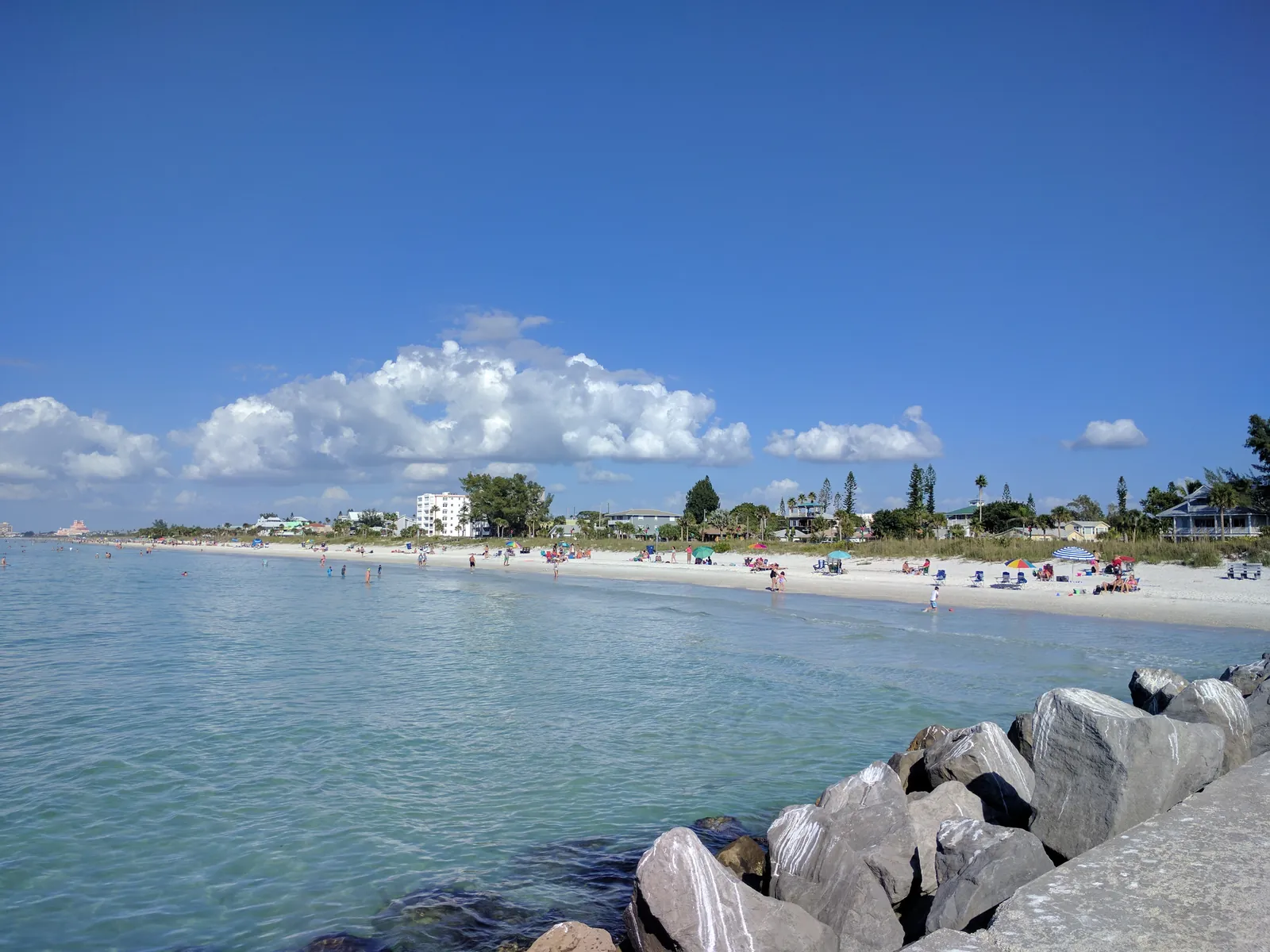
The wide, flat beach at Pass-a-Grille seen from a low concrete pier, gentle Gulf of Mexico surf rolling in under a bright sky.
The line where the cool is — Pass-a-Grille today
The Gulf shore at Pass-a-Grille (present-day photograph). The breeze that built the town still comes off the water every afternoon. Photo: George Kaplan, 2016 (CC BY-SA 3.0), via Wikimedia Commons.

A pass named for smoke

Start with the name, because it’s a tell. On a French chart drawn in 1841, the southern tip of this key is marked Passe aux Grilleurs — the grillers’ pass. The story that stuck is that fishermen used to drag their boats up on the sand here and grill the day’s catch over open fires, and the smoke gave the spot away long before anybody wrote it on a map. Nobody settled this sandbar to farm it or dig anything out of it. They came for what the water did — the fish, and the air moving over it.

For the first thirty-odd years, coming for it meant coming by boat. Zephaniah Phillips homesteaded the first house on the key in 1886. After that, everything — people, mail, lumber, groceries — landed at a dock at the foot of 8th Avenue.

An early-1900s postcard view of the boat landing at Pass-a-Grille: a long wooden dock and small vessels seen from the beach, with figures in period dress along the shore.
You arrived by water. Postcard, 1911
The boat landing at Pass-a-Grille, from a postcard postmarked 1911. Until 1919 there was no bridge or causeway — the only way onto the key was across the bay. Public domain, via Wikimedia Commons.

A ferry began carrying visitors across the bay around 1905, and until 1919 there was no other way in — no bridge, no causeway, just the crossing. That sounds like a problem. It was really the pitch. You left the hot, airless town on the mainland, you got out onto open water, and by the time you stepped off onto the sand you were already cooler than you’d been all day. The trip was the product.

A whole town built to sell cool

So a town grew up to sell the feeling. In 1901 a French travel agent named George Lizotte remodeled a house on 8th Avenue into a ten-room hotel and rented a bed near the breeze for seven dollars and fifty cents a week. By the time Pass-a-Grille incorporated in 1911 the key had about twenty homes, five stores, three hotels and a restaurant, strung along a main street so short that Ripley’s Believe It or Not! later called it the shortest business district in the country.

A low historic commercial building on 8th Avenue in Pass-a-Grille today, painted in warm beach colors, a block from the Gulf.
8th Avenue — the short main street, still here
8th Avenue, Pass-a-Grille (present-day photograph). The whole business district runs a few short blocks from the bay dock to the Gulf. Photo: Ebyabe, 2016 (CC BY-SA 4.0), via Wikimedia Commons.

And right down on the sand sat the engine of the whole thing: the beachfront bath house and casino. “Casino” didn’t mean cards or roulette. It meant a big open pavilion where you changed into a bathing costume — rented one, if you didn’t own it — and walked straight out into the Gulf.

A vintage color postcard of the two-story Pass-a-Grille Beach Hotel and Casino standing on the sand at the edge of the Gulf, a lower bath-house pavilion beside it and the water behind.
The Beach Hotel & Casino, right on the sand
The Pass-a-Grille Beach Hotel and Casino — a vintage linen postcard. The “casino” was an open bath-house pavilion where visitors changed and walked straight into the Gulf. State Archives of Florida / Florida Memory.

People came by the thousands to do a thing that sounds almost too plain to sell: get in the water, and stand in the wind. The swimsuits got lighter by the decade and the crowds got bigger, and nobody down here thought of it as a quaint little outing. It was simply the known way to beat a Florida summer. You went to where the cool was.

A vintage color postcard of a crowd of beachgoers in swimsuits sitting under striped umbrellas on the sand at Pass-a-Grille, the Gulf and more umbrellas stretching down the shore.
What they came for — a day in the water and the wind
“A popular winter pastime at Pass-a-Grille” — a mid-century linen postcard of the Gulf beaches. Getting into the water and sitting in the breeze was the entire draw. State Archives of Florida / Florida Memory.

The fancy version of the same idea

The pitch scaled up, too. The Castle Hotel opened on 8th Avenue in 1906 and is still taking guests, which makes it about the oldest hotel still running on this stretch of coast. And in 1928 a developer put up an enormous pink palace on the north end of the island — the Don CeSar — a Mediterranean fever-dream for the kind of traveler who wanted the sea breeze with room service attached.

The Castle Hotel in Pass-a-Grille today, a small historic hotel with a corner tower and arched windows on 8th Avenue.
The Castle Hotel — open since 1906
The Castle Hotel, Pass-a-Grille (present-day photograph). Opened in 1906 and still in business, it is among the oldest hotels on the Gulf coast. Photo: Ebyabe, 2011 (CC BY-SA 3.0), via Wikimedia Commons.

Different price tags, same product. Lizotte’s ten rooms and the Don CeSar’s three hundred were both selling exactly one thing: a bed close to the one cool line on the map. In 1915 that was the only way to buy it.

The Don CeSar, a large pink Mediterranean-style resort hotel on the north end of St. Pete Beach, seen against a blue sky.
The pink one. Opened 1928
The Don CeSar, on the north end of the island (present-day photograph). Opened in 1928, it aimed the old sea-breeze pitch at a grander kind of guest. Photo: Ebyabe, 2011 (CC BY-SA 3.0), via Wikimedia Commons.

The box that changed the math

Here’s the turn. Starting in the early 1950s, a machine small enough to sit in a window began showing up in ordinary Florida houses, and before long whole houses were wired for it. Cold air on demand, in your own living room, any hour you wanted it.

Think about what that did to a town whose product was cool. For half a century the deal Pass-a-Grille offered couldn’t be beaten, because it was the only deal in the state: if you wanted real relief from July, you traveled to the water. The window unit quietly deleted the traveled-to part. All of a sudden the coolest room in Florida could be your own bedroom, and you didn’t have to cross a bay to get into it.

For sixty years the town’s whole advantage was that it was where the cool was. The machine in the window turned cool into something you could own.

What a beach town does when cool goes home

A lot of Florida beach towns that lived on the old deal got bulldozed into something you wouldn’t recognize. Pass-a-Grille mostly didn’t. It stayed small — it had always been hard to reach, and then it got protected, landing on the National Register of Historic Places in 1989 with its stubby main street and its 1920s cottages still standing.

A quiet Pass-a-Grille residential street today, lined with small older beach cottages and palms a block from the Gulf.
The cottages the cool was built for
A Pass-a-Grille side street (present-day photograph). Much of the early-1900s beach town survives inside the historic district. Photo: Ebyabe, 2011 (CC BY-SA 3.0), via Wikimedia Commons.

What changed wasn’t the place. It was the reason people come. Nobody drives over the causeway now because it’s the only way to stop sweating — they’ve got cold air at home and cold air in the car that brought them. They come for the thing the cool used to be wrapped around: the walk on the sand, the fish off the pier, a drink while the sun falls into the Gulf. The breeze is still free and still blowing. It just isn’t the product anymore. It’s the view.

Go back down to that line where the land quits and the water starts. On a dead-still July afternoon it’s still the coolest spot on the island — the one honest breeze for miles. The only difference is that every person standing in it tonight could be home in the air conditioning instead, and picked this. Pass-a-Grille spent its first sixty years as the only cool place people could get to. Now it’s the cool place people choose.

A present-day note · I Know A Guy AC

The breeze used to be the only air conditioning for miles. Now it’s a nice-to-have.

For most of Pass-a-Grille’s life, the only real way to cool off in a Tampa Bay summer was to go find moving air — cross the bay, get to the water, and stand where the Gulf was pushing a breeze onto the sand. That whole trip was the air conditioning.

We’re the reason that trip is optional now. A century on, keeping a house cool through a Florida July is still the entire job — we just do it with real equipment instead of a ferry ride, sized and set up for your place so the coolest spot in town can be your own couch.

So when the system that’s been doing that quietly for years finally picks the hottest afternoon of the summer to quit — and that’s the afternoon it picks — you’ve got an easier move than anyone on that old beach ever did. You don’t have to load the family onto a boat and go chase the wind like it’s 1915. You make one call, because for keeping a Tampa Bay home cool the modern way… we know a guy.

See what a new system costs→
Sources & Photo Credits

On the history

Photographs

  1. The Gulf shore at Pass-a-Grille (present-day, HERO) — photograph by George Kaplan, 2016 (CC BY-SA 3.0), via Wikimedia Commons. Clearly a modern image. File: pag-beach-from-pier-today.
  2. Boat landing, Pass-a-Grille — from a postcard postmarked 1911; public domain, via Wikimedia Commons. File: pag-boat-landing-1911.
  3. 8th Avenue (present day) — the historic Hurricane Seafood Restaurant building at 809 Gulf Way; photograph by Ebyabe, 2016 (CC BY-SA 4.0), via Wikimedia Commons. File: pag-hurricane-8th-ave-today.
  4. The Castle Hotel (present day) — photograph by Ebyabe, 2011 (CC BY-SA 3.0), via Wikimedia Commons. File: pag-castle-hotel-today.
  5. The Don CeSar (present day) — photograph by Ebyabe, 2011 (CC BY-SA 3.0), via Wikimedia Commons. File: pag-don-cesar-today.
  6. Pass-a-Grille side street (present day) — photograph by Ebyabe, 2011 (CC BY-SA 3.0), via Wikimedia Commons. File: pag-street-today.

Present-day photographs are identified as modern; the 1911 boat-landing postcard is the period image in this set. Original downloads and a full research record are kept alongside this page in assets/images/originals/ and source-record.md. No image’s factual content was altered; the print frames and handwritten notes are CSS added around the photographs, never onto them. Any owner who would like an image removed need only ask.