Here is a photograph of a promise. A big stucco gate, four bell-towers tall, thrown up across a brand-new boulevard in South Tampa in 1925, with the word PARKLAND ESTATES arched across the middle of it in iron letters. Drive under it and the street runs off into open scrub — a few bare house-frames, some power poles, a couple of Model Ts, and a whole lot of nothing yet. The gate is selling a neighborhood that mostly doesn't exist.
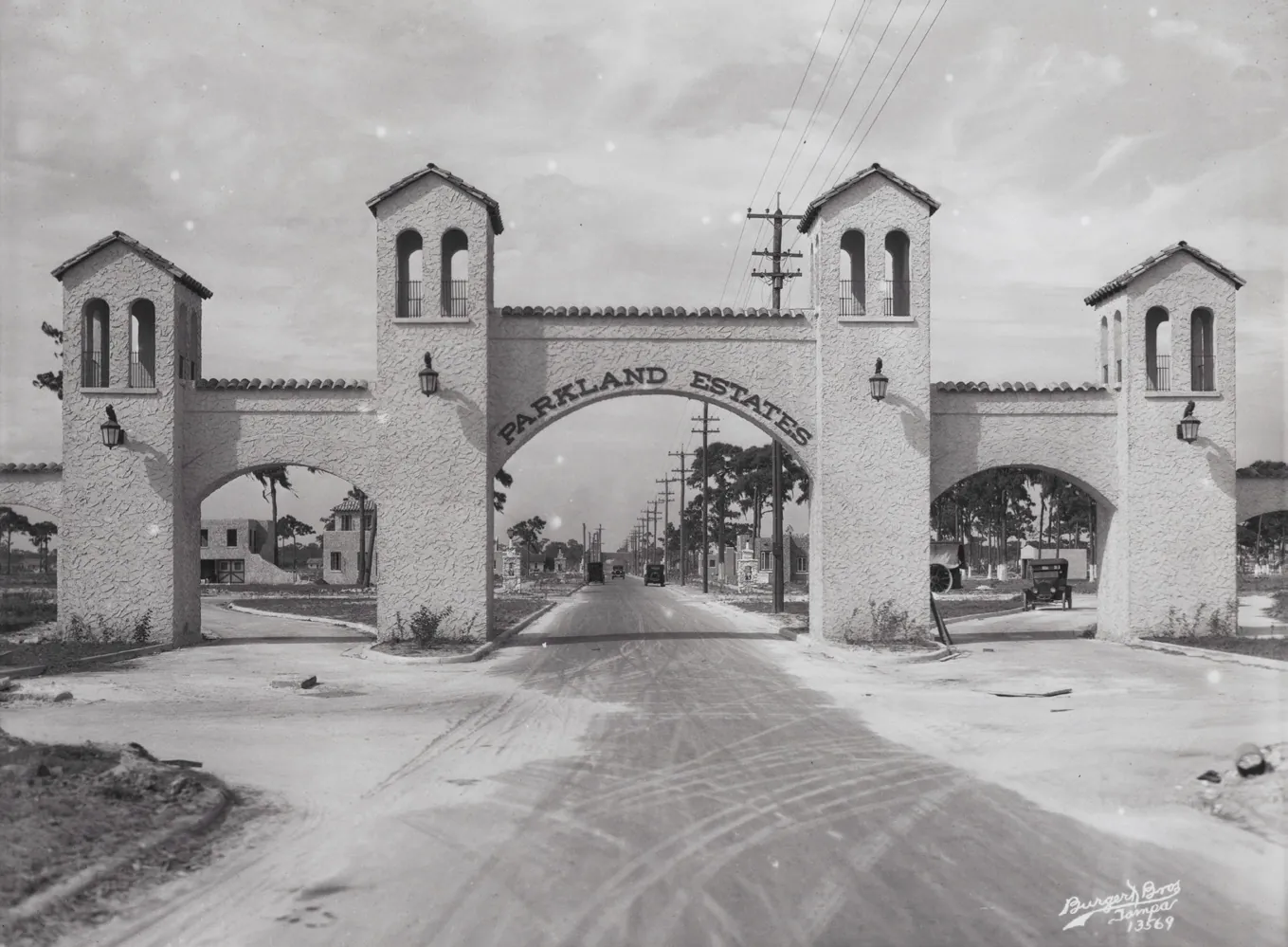
What the gate was really selling, though, wasn't lots. It was a way out of the heat.
You have to put yourself back before the machine for this to make sense. In 1925, nobody in a Tampa house had cold air. Not in the bedrooms, not in the parlor, not anywhere an ordinary family lived. So if you were going to sell people a place to live in the middle of a Florida summer, you couldn't sell them cool air — it didn't exist to sell. You had to sell them the next best thing. You sold them shade, and water, and a breeze. You sold them a park.
The heat was the thing to beat
For most of the year Tampa does a convincing impression of paradise, and the whole state was busy saying so. This was the top of the great Florida land boom, when trains came south packed with people buying a piece of the sun, most of them from places where winter actually hurt.
But everybody who stayed through a summer knew the other half of the bargain. From about June to September the air here goes thick and wet and sits on you like a hand, and in 1925 there was exactly one answer to it: get out from under the sun and find some moving air. Shade did real work. Water did real work. A grove of oaks could pull a street a few degrees cooler just by standing over it.

And the moment had just gotten easier to sell, because getting here had just gotten easier. In November 1924 the Gandy Bridge opened straight across the bay, and a trip between Tampa and St. Petersburg that used to eat half a day shrank to about an hour. South Tampa — Palma Ceia, the neighborhood they called New Suburb Beautiful, and this new one called Parkland — all filled in fast on the back of that.

So he built a park and charged admission by the lot
The man usually credited with Parkland Estates is a Tampa developer named Allen J. Simms — a street inside the neighborhood still carries his name. In the same couple of boom years he was also putting up the Floridan downtown, the first real skyscraper in Florida, so you can picture the two halves of his imagination at once: a tower reaching for the sky in one part of town, and over here, a cool green refuge spread flat along the ground.
Parkland was the refuge. The name wasn't decoration — it was the entire pitch. He laid out curving streets instead of a hard grid, planted them, and let the ground itself be the amenity.

And then, because shade alone is a hard thing to photograph, he built the one feature that could sell cool in a single picture.
He built a fountain.

Look at where it is. There's a stone cascade with little figures on top, a proper lagoon ringed by a low white wall and a row of fancy lampposts — and all around it, raw dirt, survey stakes and a lone parked car. He had poured a European water-garden into the middle of a South Tampa cow field, and he did it early, before the buyers came, because the fountain was the sales brochure. It told you, in one glance, exactly what you were buying: a place with water in it. A place a few degrees cooler than the one you were standing in.
You couldn't manufacture cool air in 1925. So Parkland Estates sold the only cool a developer could build — shade, water and a fountain — and called it a park.
The houses knew the same trick
The homes that filled in behind the gate were built to play along. They went up in the grand revival styles of the Twenties — Spanish and Mediterranean stucco under red barrel tile, columned Georgian fronts, steep French roofs — and under the style, they were all quietly doing the same job as the oaks and the fountain.
The ceilings run high, because hot air climbs and a tall room lets it get up off your neck. The windows are big and set to face each other across a room, so a breeze can come in one side and leave by the other. The porches are deep enough to hold the sun off the walls all afternoon. Some of these houses have a whole arched passage cut right through them — a shaded breezeway you could drive under — which is a very elegant way of saying the architecture itself was trying to catch a draft.


None of it was magic, and none of it was quite enough. On a dead-still August night, when the bay breeze simply didn't come, a deep porch and a tall ceiling only got you so far. You lived with the heat; you just arranged your whole house, and your whole evening, to lose to it by as little as possible. For a hundred years of Tampa that was the deal, and nobody had ever known anything else.
Which is the thing that makes the next part land. The whole time Simms was pouring that fountain to sell people a cooler patch of ground, the real answer to the Florida summer was already humming away a few miles north — and it had nothing to do with shade.
A cold room you had to stand in line for
In October 1926, while Parkland's lots were still filling in, a movie palace opened downtown on Franklin Street: the Tampa Theatre. It had the same dreamy Mediterranean look Simms was selling out on his sandy Parkland lots. But it had one thing no building in the city had ever had before, and the thing it had was not a view.
It was cold air. Real, manufactured, machine-made cold air, in a town where that had never existed.

The theatre barely bothered advertising the movies. It advertised the temperature. The signs out front told sweltering Tampa to come feel the man-made air — and people did exactly that, lining up in the heat to buy a ticket into a cold dark room for the sheer novelty of being cold in September. The picture was almost beside the point. They came to feel the air.

So here are the two ideas of cool, running side by side in one city in one year. Out in Parkland, a fountain and a grove and a deep front porch — comfort you had to go find, or move toward, or build a house to catch. And downtown, in a dark room with a machine in the basement, comfort you could simply switch on. One of those two ideas was about to win so completely that it would make the other one invisible.
The box that made the park optional
It didn't happen overnight. The land boom collapsed first — by 1926 the easy money dried up, lots that had traded three times in a week wouldn't move once, and plenty of grand Florida plans went quiet, Parkland's included. The cold-air future took its time, too. Air conditioning stayed a thing you went out to visit — a theatre, a department store — for the better part of forty years. It wasn't really common in a Tampa home until around the 1960s.
What finally changed everything wasn't a fountain or a grand gate. It was a box you set in a window.

Once an ordinary family could buy a window unit and flip it on, every clever thing Parkland had been built around turned into decoration. Nobody needed the fountain to feel cool. Nobody needed the breezeway to catch a draft, or the deep porch to beat the afternoon, or the oaks to drop the street a few degrees. The house would just do it, on demand, on the stillest night of the year, for the price of the electric bill. The park was still a lovely place to live. It had simply stopped being the cooling system.
What the gate guards now
Parkland Estates came through all of it. It's still here, tucked into South Tampa between Swann and Morrison, one of those grand old shaded neighborhoods where the oaks Simms planted a century ago now meet in a green roof over the street.

The grand four-tower gate from that 1925 photo doesn't throw its shadow across the boulevard anymore; a quieter stucco marker carries the name today, and the fountain the neighborhood was named for still sits down in the green, water moving in the heat the way it has since the dirt around it was survey stakes. You can walk the streets and read the old instructions right off the houses — the deep porches, the high windows, the arch cut through the wall to catch a breeze nobody's waiting on anymore.

So go back to that first photograph — the big gate standing over an empty street, selling cool by the acre. Everything it promised actually came true. The oaks grew in, the houses filled the lots, the fountain still runs. The neighborhood is exactly as cool and green as the picture swore it would be. It's just that the cool everybody actually lives on now isn't the fountain, or the shade, or the breeze off the bay. It's the quiet machine behind the wall, doing on command the one job this whole beautiful place was built, a hundred years ago, to do by hand.