There’s a spot on Bayshore Boulevard where a spring still runs out of the ground, green and quiet under the palms, and most people who drive past it have no idea they’re looking at the reason a whole neighborhood is there. The water comes up at a steady seventy-two degrees. It did a hundred years ago, and it does right now, on the hottest afternoon in August.
For a long stretch of years, that was about the most valuable thing in South Tampa. Not the land. Not the view. The cold. Because there was a time around here when seventy-two degrees was something you couldn’t make — you could only go and find it.
A Florida problem with no machine to fix it
Picture a Tampa summer with the air conditioning switched off. Not for an afternoon — for your whole life. That was ordinary here well within living memory. The heat sat on the city for half the year, and the humidity came with it, the kind that soaks a shirt by mid-morning and never really lets go after dark.
So you did what everyone did. You chased the shade, you sat on the porch and waited for the evening to finally move the air, and when it got bad enough you went to the one thing that actually worked: you got in the water. And the best water around didn’t come from the bay, which goes warm as a bath by July. It came up cold, straight out of the ground.

The coldest place in town
The spring had been drawing people since the mid-1800s, back when folks came to bathe in it and swore the water could heal them. By 1907 there was a real pool there, built so the growing south end of Tampa had somewhere to climb out of the heat, and by the late 1920s a much bigger one had gone in beside it. Two pools, both fed by the same cold spring.
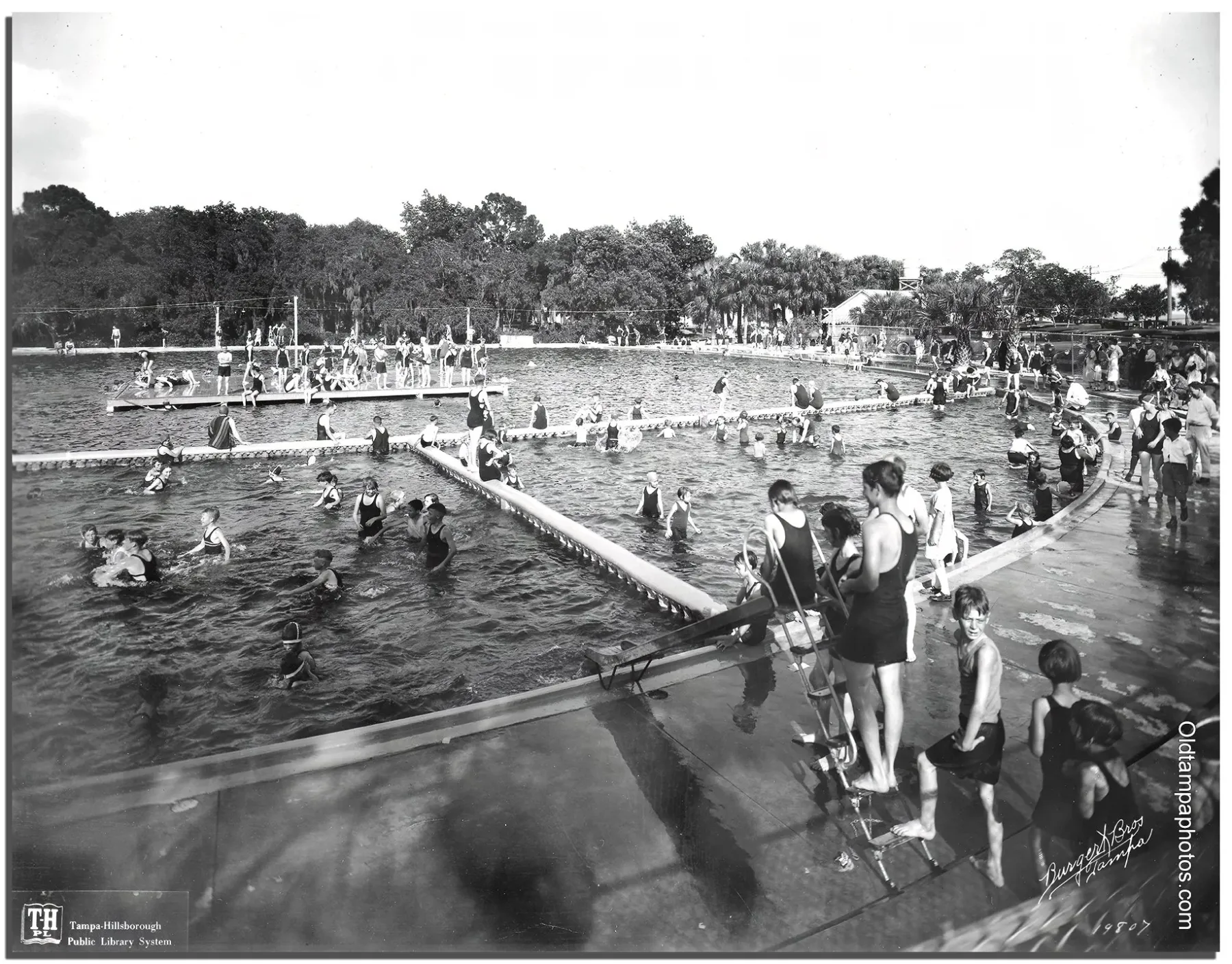
The whole draw was that one number. Seventy-two degrees, all day, every day, in a place where the air won’t hand you that for months at a time. On a July afternoon, that water felt like a different planet — and the pictures show what that was worth. Look at the crowd up there: kids packed in shoulder to shoulder in heavy wool swimsuits, a diving board, walkways laid across the water just to fit everybody in.

You rode out to get cold
And here’s the part that’s easy to miss from a cooled living room: getting there was a whole trip. The spring sat about three miles down Bayshore from downtown, out where the city gave way to country, and the streetcar ran right to it. The electric company advertised the pools in the paper — ride our line, cool off at the spring — because the streetcar is how most people would get there in the first place.
Cold was a destination. You packed a swimsuit and you traveled to it, the same way you’d pack up and go to the beach. The idea that cool air was something you could just have, at home, whenever — that wasn’t on the table yet. You went to where the cold already was.

A developer, and a name nobody can quite explain
Then the houses came. A developer named Thomas Palmer bought up the land around the spring and laid out a neighborhood right on top of the thing people were already coming for. He gave it a name that sounds Spanish but isn’t quite — Palma Ceia — and to this day nobody is really sure what it’s supposed to mean. He hung old Havana street names on the blocks. The postcards spelled the spring itself “Palmaceia,” all one word.
However you read the name, the shape of the thing is plain enough. The neighborhood was built around the cold. The spring was the amenity before anybody used the word — the reason to live out there, three miles from town, instead of somewhere closer in.
Then somebody put the cold in a box
Here’s the turn the whole story was waiting on. Along came the machine. Window units reached ordinary houses in the 1950s, and the central systems that followed finished the job. Cold stopped being a place you went to and became a thing you owned. Seventy-two degrees now came out of a box in the bedroom window, at midnight, in your pajamas, in July.
So why ride a streetcar three miles to sit in a spring? You wouldn’t. Nobody did. And just like that, the most valuable thing in South Tampa wasn’t valuable anymore — not because the spring had changed one degree, but because suddenly everyone could make what it made, in their own house, without going anywhere at all.
The spring never stopped being seventy-two degrees. The world just learned how to make seventy-two degrees anywhere — and quit driving out to borrow it.
The slow quiet
The pool had been having a hard time anyway. There was a typhoid scare in the twenties that the health officials eventually knocked down. By local accounts a ten-year-old boy, Walter Valle, drowned in the unattended pool in 1935, and the neighborhood pushed to have it drained. After the war the water went bad with pollution, and the city finally filled in the last of the old pool at the end of the fifties — and the story goes they had to run off a five-foot alligator that had moved into the water nobody was swimming in anymore.
But the spring underneath it never actually quit. It kept welling up cold under the fill, the way it always had, with no crowd left to notice.

What’s still there
In the 1940s a local official named Fred Ball talked Hillsborough County into buying the spring, and in time it became Fred Ball Park. The old round basin got rebuilt. Stand there now and you can line it up against the hundred-year-old postcard — the same ring of stone, the same palms, the same water welling up in the middle of it.

The water’s gone green and quiet, and a small fountain stands where the crowd used to wade. It hasn’t had an easy time of it — but neighbors and a garden club have spent years keeping the old spring from going under for good, which is about the only reason it’s still welling up at all.

And it’s still seventy-two degrees. Same as the afternoon the streetcar let out a crowd of kids in wool swimsuits, same as right now. The only thing that changed is that seventy-two degrees stopped being a reason to go anywhere. Every house on the streets named for that spring makes its own, all day, without a soul thinking about it — which leaves the cold that built the whole neighborhood bubbling up right in the middle of it, in the one spot in Palma Ceia where nobody goes to cool off anymore.