Ozona · Pinellas County, Florida  ·  A Local History

The Town That Named Itself After the Air


In the middle of a yellow-fever panic, a little Gulf-coast settlement threw away the name Yellow Bluff and called itself Ozona — “pure air” — back when the breeze off the sound was the only cooling anyone had, and the only medicine anyone trusted.

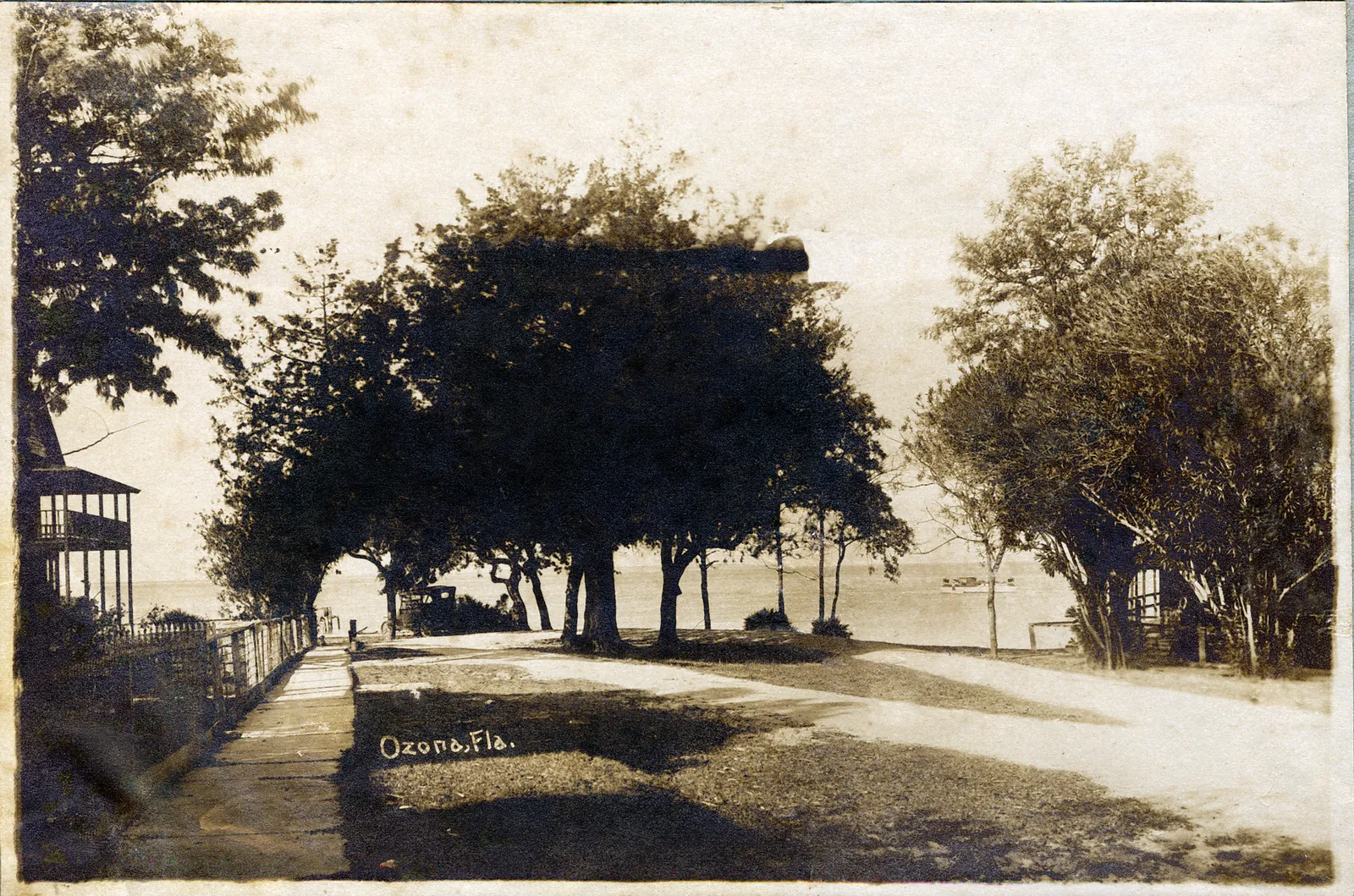
A sepia-toned early-1900s photograph of a sandy Ozona street running under a long canopy of live oaks toward the open water at the end, with a low fence along one side.
Ozona, Fla. — the whole town kept to the shade
An Ozona street under the oaks, looking toward St. Joseph Sound, around the early 1900s. Before anyone could make cool air, the shade and the breeze off the water did the whole job. Historic view, Ozona Village Improvement Society collection (ozonavillagefl.us).

Here is a thing a town can do when it is desperate enough: it can change its own name because the name has the wrong kind of air in it. That is more or less what happened on this quiet stretch of the Gulf coast. For a few years the place was called Yellow Bluff, after the pale sand along the shore. Then, late in the 1880s, the whole country caught a fever — and anything with the word yellow in it started to sound like a death sentence.

So the townspeople did the only sensible thing. They picked a new name that sounded like the opposite of sickness. They called it Ozona — “pure air.”

And that tells you almost everything about how people lived here before the machine showed up. Because back then the air wasn’t a detail you adjusted. It was the product. It was the cure, the comfort, and the whole reason to be standing on this shore at all. A town that stakes its name on “good air” is a town that has nothing else to cool itself with.

When the cool was something you went outside to find

Picture this coast with no air conditioning anywhere — not in a house, not in a store, not in a single room for a hundred miles. From about May to October the heat comes down thick and wet and just sits there. That was ordinary life, and people got clever about the only thing that worked.

You didn’t make cool air. You went and found it. The first families built right up on the little bluff, where the ground was a touch higher and the wind off St. Joseph Sound could reach them. They wrapped the houses in deep porches to keep the sun off the walls, let the live oaks grow up thick overhead, and kept to the shady side of the street. When the day was at its worst, you did what everybody did: you waited for the evening, when the breeze finally came in off the water.

A sepia photograph of Ozona homes set well back behind a low white fence, almost hidden under tall live oaks, with a dirt road in the foreground.
Big porches, bigger oaks — Ozona, Fla.
Houses behind the white fence, tucked under the oaks in early Ozona. The shade was worth more than the view; a porch and a good tree were the closest thing to a thermostat anyone owned. Historic view, Ozona Village Improvement Society collection.

It sounds romantic now. It mostly wasn’t. It was a life arranged, start to finish, around dodging the heat — where you built, which way the house faced, where you put the beds, what time you did the hard work. The whole town was one long negotiation with the weather, and the weather usually won.

Then the railroad arrived and changed who got to come try it.

A historic black-and-white photograph of an Orange Belt Railway steam locomotive with a crew, stopped beside a depot, lettering visible on the tender.
The Orange Belt line — it brought the winter people
An Orange Belt Railway locomotive. The line reached this part of upper Pinellas in 1887, and suddenly a remote fishing settlement was a place Northerners could ride straight into — most of them chasing the climate. Historic photograph, via FOX 13 Tampa Bay.

In 1887 the Orange Belt Railroad pushed down into this part of upper Pinellas, and a place that used to be two hard days from Tampa was suddenly on the map. The trains came loaded with people who had never owned a square foot of Florida and were about to. A lot of them weren’t coming for land at all. They were coming for the air.

The fever that cost the town its name

To understand why a town would rename itself after a breeze, you have to remember what people believed back then about why they got sick. The idea of the day was that disease rode in on bad air — a rotten, swampy vapor that settled over a place and made everyone in it ill. Good air, by the same logic, was medicine. If you could just get yourself to clean, moving, high, salty air, you’d be safe.

So when yellow fever tore through Florida in the late 1880s — the worst of it up in Jacksonville, where whole streets emptied out — people did some strange things to the air to fight it. They burned barrels of tar in the streets at night to “disinfect” it. They fired guns into the sky, hoping to shake the sickness loose. None of it did a thing, because the fever wasn’t in the air at all. It was in the mosquitoes, and nobody knew it yet.

An 1888 newspaper engraving captioned 'The Sand Hills Hospital, looking west,' showing low frame buildings and figures at a yellow-fever hospital outside fever-stricken Jacksonville.
The scare that renamed a town — Jacksonville, 1888
A fever hospital outside “fever-stricken Jacksonville,” 1888. The epidemic that panicked the whole state is what made the name Yellow Bluff suddenly unlivable. Period engraving, U.S. National Library of Medicine, The Politics of Yellow Fever.

Down on the coast, the little settlement called Yellow Bluff had a marketing problem it couldn’t afford. In a year when the whole country flinched at the word, nobody was going to buy a lot, book a winter, or move a sick wife to a town whose name sounded like the thing that was killing people. And so, around 1888, Yellow Bluff became Ozona. The new name pointed straight at the one thing the place could actually sell: the fresh, salt breeze coming in off the sound, the kind of air everyone then believed could heal you.

They weren’t just renaming a post office. People genuinely moved here to get well — some of them convinced the very water of St. Joseph Sound had something curative in it. The town was selling comfort and health as the same thing, and both of them were made entirely of air.

Strip away the century and the town’s whole comfort plan was four words long: find the shade, catch the breeze.

And here’s the part that lands a little strangely, knowing what came later. The great fever finally broke that autumn — not because the air got any purer, but because the cold came. A hard frost rolled in, killed off the mosquitoes, and the dying stopped. The thing that actually saved everyone wasn’t the right air. It was a drop in temperature. It would take two more generations for anybody to figure out how to make that cold on purpose.

A town that lived and died by the weather

Ozona made its living two ways, and both of them were just arguments with the same heat. Out on the ridges behind town, settlers planted citrus; down on the water, they fished. The groves were a gamble against the cold — a couple of brutal freezes came through in those early years and wiped the trees out more than once. The fishing was a gamble against the warmth, a daily race to get the catch onto ice and onto a train before the Florida afternoon could spoil it.

A black-and-white real-photo postcard of a Florida orange grove, rows of heavily-laden citrus trees along a sandy lane, captioned as a grove near Dunedin.
The groves the freezes kept killing
An orange grove near Dunedin, Ozona’s next-door neighbor. The coastal ridge grew good fruit — until a hard freeze came through and the growers started over. Real-photo postcard, via cardcow.com.
A historic black-and-white photograph of commercial fishermen hauling a long seine net full of mullet up onto a Gulf-coast beach.
Hauling the net — racing the heat to the train
A Gulf-coast net haul. Commercial fishing was the town’s other backbone, and the whole job was a race: get the catch cold and shipped before the afternoon turned it. Historic Gulf mullet-fishing photograph (gulfseafoodnews.com); representative of the era, not Ozona specifically.

Everything bent back to the same two facts. Keep the fruit from freezing. Keep the fish from cooking. A whole economy balanced on the edge of a few degrees in either direction, with nothing to lean on but the seasons and the weather off the water.

A nautical chart titled 'Tampa Bay and St. Joseph Sound,' dated 1932, showing the Gulf coastline, depth soundings, and the shallow sound that Ozona fronts.
St. Joseph Sound — the water they came to be healed by. 1932
Tampa Bay and St. Joseph Sound, on a 1932 coast chart. The shallow, bright sound in front of the town was the thing people believed in — the source of the healing air and the water the new name was built around. U.S. coast chart reproduction, 1932.

The town held together anyway. The women of Ozona organized an improvement society in the 1890s, raised the money themselves, and put up a wooden village hall — a cool, shaded place to gather in a town that had no cool rooms at all. It’s still standing. A good deal of old Ozona is.

And then the cool came indoors

The strange, lopsided deal the town lived under — good air outside, nothing but heat once you shut the door — didn’t last forever. The same basic trick that frost had pulled off by accident in 1888, pulling the warmth out of the air, kept getting smaller and cheaper and more reliable, until one day it fit in a window.

A 1956 General Electric magazine advertisement for the slim 'Thinline' room air conditioner, showing a family relaxing in a cooled living room.
The cool, boxed up and brought indoors — 1956
A 1956 room air-conditioner advertisement. By the 1950s the thing Ozona had chased outdoors for seventy years could be bought in a box and set in the wall. Advertisement in Time, 1956. General Electric, public domain, via Wikimedia Commons; shown to mark the arrival of home cooling, not Ozona specifically.

By the 1950s and ’60s a family in Ozona could buy a unit, drop it in the window, close up the house, and sit in a cool room on the worst afternoon in July. No bluff, no evening wait, no shady side of the street. The cool wasn’t a place you traveled to anymore, and it wasn’t a gift the sound handed you at dusk. It was just there, in the room, humming, whether you’d earned it that day or not.

And so the porches slowly went quiet. The whole elaborate art of staying cool without a machine — the oaks, the high ground, the deep verandas, the patience — turned into decoration. The town had spent its entire life learning to find good air. Now you could manufacture it, and the finding stopped mattering.

A present-day photograph of a person wading in the shallows of St. Joseph Sound at sunset, a fishing dock silhouetted against the bright water.
Still the same water, still the same breeze
St. Joseph Sound at dusk, today. The breeze the town was named for still comes in off this water every evening — it’s just that nobody has to wait for it to get comfortable anymore. Present-day photograph, Ozona Village Improvement Society collection.

What stayed

Ozona had one last trick, though: it refused to disappear. The groves finally gave out and the last commercial fishermen packed it in a couple of decades ago, and the town could easily have been bulldozed into another stretch of subdivision. Instead it held on as one of the few places in the county that still looks like a turn-of-the-century Florida village — the oaks, the plain wooden houses, the fish camp on the water, the little hall the women built. The old railroad bed is a walking trail now. The sound is right where it always was.

A present-day aerial view of the Ozona fish camp and marina, docks and small boats reaching out into the calm water of St. Joseph Sound.
Ozona today — the fish camp’s still on the water
The Ozona fish camp, present day. A working remnant of the town’s fishing century, still tied to the same sound that gave the place its name. Photograph via florida-backroads-travel.com.

And the name stayed too. It’s still Ozona — still, right there in plain sight, “pure air.” Except now the air that actually makes the town livable through August doesn’t come off the Gulf. It comes out of a box in the window, or a condenser humming beside the house, in Ozona exactly the same as everywhere else in Florida.

A vintage-postcard aerial view of Ozona, a green peninsula of streets and homes wrapped on nearly every side by the blue water of St. Joseph Sound.
A town wrapped in air and water — just like the name says
Ozona from the air, a vintage aerial postcard. Streets and oaks on a low peninsula, the sound on nearly every side — the whole place is built around the air and water it was named for. Vintage postcard, via florida-backroads-travel.com.

The people who crossed out Yellow Bluff and wrote Ozona had it right, in the end. Air really was the whole thing — it decided where they built, how they lived, whether they got well, whether they stayed. They just happened to bet on it a little early, back when the only way to get good air was to go stand where the breeze was. The machine that finally made them right showed up two generations after they picked the name.

A present-day note · I Know A Guy AC

Ozona bet its whole name on good air. Keeping a home full of it is still the entire job.

That’s the thread that runs the length of this place — from the bluff and the porches to the day the first window unit went in. The whole story of Ozona is really one long argument with the Florida heat, and for most of it the best a family could do was chase the shade and wait for the evening breeze off the sound.

Keeping a Tampa Bay home cool is still exactly that job, just handed to a machine instead of a tree. We do it with real equipment now — a system sized and set up for your actual house, so a Pinellas County August turns into something you only feel for the few steps between the car and the front door. When it’s working, you forget it’s there, the same way the old town forgot to be grateful for a good oak.

Right up until the afternoon it quits — and it always picks the hottest one. When that happens, you’ve got an easier move than any of those porch-sitters waiting on the sundown air ever did. You don’t have to go anywhere to find the cool. You make one call, because for keeping a home full of good air the modern way… we know a guy.

See what a new system costs→
Sources & Photo Credits

On the history

Photographs

  1. Ozona street under the oaks, looking toward the sound (HERO, historic) — Ozona Village Improvement Society collection (ozonavillagefl.us). File: ozona-oak-street-to-sound-historic.
  2. Ozona homes behind a white fence under the oaks (historic) — Ozona Village Improvement Society collection. File: ozona-homes-white-fence-oaks-historic.
  3. Orange Belt Railway locomotive (historic) — via FOX 13 Tampa Bay (fox13news.com). File: orange-belt-railway-locomotive.
  4. “The Sand Hills Hospital, looking west” — fever-stricken Jacksonville, 1888 (period engraving) — U.S. National Library of Medicine, The Politics of Yellow Fever exhibition (nlm.nih.gov). Shown to illustrate the 1888 epidemic that prompted the renaming; not Ozona. File: yellow-fever-jacksonville-1888.
  5. Orange grove near Dunedin, Florida (real-photo postcard) — via cardcow.com. Ozona’s neighboring town; representative of the coastal-ridge citrus the freezes destroyed. File: dunedin-orange-grove-postcard.
  6. Gulf-coast mullet net haul (historic) — via gulfseafoodnews.com. Representative historic Gulf commercial fishing, not Ozona specifically. File: gulf-mullet-net-haul-historic.
  7. Tampa Bay and St. Joseph Sound coast chart, 1932 (document) — reproduction of a 1932 U.S. coast chart. File: st-joseph-sound-chart-1932.
  8. St. Joseph Sound at dusk (present day) — Ozona Village Improvement Society collection. File: st-joseph-sound-wade-today.
  9. General Electric “Thinline” room air-conditioner advertisement (1956) — General Electric, published in Time, 1956. Public domain, via Wikimedia Commons. Shown to mark the arrival of home air conditioning; not Ozona specifically. File: ge-room-air-conditioner-1956.
  10. Ozona fish camp and marina (present day) — via florida-backroads-travel.com. File: ozona-fish-camp-today.
  11. Ozona from the air (vintage aerial postcard) — via florida-backroads-travel.com. File: ozona-aerial-vintage-postcard.

Present-day photographs are identified as modern; period images carry their known or approximate dates. Where an image is representative of the era rather than of Ozona itself — the Dunedin grove, the Gulf mullet haul, the Jacksonville fever engraving, and the 1956 air-conditioner advertisement — this record says so rather than implying a false location. Where the record is uncertain or conflicting — the exact year of the name change (1888 vs. 1889) and the precise meaning attached to “Ozona” — the page hedges rather than choosing the tidiest version. Untouched original downloads are kept alongside this page in assets/images/originals/ with a full research record in source-record.md. No image’s factual content was altered; the print frames and handwritten notes are CSS added around the photographs, never onto them. Any owner who would like an image removed need only ask.