Oldsmar, Florida  ·  Old Tampa Bay  ·  A Local History

The Carmaker Who Tried to Beat the Heat With a Map


In 1916 the man who put America on wheels bought a stretch of Old Tampa Bay and aimed an entire town at the water — because the breeze off the bay was the only air conditioning anyone had. He was about forty years early.

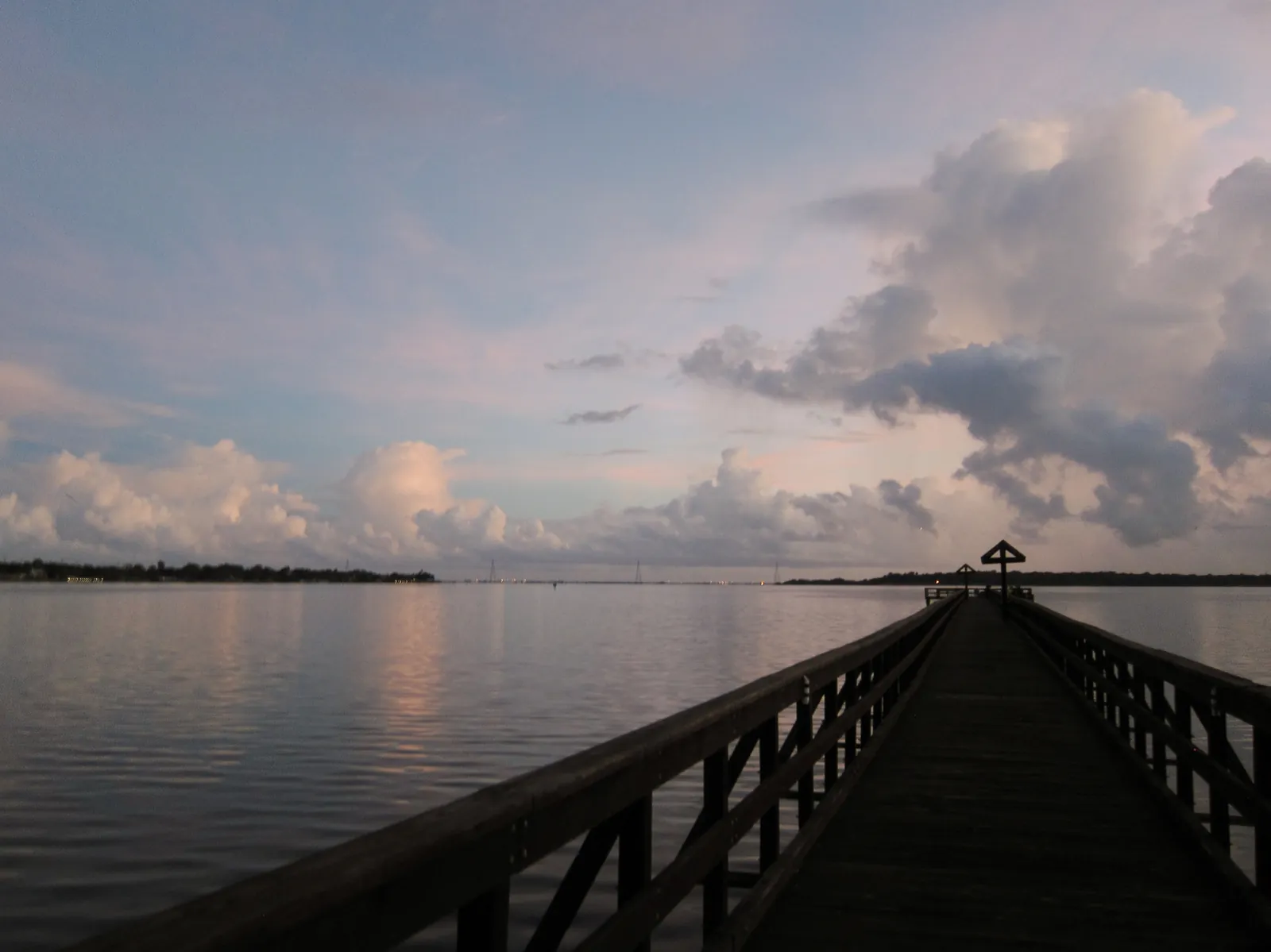
A long wooden pier reaching straight out into the calm water of Old Tampa Bay under a wide pink-and-grey dusk sky, Oldsmar, Florida.
Old Tampa Bay — the only air conditioning anyone had
A pier out into Old Tampa Bay at Oldsmar (present-day photograph). The whole town was laid out to face this water, because the breeze coming off it was the closest thing to cool air a Florida summer offered. Photo via Wikimedia Commons (Panoramio archive).

In the spring of 1916, the man who had just finished putting America on wheels stood on a buggy, low stretch of shoreline north of Tampa and decided he was going to build a city on it. Ransom E. Olds had the money, the land, and a street plan drawn up to look like a little Washington, D.C. What he was actually up against was the month of July.

Olds was not a dreamer by trade. He was close to the opposite — a machine man, maybe the best one in the country at the time. To understand what he thought he was doing on that shoreline, you have to know what he’d already done up north.

The machine man

A sepia studio portrait of a young Ransom E. Olds in a dark suit, seated, resting his forehead on one hand as he looks down at a sheaf of papers.
The man who put America on wheels
Ransom E. Olds, circa 1901. Founder of Oldsmobile and, later, the REO Motor Car Company. Photograph via Wikimedia Commons; public domain.

Before there was a Ford assembly line, there was an Olds one. He built the Curved Dash Oldsmobile — the first low-priced car made in anything like real numbers — and he did it by moving the work past the men instead of marching the men around the work. A progressive assembly line, running in Lansing a few years before Detroit made it famous. Then he walked away from his own company, started over, and built the REO. By his fifties he had done the hard thing twice and had a fortune to show for it.

A restored 1902 Curved Dash Oldsmobile, a small open horseless carriage with large spoked wheels and a curved front footboard, on display.
The little car that made him rich. 1902
A Curved Dash Oldsmobile, 1902 model. The first mass-produced, low-priced American automobile — the machine that built the fortune Olds carried to Florida. Photograph via Wikimedia Commons.

So when Olds finally looked south at Florida, he looked at it the way he looked at everything else: as a problem he could engineer his way through. Hot, empty, a little hard to live in — fine. He’d made cars cheap and factories fast. How hard could a town be?

A long two- and three-story brick automobile factory with a tall water tower, seen from a wide dirt street with utility poles, in the early 1900s.
His real trick: the moving line. Lansing
The Olds Motor Works, Lansing, Michigan (early 1900s). The plant where Olds proved a machine-age idea — move the work, not the worker — that would reshape American manufacturing. Detroit Publishing Company; public domain, via Library of Congress / Wikimedia Commons.

A city pointed at the breeze

He bought more than thirty-seven thousand acres on Old Tampa Bay and named it, with no particular modesty, R. E. Olds-on-the-Bay. Pretty soon it was just Oldsmar. He had the streets laid out in a fan, like spokes on a wheel, and he set the hub of that wheel right on the shoreline — so that nearly every road in town ran downhill to the water.

An aerial view of modern Oldsmar, a town of streets and rooftops spread along the curving edge of Old Tampa Bay, with summer clouds piled overhead.
Still aimed at the water
Oldsmar from the air (present-day photograph). The town still sits where Olds platted it, hard against the edge of Old Tampa Bay. Photo via Wikimedia Commons.

That wasn’t decoration. Read the plan again and it’s a cooling system.

There was no such thing as air conditioning in a house in 1916. The way you got through a Florida summer was the way people always had: shade, a high ceiling, a deep porch, and a breeze — and on this coast the breeze came off the water nearly every afternoon, like something on a schedule. Olds pointed his whole town at it. Ten miles of bay-front, and every street a funnel aimed at the one bit of cool air anybody could count on.

An old black-and-white photograph of three men, one mounted on a horse, standing among rows of corn that tower well above their heads.
“Health, Wealth and Happiness” — sold by the acre
Corn grown taller than a man on horseback, an Oldsmar promotional photograph from the town’s founding era. Olds’s company planted farms and groves to prove the ground was rich. Via Wikimedia Commons (date as filed is uncertain; see the record below).

He sold the place as “Oldsmar for Health, Wealth and Happiness.” He put in farms and citrus groves to prove the dirt was worth something, and ran photographs of corn grown taller than a man on a horse. He built a sixty-room hotel, the Wayside Inn, and brought winter tourists down on the train — he and his wife were the first guests when it opened in 1917. Winter. That was the tell. Florida in the cool months sold itself. The summer was the part nobody put on a postcard.

The summer wins

And the summer, more or less, is what beat him.

A 1921 black-and-white photograph of a bay-front boardwalk and bungalow smashed into splintered wreckage by a hurricane, with bent palms and figures picking through the debris.
October 1921 — the bay came back for it
Wreckage along Old Tampa Bay after the hurricane of October 1921. The storm drove the bay well above its banks and tore through the low, water-facing towns around it. Burgert Brothers / public domain, via Wikimedia Commons. A Tampa-area view of the same storm that struck Oldsmar.

In October of 1921 a hurricane shoved the bay roughly fourteen feet above where it was supposed to sit and sent all that water straight through the low, pretty town Olds had aimed at it. Then came the bridges — the Gandy, and later the causeway across the bay — giving travelers a quick way into Tampa that skipped Oldsmar entirely. The winter tourists suddenly had somewhere else to be.

But under the storm and the bridges was the plain thing no street plan could fix. You could sell a man a lot on the bay for the winter. Getting him to stay through August, year after year, with nothing but a porch and a hope for a breeze — that was the harder sale, and Olds never closed it. He’d pictured a city of a hundred thousand people. A couple hundred showed up. He poured in a fortune, finally let it go, and the town got discouraged enough that it swapped his name out for “Tampa Shores” for a decade before it took him back.

One machine too early

A white Frigidaire window air-conditioning unit mounted in the opening of a house wall, with electrical conduit running along the siding beside it.
The machine he never got to buy
A window air-conditioning unit. Around 1953, boxes like this got cheap enough for ordinary families and sold by the million — the thing that finally made year-round Florida easy. Present-day photograph via Wikimedia Commons.

Here’s the part that would have stung a man like Olds.

The thing that finally made living in Florida year-round ordinary wasn’t a bridge, or a sea wall, or a smarter grid of streets. It was a box you shoved in a window. The window air conditioner got cheap enough for a regular family right around 1953, and once it did it sold by the million, and the whole state quietly filled in behind it. People stopped needing the porch, the bay breeze, the tall ceilings. They shut the windows and turned a dial.

Olds died in the summer of 1950, up in Lansing, at eighty-six. The one machine he’d needed to win his Florida bet showed up about three years after the funeral. Of all the men who’d have appreciated that it took a machine, and not a map, to beat the heat — he missed it by a hair.

What the water kept

A restored 1920s two-story Mediterranean Revival house with pale stucco walls and a red tile roof, set behind a green lawn and palms in present-day Oldsmar.
Still standing — cool now, behind the walls
A 1920s Oldsmar house, restored (present-day photograph). Houses from Olds’s era still stand among the new ones — shut up tight and cooled now, against a heat nobody waits out on the porch anymore. Photo via Wikimedia Commons.

Oldsmar did just fine without him, in the end. It took its name back in 1937 and grew the way all of Florida grew once the air turned cold indoors — into a real city of tens of thousands, the old 1920s houses folded in among the new ones, every last one of them sealed up and cool against a summer their first owners simply lived inside of.

He built a whole town to catch a breeze, about forty years before you could buy the same thing in a box.

The fan-shaped streets are still there, though, and they still run down to the water. On the shore where the hub of Olds’s wheel was meant to go, there’s a park now with his name on it and a long pier out into Old Tampa Bay.

A round carved sign reading 'R.E. OLDS PARK' set in low green shrubbery beside a small stone pillar in present-day Oldsmar.
His name, on the water he aimed at
R.E. Olds Park, on the Oldsmar waterfront (present-day photograph). The park sits where Olds set the center of his fan-shaped town, on the bay he built the whole plan around. Photo via Wikimedia Commons.

Stand out on that pier on a hot afternoon and the same breeze he built a town to catch still comes up off the water, right on schedule, the way it did for people who had no machine and no choice. It was never quite enough to raise a city on. He wasn’t wrong about the cool air — he was just early. It was real, and it was coming. It was only about forty years down the road, and it arrived in a box.

A present-day note · I Know A Guy AC

Olds tried to beat the heat with a map. Turns out it takes a machine.

Ransom Olds aimed a whole town at the bay because that breeze was the only cooling anyone had in 1916 — and it still wasn’t enough to keep people here through the summer. He had one half of it right and the other half early. The cool air was coming. It just had to show up as equipment instead of architecture.

A hundred-odd years on, keeping an Oldsmar house cool through a Florida August is still the whole job. We just do it the way Olds couldn’t — with a real system, sized and set up for your house, so you never have to think about the heat the way those first families on the bay thought about it every single afternoon.

So when the machine that’s been quietly handling your summers finally picks the hottest day in July to quit — and that’s the day it picks — you’ve got an easier move than anybody Olds ever sold a lot to. You don’t have to chase the shade or wait on the bay. You make one call, because for keeping an Oldsmar home cool the modern way… we know a guy.

See what a new system costs→
Sources & Photo Credits

On the history

Photographs

  1. Pier into Old Tampa Bay at Oldsmar (present-day, HERO) — via Wikimedia Commons (Panoramio archive). Clearly a modern image. File: oldsmar-bay-pier-today.
  2. Ransom E. Olds, portrait, circa 1901 — public domain, via Wikimedia Commons. File: ransom-olds-portrait-c1901.
  3. Curved Dash Oldsmobile, 1902 model — photograph of a preserved example, via Wikimedia Commons. Represents the car type, not a specific Oldsmar vehicle. File: curved-dash-oldsmobile-1902.
  4. Olds Motor Works, Lansing, Michigan (early 1900s) — Detroit Publishing Company; public domain, via Library of Congress / Wikimedia Commons. File: olds-motor-works-factory.
  5. Giant corn, Oldsmar promotional photograph — via Wikimedia Commons. The file is titled “12 foot corn — Oldsmar, Florida, 1900 (circa),” but Oldsmar was not founded until 1916, so the filed date is unreliable; used here as a town-promotion image of the founding era, labeled as such. File: oldsmar-giant-corn-promo.
  6. Aerial view of Oldsmar (present day) — via Wikimedia Commons. File: oldsmar-aerial-today.
  7. Hurricane wreckage along Tampa Bay, October 1921 — Burgert Brothers / public domain, via Wikimedia Commons. A Tampa-area view of the 1921 storm that also struck Oldsmar; not an Oldsmar-specific photograph. File: tampa-1921-hurricane.
  8. Window air-conditioning unit (present-day photograph) — via Wikimedia Commons; a modern image of a window unit, standing in for the mid-century machine described. Cropped to the unit. File: window-ac-unit.
  9. Restored 1920s house, Oldsmar (present day) — via Wikimedia Commons. File: oldsmar-1920s-home-today.
  10. R.E. Olds Park sign, Oldsmar waterfront (present day) — via Wikimedia Commons. File: reolds-park-sign-today.

Present-day photographs are identified as modern. Where a period Oldsmar image was unavailable, a clearly-labeled Tampa-area or representative image of the same era is used in its place, and said so. Original downloads and a full research record are kept alongside this page in assets/images/originals/ and source-record.md. No photograph’s factual content was altered; the print frames and handwritten notes are CSS added around the images, never onto them. Any owner who would like an image removed need only ask.