There’s a story about this town that nobody can prove, and it’s the one the town is named after. A chief was sick — dying, the way some people tell it — and a medicine man carried him to a spring that pushed up out of the ground inside a ring of rocks. The chief drank the water, and the water made him well.
For years after, so the story goes, his people came back to those rocks — to fish the shore and to drink from the spring that had healed him. The settlers who turned up later heard all of it, looked at the circle of rock, and called the place Indian Rocks.
How much of that is true, nobody can say. The people who keep this town’s history will tell you flatly that the real origin of the name is lost. But sit with the story for a second, because underneath the legend there’s something that isn’t legend at all.
Every version of it — and there are a few — is about the same single idea. People coming to this water to be made better. That turns out to be the whole history of the place, told about a hundred years early.
The water that was supposed to cure you
Long before anyone laid out a street here, the people the stories came from were already on this coast. The Tocobaga lived around Tampa Bay, and like native people all over Florida they knew the springs. Mineral water that came up cool and heavy and strange-tasting was treated as medicine — you traveled to it the way you’d go see a doctor now.

The spring that supposedly gave Indian Rocks its name is said to have bubbled up about where Kolb Park sits today, across from the modern city hall. It was a sulfur spring — which means it almost certainly smelled like a struck match and a rotten egg, the kind of water you only believe is healing you because nothing that unpleasant could be anything else.
You can’t go find it now. The spring is gone, and what’s left of it is the name — repeated so many times that nobody hears what it’s actually saying. It’s saying this was a place you came to for the water.
Tampa’s playground across the bay
By the early 1900s the people doing the traveling weren’t coming for a spring anymore. They were coming for the Gulf. And most of them were coming from Tampa.
A Tampa summer, before air conditioning, was its own kind of affliction. The city sat inland and baked, and there was no cool room to escape into — not in the house, not in the store, not anywhere a person spent their day. The one cure you could actually reach was the oldest one on this coast: get to the water, get into it, and stand where the breeze comes off the open Gulf until the heat finally lets go of you.

Indian Rocks became the place Tampa went to do exactly that. They called it Tampa’s playground, and they meant it plainly — you left the hot city behind, crossed the bay to the beach, and came back feeling like a person again.
One of the early settlers, a man named Horace Hamblin, put the whole appeal of the place into a single line back in 1914: “Indian Rocks Beach, where the surf sings one to sleep.” He was selling the same thing the spring had sold. He’d just moved the cure to the shore.
Getting to the cure
The catch was getting there. The beach sits on a barrier island, Sand Key, with a run of open water between it and the mainland. For a long while the only way across was by boat — visitors came down by train and were ferried over to the sand.

Then the railroad came closer. Around 1914 the Tampa & Gulf Coast line ran a spur down toward the beaches, and the trickle of summer visitors turned into a crowd.

Two years later the island finally got its first bridge across the Narrows. And it was a wonderful, fiddly contraption: a swing bridge that a man opened with a giant key, cranking the whole span sideways so a boat could slip through, then cranking it back. That was the literal gate to the cool.

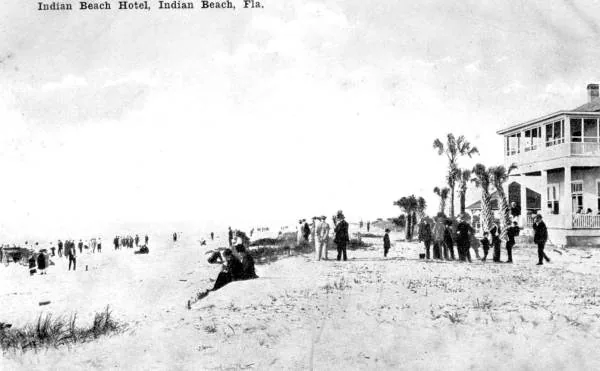
Once you could drive to it, the beach filled up with places to spend the weekend. There was the Indian Beach Hotel, pulling guests down from Tampa all summer. There was a bath house a man named Brandon bought in the early twenties and turned into the Indian Rocks Inn, so you could change, rinse the salt off, and spend the whole day moving between the shade and the water.
That was the shape of comfort here, and it held for decades. You didn’t cool a room, because you couldn’t. You went to where the cool already was, and you stayed in it for as long as the day would let you.
The cure that came in a box
What finally changed it did the one thing the healing spring never could. It gave people relief that didn’t depend on the season, or the breeze, or how close you happened to live to the shore.
After the war, air conditioning started turning up in ordinary Florida life — first the movie houses, then the shops, and then the big one, the house. You could buy a unit, set it in a window, shut the place up tight against the very heat the whole town had been built to flee, and make yourself a cool afternoon in the middle of July.

For the first time in the history of this coast, the cool came to you. You didn’t have to go anywhere to find it. It sat in the window and hummed, and it didn’t care what month it was.
And here’s the part people expect to go the other way. It didn’t empty the beach out. It did the opposite.

Once you could actually live here year-round, people did. The seasonal playground filled in with motels, then condominiums, then the snowbirds who came for one winter and never went home. At the peak, a single roadside attraction up the beach — Tiki Gardens — was pulling around 300,000 visitors a year. The town the heat used to empty every summer became a place you could stay in through every summer, because the summer had finally been tamed indoors.
What the name still says
Indian Rocks Beach is a real year-round town now, packed close in places. The spring is gone. The old swing bridge is gone. The Indian Beach Hotel is gone. Even the word “Beach” is a latecomer — it wasn’t added to the name until 1949.

But stand on that sand on a July evening and the oldest thing about the place is still right in front of you. People in the water, cooling off, the same way the stories say the Tocobaga once did. The only difference is that when they’ve had enough, they walk back to a cool car and a cool house — and the relief doesn’t stop at the waterline anymore.
The town was named, by legend, for water that was supposed to heal you. The thing that finally made a Florida summer something you could live inside of showed up a little late to get its name on anything — and it didn’t bubble up out of the ground. It came in a box, and it hummed.