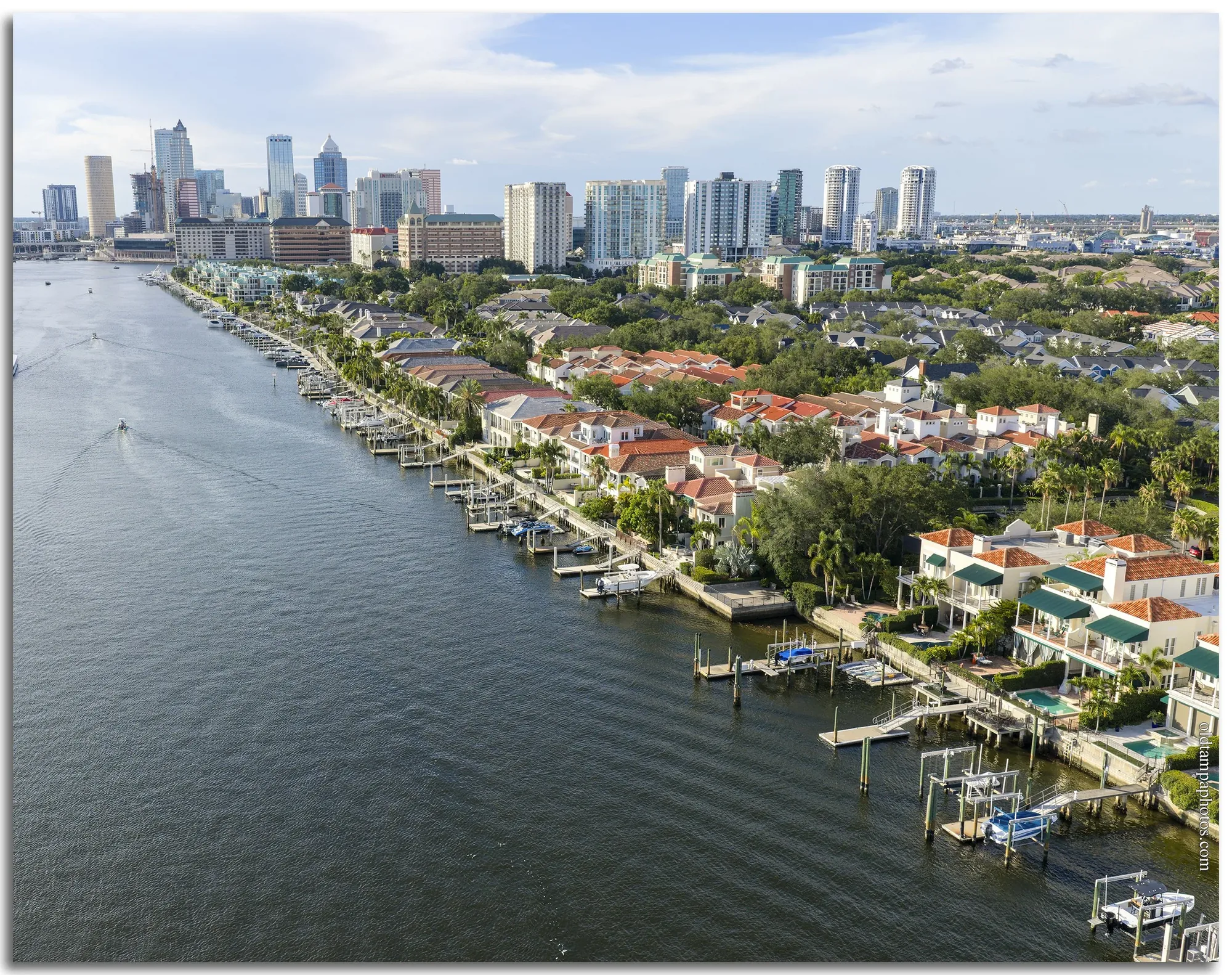
There’s an island in the middle of Tampa where the houses have a water view on every side, and almost nobody opens a window to enjoy it. Red tile roofs, boat lifts, palms, the downtown skyline sitting right across the channel — Harbour Island is about as pleasant a spot as the city has. Which is a strange thing to have become, because for most of a hundred years this exact patch of ground was the one place in Tampa nobody pretended was pleasant at all.
This wasn’t a neighborhood that lost its charm and clawed it back. It never had any charm to lose. It was a factory floor with water around it — a man-made island whose entire reason to exist was heat, dust, and phosphate. So how does a place like that turn into the kind of address people pay a fortune to sleep on?
It started as somewhere to put the sand
Seddon Island didn’t exist before about 1906. When Tampa set out to deepen its harbor, the dredges that cut the channel had to put all that sucked-up sand and muck somewhere, and they piled it into a brand-new island out in the bay. A Seaboard Air Line railroad engineer named W.L. Seddon got the credit for the plan, and the island took his name in 1909 — the same day the railroad’s terminals opened on it.

From the first day it had one purpose. Freight trains rolled out onto it over a steel drawbridge, and the island loaded phosphate — Florida’s great chalky export — into the holds of ships bound for the far side of the world. That was it. A place where rock got moved from land to sea, by the millions of pounds, under an open sky.
A job with no shade in it
Here’s the part worth sitting with, because it’s the whole point. Everywhere else in Tampa, people had worked out how to get through the heat — barely. The city cooled itself outdoors. You found the breeze off the water, you sat on the porch until the air finally moved, you got in the bay when it got bad. The neighborhoods going up across the channel were literally sold on it: buy a lot by the water and let the breeze do the rest.
Seddon Island had none of that on offer. You don’t porch-sit your way through loading a ship. The men out there worked the docks and the elevators in the full sun, in the dust, with the heat coming off the steel and the glare bouncing up off the water. The phosphate dust drifted so far that families across the channel on Davis Islands griped about it settling on their cars. That was the island in one picture: the thing the comfortable neighborhoods were comfortable next to.

It ran like that for about sixty years. The elevators got taller, the ships kept coming, the rock kept moving. And then, sometime in the late 1960s, the phosphate business drifted off to bigger terminals elsewhere, and the loading stopped.
Every neighborhood around it was built to chase the breeze. The island in the middle was built to work in the heat — and then to be forgotten in it.
Then it just sat there, green and empty
When the railroad finally sold the land at the end of the 1970s, what was left was one of the odder things in Tampa: a large, flat, man-made island a few minutes from downtown, with absolutely nothing on it that anyone wanted. The structures rusted. Scrub and cabbage palms grew up over the fill. From the air it looked like a green thumbprint pressed into the bay, a blank nobody had a use for.

People pitched ideas for it. One local merchant wanted a stadium and schools out there. The regional planners floated a fairgrounds. None of it stuck, and the real problem underneath every plan was always the same, simple question: who, in their right mind, pays to live on a treeless slab of dredged sand baking in the middle of a Florida bay?
The thing that changed the answer
The answer flipped, and it didn’t flip because of a developer or a bridge or the view. It flipped because of a machine.
By the time anyone was seriously drawing houses on the old terminal, air conditioning had quietly done something enormous to Florida. The window units of the 1950s and the central systems that followed had taken the whole question of “can a person actually stand it here” and answered it, for good, with a knob. You didn’t need the breeze anymore. You didn’t need the porch, or the deep shade, or water on three sides. You needed a sealed room and a compressor, and you could put those anywhere.
Which meant the island’s one lifelong curse — nothing anywhere to hide from the sun — suddenly didn’t count for much. Seal the houses, chill the air, and the exact thing that had made Seddon Island miserable for sixty years got cancelled out by a box the size of a footlocker humming under a window. The worst address in old Florida was, overnight, no worse than any other.

They built it about as fast as they’d torn it down
So they built it. The old drawbridge came down in 1984. Crews scraped the fill flat and renamed the place Harbour Island. In 1985 the first phase opened — a hotel, offices, and a waterfront shopping center — and the developers threw the kind of party that tells you how badly they needed this to land: a former president, Gerald Ford, came to speak, and tens of thousands of people streamed across to look.
They even strung a little driverless tram on an elevated track to shuttle people over from downtown, because crossing on foot in the August heat was still the one thing a chilled condo couldn’t fix. It was a lovely idea almost nobody rode. By the mid-1990s that tram was costing around $600,000 a year to run and taking in about $28,000 in fares, and in 1999 they switched it off and pulled the track down. The island had finally beaten the heat indoors; it just never did solve the hundred yards of open air in between.

For a few years the new buildings and the old dead phosphate elevators stood on the same island at the same time, which is about the clearest picture you’ll ever get of what happened here — the thing built for sweat, parked right next to the thing built to never sweat again.
What stuck
The elevators are gone now. Even that grand 1985 shopping center went quiet within about a decade and got rebuilt into other things. But the island itself stuck, and then some.

Harbour Island now is exactly what no one standing on that loading dock in 1909, or 1950, or 1975 could have pictured: block after block of waterfront homes and towers on the same ground where the phosphate used to pile up, some of the most wanted land in the city. The shape is still the dredgers’ shape. The seawall still runs about where the ships tied up. Even the name is a soft echo — Seddon became Harbour, the sweating engineer swapped out for the view.
And those houses with water on every side, where nobody bothers to open a window — now you know why. The neighbors across the channel beat the Florida heat the old way, by chasing the breeze and mostly losing to it. This island skipped all of that. It sat empty and baking for years, waiting on the one thing it never had, and when the machine finally showed up that made the breeze beside the point, it put the whole island behind the glass and set it to about seventy-two degrees.