Harbor Oaks · Clearwater, Florida  ·  A Local History

The Neighborhood Built to Catch a Breeze


In 1914 Harbor Oaks became the finest address in Clearwater — a decade before anyone could buy a box that made cold air. So the whole place was built to beat the heat the only way left: a high bluff over the water, a canopy of oaks, and houses that breathed. The strange part is who moved into the grandest house of all, and what he spent his days building a few steps out the back door.

Walk Harbor Oaks on a July afternoon and it is still the prettiest few blocks in Clearwater — big two-story houses set back on green lawns, live oaks arching over the street, the harbor flashing between the trunks at the bottom of the hill. It is also brutally hot, the kind of wet heat that sits on you. Behind every one of those grand old doors, a machine is quietly handling it. Nobody inside is thinking about the weather at all.

Which is the whole trick, and it's a new one. When these houses went up, there was no machine. The most expensive address in town had the same tool against a Florida summer that a fish camp did: shade, water, and whatever air happened to be moving. What's interesting about Harbor Oaks is that somebody looked at that problem and spent a fortune solving it on purpose.
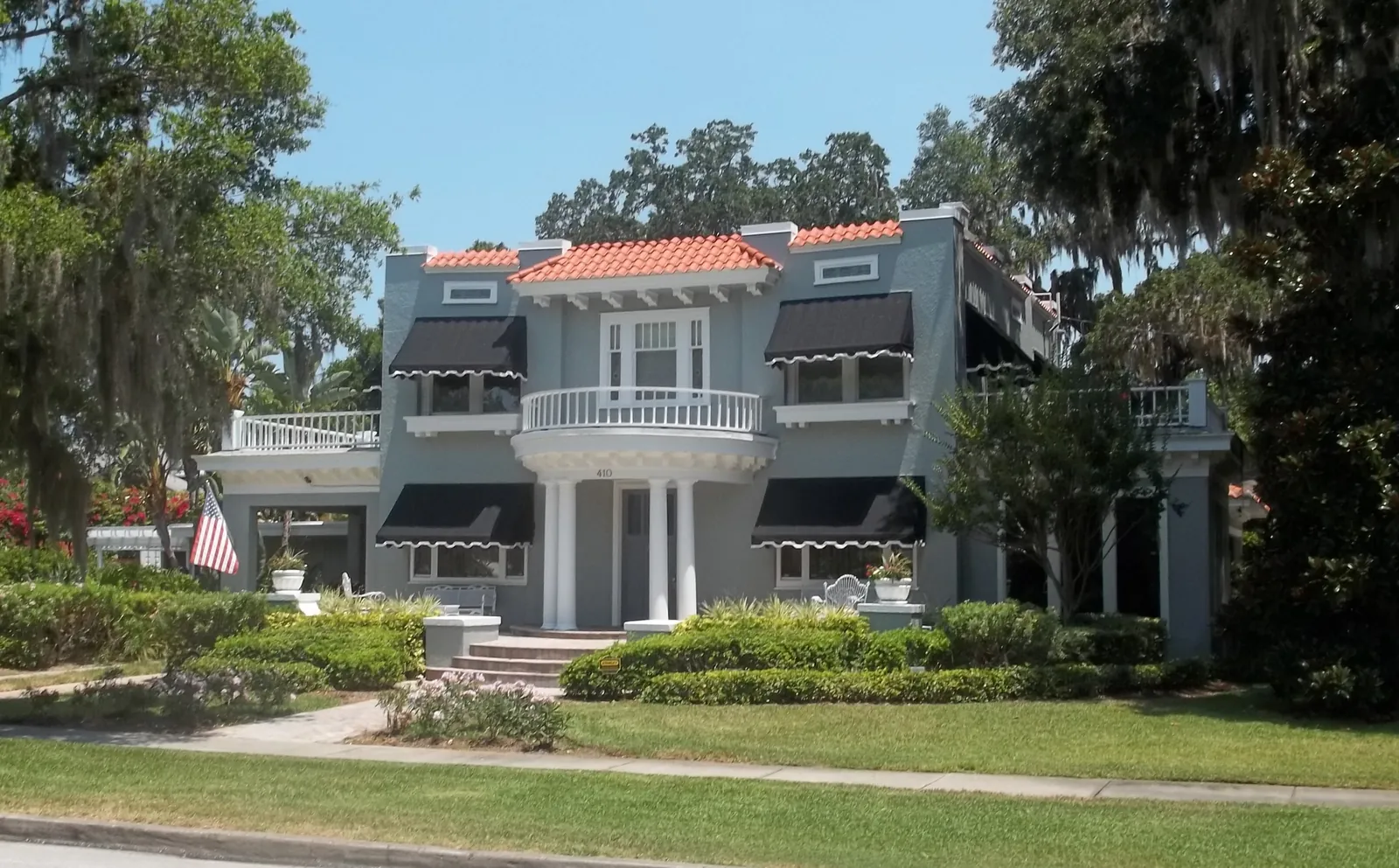
A large two-story cream-colored house with striped awnings, a flag, and tall palms, on a quiet shaded street in the Harbor Oaks neighborhood of Clearwater, Florida, present day.
Harbor Oaks today — the breeze is still here. So is the machine behind the door.
A house in the Harbor Oaks Residential District, Clearwater (present-day photograph). The neighborhood opened in 1914 and filled in over the next twenty-odd years — nearly all of it built before a Florida house could be cooled by anything but its own design. Photo: Ebyabe (CC BY-SA 3.0), via Wikimedia Commons.

What cool cost before it came in a box

Think about what comfort actually meant in Florida then. If you had money, you didn't buy a cooler house. You bought a better spot to put one. You chased high ground, moving water, and a tree old enough to throw real shade — and the people with the most money chased the best versions of all three.

Clearwater had been selling exactly that for years before Harbor Oaks existed. The town's whole pitch was in its name — the clear water of the harbor — and the bay-front hotels ran on the promise of a breeze coming off the Gulf that you couldn't get back home in the North. You went there to be cooler. That was the product.

An old color postcard of a manicured waterfront lawn with a stone balustrade and lamp posts above Clearwater Bay, a sailboat on the open water beyond.
The water was the whole pitch. Clearwater
“Water Front Scene, Clearwater” (vintage postcard, early 1900s). Hampton Dunn Collection of Florida Postcards, University of South Florida Libraries — no known U.S. copyright.

Here's the thing most people forget standing on the flat Florida coast: Clearwater has an actual bluff. The land south of downtown climbs to a rise of about twenty-five feet above the harbor — nothing in Vermont, but on a coastline where you can usually see over everything, it's high ground, and high ground catches the wind. For a hundred years that bluff was a citrus grove tied to a short-lived 1840s army post called Fort Harrison. Then a developer from Brooklyn looked at it and saw the best seat in town.

A vintage color postcard of the Sunset Point Hotel, a large Mediterranean-style resort with arched windows and palms, set directly on Clearwater Bay.
You came for the air off the bay
“Sunset Point Hotel, Clearwater” (vintage postcard, early 1900s) — a bay-front resort selling the same thing Harbor Oaks soon would: cool water and moving air. Hampton Dunn Collection, USF Libraries — no known U.S. copyright.

The man from Brooklyn who planted the shade

His name was Dean Alvord, and back in New York he'd built one of Brooklyn's prettiest neighborhoods, Prospect Park South — the kind of place where the developer decides where every tree goes. He came down to Clearwater in 1913 meaning to retire. He lasted about a year before the bluff got him, and in 1914 he opened Harbor Oaks on the old orange grove.

It was the first real planned neighborhood on this coast, and Alvord gave it everything money could buy underground — buried power lines so no poles cluttered the street, a sewer system, paved roads, curbs. But the part that mattered most for the heat was the part you could see: he lined every street and parkway with oaks and palms and wrote rules to keep them there. The shade wasn't landscaping. On a street with no air conditioning, a canopy of live oaks was the cooling system, and Alvord was installing it the way you'd install plumbing.

A black-and-white postcard looking down Druid Road in Harbor Oaks: a straight road flanked by two stone entrance posts, arched over by live oaks draped in Spanish moss.
Druid Road — the oaks were the plan
“Druid Road, Harbor Oaks, Clearwater” (vintage postcard). Alvord lined the streets with oaks and palms and wrote rules to keep them; the shade was part of the engineering, not just the look. Hampton Dunn Collection, USF Libraries — no known U.S. copyright.

The lots sold to exactly the sort of people you'd expect to pay for the best breeze on the coast — a popular adventure novelist, the owner of the Brooklyn Dodgers, a watch-and-machinery magnate, families whose names were on things you bought at the store. The local papers started calling the place “the Riviera of the Sunny South.” Everyone who bought in was, whether they'd have put it this way or not, buying the same thing: a cooler way to live, assembled out of ground, water, and trees.

Houses that had to do the work themselves

The homes matched the idea. Deed restrictions pushed them back off the street onto big lawns, and they came up in every style of the day — Mediterranean Revival under tile roofs, Colonial and Tudor and Mission and bungalow. Different faces, same engineering underneath. High ceilings to let the heat climb off you. Windows set across from each other so a breeze had a door in and a door out. Deep eaves and porches that kept the sun off the walls. The house was expected to breathe, because nothing else was going to breathe for it.

A two-story stucco Mediterranean Revival house with a low-pitched tile roof, set back behind trees and greenery in Harbor Oaks, Clearwater, present day.
Thick walls, deep eaves, built to breathe
A Mediterranean Revival home in Harbor Oaks (present-day photograph). High ceilings and cross-ventilated rooms were a house's cooling system before the machine. Photo: Ebyabe (CC BY-SA 3.0), via Wikimedia Commons.

The richest neighborhood in Clearwater was, underneath the tile roofs and the magnolias, one large machine for catching a breeze — finished right before the breeze stopped mattering.

The man in the finest house, building a machine to beat Florida

The grandest house on the bluff belonged to a young man named Donald Roebling, and he is where this story takes a turn nobody would script. His great-grandfather designed the Brooklyn Bridge; the family had bridge-and-cable money. In 1929 Donald finished a big Tudor place in Harbor Oaks he called Spottis Woode, with something most mansions don't come with: a fully equipped machine shop on the grounds.

A red-brick Tudor Revival house with a tall chimney and steep roof, half-hidden by trees, in Harbor Oaks, Clearwater, present day.
Spottis Woode — the finest house on the bluff
The Donald Roebling estate, “Spottis Woode,” in Harbor Oaks (present-day photograph). The Tudor Revival house was finished in 1929; a working machine shop stood on the grounds. Photo: Ebyabe (CC BY 2.5), via Wikimedia Commons.

What drove him wasn't the heat. It was the other thing Florida does. The hurricanes of the 1920s had drowned people by the hundreds in water too deep for a boat to reach and too flooded for a car to cross — stranded in the exact gap between the two. Roebling's father put the problem to him plainly: build something that could go where neither a boat nor a car could. So out in that backyard shop, year after year, he did.

A grainy 1930s photograph of an early amphibious tractor, the Roebling Alligator, a boxy tracked vehicle built to travel over both land and water.
The “Alligator,” 1935 — built to beat the water
The Alligator I, 1935 — Roebling's first amphibious tractor, built at his Clearwater estate to reach people stranded by hurricanes. U.S. Marine Corps; public domain, via Wikimedia Commons.

By 1935 he had a working one, a tracked machine that swam and crawled, and he called it the Alligator. He kept improving it, and in 1937 a photograph of the thing ran in a national magazine. The people who saw it weren't thinking about hurricanes. The Marine Corps was looking for a way to put men on a beach across water and sand where no landing craft could go — the same gap, a different ocean. Roebling's rescue machine became the LVT, and by the war thousands of them were carrying troops ashore across the Pacific.

A black-and-white World War II photograph of an LVT-1 amphibious landing vehicle, a U.S. Marine standing beside its tracked hull.
What it became
An LVT-1 — the Marine Corps version of Roebling's Alligator — in training during World War II. U.S. government; public domain, via Wikimedia Commons.

Sit with that for a second. On the breeziest bluff in Clearwater, in a neighborhood built from the ground up to outsmart Florida's weather with trees and porches, the man in the best house couldn't leave the weather alone either. He just went after the water instead of the heat, with a machine. Everyone on that bluff was, in their own way, trying to build their way out of the Florida climate.

The day the breeze became a view

The thing that finally beat the heat wasn't grand, and it didn't come from the bluff. It was small enough to lift into a window, and it showed up for ordinary houses through the 1950s. Cool air became something you could buy by the box — and then something a building bragged about, the words painted big across the front where the breeze used to be the only selling point.

A vintage color postcard of a brick restaurant storefront with awnings and a tall marquee, the words 'AIR CONDITIONED' printed across the bottom of the card.
The new pitch: AIR CONDITIONED
A mid-century “Air Conditioned” advertising postcard (a national example of the era). Once cool air came in a box, it became the thing a place put on the sign out front. Tichnor Brothers Collection; public domain, via Wikimedia Commons.

When that reached the bluff, it quietly undid a hundred years of reasoning. The oaks were still beautiful, but you no longer needed them to survive August. The cross-breeze windows could stay shut so the cold wouldn't leak out. The harbor breeze kept coming up the hill every evening — and became a thing you enjoyed, not a thing you planned a whole house and a whole neighborhood around.

A present-day Harbor Oaks street lined with tall palms and oaks, historic two-story homes set back on green lawns, a car parked at the curb.
Still a neighborhood you walk — now by choice
A Harbor Oaks street today (present-day photograph). The oaks still shade it and the harbor breeze still comes up it — now past houses kept cool by the units humming behind their walls. Photo: Ebyabe (CC BY-SA 3.0), via Wikimedia Commons.

So go back to that July afternoon under the oaks. Every reason this neighborhood exists in the shape it does — the high ground, the arching trees, the deep porches, the windows facing each other across cool rooms — was somebody's answer to a heat the box in the wall now answers in about a minute. The breeze that the richest men in Clearwater once paid a fortune to stand in still comes up off the harbor every evening, costs nobody a cent now, and nobody up there is counting on it anymore.

A present-day note · I Know A Guy AC

The bluff and the oaks did the job for a hundred years. Now it's the unit behind the wall.

Harbor Oaks spent its first forty years beating a Florida summer the only way anyone could — with high ground, shade, and a house built to catch whatever air was moving. It was clever, and it was never quite enough, which is exactly why cold air sold the moment it could be bought, and why nobody on that bluff leans on the harbor breeze to get through August anymore.

Keeping a Clearwater house cool is still the whole job — we just do it with real equipment now instead of trees and porches, sized and set up for your house so the heat outside stays a thing you notice only when you step out into it. The machine that replaced the breeze is quiet, and it's easy to forget it's there, right up until the afternoon it stops.

And when it does — on the hottest day, because that's the day it picks — you've got an easier move than any of those first families on the bluff ever had. You don't have to chase the shade or wait for the wind off the water. You make one call, because for keeping a Harbor Oaks home cool the modern way… we know a guy.

See what a new system costs→
Sources & Photo Credits

On the history

Photographs

  1. House in the Harbor Oaks Residential District (present-day, HERO) — photograph by Ebyabe, 2011 (CC BY-SA 3.0), via Wikimedia Commons. Clearly a modern image. File: harbor-oaks-mansion-hero-today.
  2. “Water Front Scene, Clearwater” (vintage postcard, early 1900s) — Hampton Dunn Collection of Florida Postcards, USF Libraries; no known U.S. copyright. File: clearwater-waterfront-bluff-postcard.
  3. “Sunset Point Hotel, Clearwater” (vintage postcard, early 1900s) — Hampton Dunn Collection, USF Libraries; no known U.S. copyright. A Clearwater bay-front resort, used to illustrate the pre-A/C “come for the breeze” trade. File: sunset-point-hotel-postcard.
  4. “Druid Road, Harbor Oaks, Clearwater” (vintage postcard) — Hampton Dunn Collection, USF Libraries; no known U.S. copyright. The oak-lined entrance parkway. File: druid-road-oak-parkway-postcard.
  5. Mediterranean Revival home, Harbor Oaks (present day) — photograph by Ebyabe (CC BY-SA 3.0), via Wikimedia Commons. File: harbor-oaks-mediterranean-today.
  6. Donald Roebling Estate, “Spottis Woode,” Harbor Oaks (present day) — photograph by Ebyabe (CC BY 2.5), via Wikimedia Commons. File: roebling-estate-tudor-today.
  7. The Alligator I, 1935 — Roebling's first amphibious tractor; U.S. Marine Corps Air-Ground Museum, Quantico; public domain, via Wikimedia Commons. File: roebling-alligator-1935.
  8. LVT-1 in training, World War II — U.S. government photograph; public domain, via Wikimedia Commons. File: lvt1-marines-wwii.
  9. “Air Conditioned” advertising postcard (mid-century) — Tichnor Brothers Collection; public domain, via Wikimedia Commons. A national example of the era, not a Clearwater building. File: air-conditioned-sign-postcard.
  10. Harbor Oaks street (present day) — photograph by Ebyabe (CC BY-SA 3.0), via Wikimedia Commons. File: harbor-oaks-street-today.

Period postcards are shown at archival resolution; the “Air Conditioned” postcard is a national example of its era, labeled as such, used where no equivalent Clearwater image was available. Present-day photographs are identified as modern. The Donald Roebling portrait and the Alligator I and LVT images are U.S. government / Marine Corps records in the public domain. Original downloads and a full research record are kept alongside this page in assets/images/originals/ and source-record.md. No image's factual content was altered; the print frames and handwritten notes are CSS added around the photographs, never onto them. Any owner who would like an image removed need only ask.