Golf View · South Tampa, Florida  ·  A Local History

The Golf Course That Emptied Out Every Summer


Golf View grew up wrapped around Tampa’s oldest golf course — a view worth building a whole neighborhood on. There was just one problem with living on it: for half the year, the people who could afford it were gone. Back then a Florida August was something you escaped, not something you cooled.

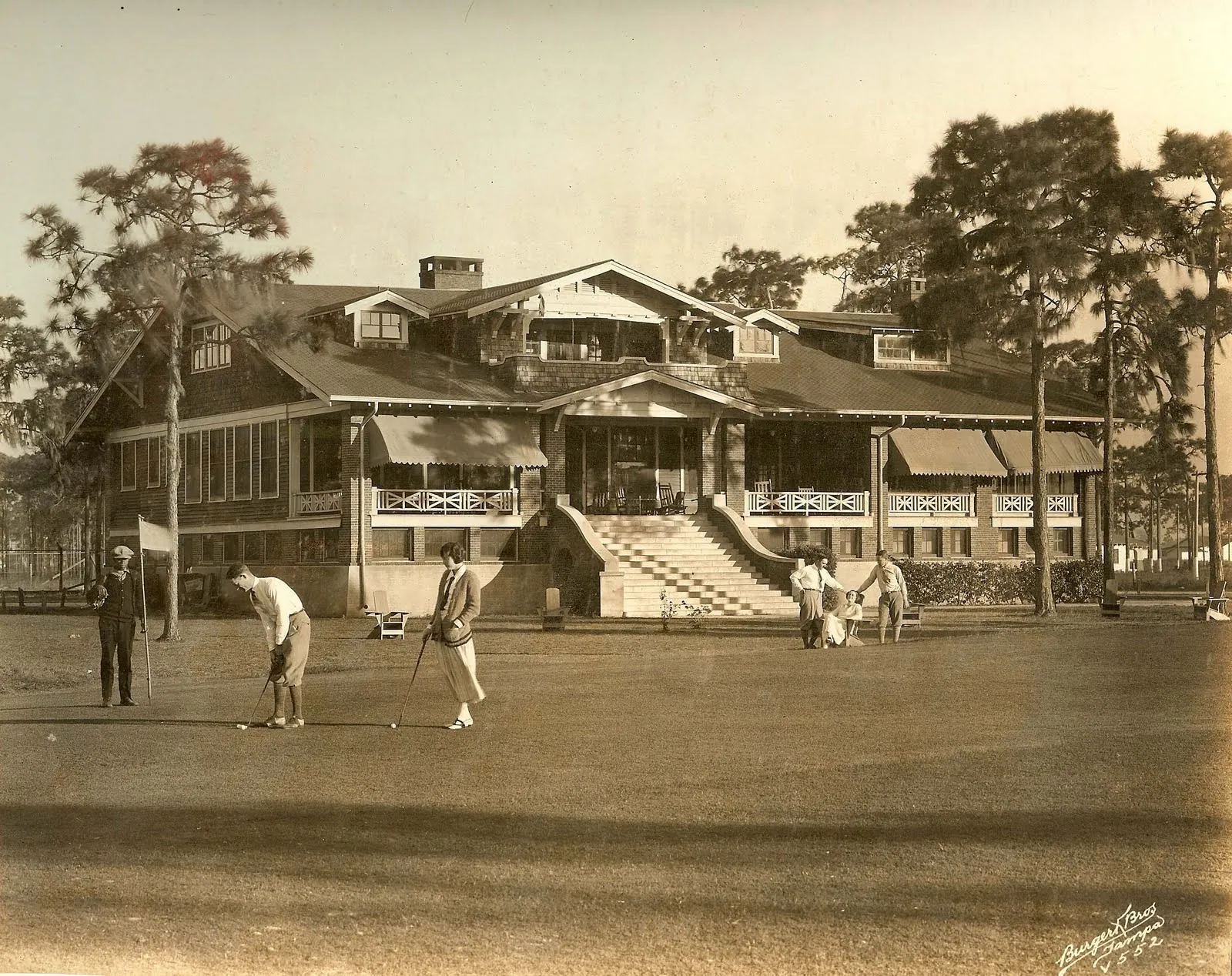
A warm-toned early photograph of the shingled Palma Ceia golf clubhouse, with golfers and caddies out on the practice green in front of it under tall pines.
Palma Ceia — the whole neighborhood would grow up around this view
The Palma Ceia clubhouse and its golfers, early days. A whole South Tampa neighborhood took its name from the right to look out at this. Historic photograph, Palma Ceia Golf & Country Club (1920s); via online archive.

There is a neighborhood in South Tampa named after a view. Not a bay view, not a skyline — a view of a golf course. They called it Golf View, and the whole appeal, right there in the name, was that your house looked out over the fairways of the Palma Ceia course. People paid a premium to live beside a game.

Which raises a question nobody asks anymore, because the answer has been humming in the window for seventy years. Why would you build an entire neighborhood around an outdoor game, in a place where, for half the year, going outside to play it was close to unbearable?

The short version: they didn’t plan to be here for that half. Golf, in Florida, was a winter thing. And so, at the start, was Golf View.

How South Tampa stayed cool before anyone could make cool

To see why, you have to go back to how people out here beat the heat when there was no machine to do it for them. The answer is that they went and found the cool, wherever it happened to be, and a lot of the time it was in the water.

A few blocks from where the golf course would go, a man named Thomas Palmer had opened a spring-fed swimming pool along Bayshore Boulevard. It bubbled up cold out of the ground, and from 1907 on it was simply where South Tampa went to stop sweating — a short streetcar ride from downtown to a pool of cool spring water, with the bay breeze coming in off Hillsborough Bay right beside it.

A 1926 photograph of the large open-air Palma Ceia Springs swimming pool along Bayshore Boulevard, with a diving platform and bathers around the deck.
Palma Ceia Springs pool, Bayshore Blvd — where you went to stop sweating. 1926
The spring-fed pool at Palma Ceia Springs, 1926. Opened in 1907 as the place for the growing south side of Tampa to get relief from the heat — cold spring water and the bay breeze, no machine required. Burgert Brothers, Tampa-Hillsborough County Public Library System.

That was the state of the art. A cold spring, a sea breeze off the bay, a deep shaded porch, and a willingness to arrange your whole day around the hottest hours. It worked well enough that people came from the North to do exactly that — but only in the season when it was pleasant, and the season when it was pleasant was winter.

So when a group of Tampa men went looking, in 1915, for the next thing to build out on that same breezy ridge above the bay, they didn’t build a summer resort. They built a winter one. They built a golf course.

Eighteen men, a hundred acres, and a dollar a year

Eighteen of them put it together. They leased a hundred acres of pine and sand for a dollar a year, with a handshake option to buy it down the road, and in 1916 they had a course laid out through the pines by Tom Bendelow, the man who routed more early American courses than almost anyone. Palma Ceia opened as the first private club in Tampa, and it opened for the season.

A 1930s black-and-white photograph of women golfers in long skirts putting on a green at Palma Ceia, a caddie standing by and the clubhouse behind them through the pines.
On the green at Palma Ceia — a winter afternoon, 1930s
Women golfers and their caddie on the green at Palma Ceia, in the 1930s. The course filled up in the cool months and thinned out in the heat — golf here ran on the calendar, not the clock. Burgert Brothers, Tampa-Hillsborough County Public Library System, via golfclubatlas.com.

And for a few years it was a pleasant, slightly rustic winter club on the edge of town. Then, in 1923, the members did something that tells you how serious the golf had gotten. They voted to bring in Donald Ross.

A 1913 photograph of golf course architect Donald Ross in a flat cap and suit, following through on a golf swing on a course.
Donald Ross — the man they hired to redraw the course. 1913
Donald Ross, 1913. The Scottish-born architect behind Pinehurst was already shaping courses up and down the coast when Palma Ceia paid him to redraw theirs. Bay State Publishing Co., via Library of Congress / Wikimedia Commons (public domain).

Ross was the most famous golf architect in the country, the man who built Pinehurst. He came to Tampa, shifted the routing, carved in more bunkers, and left behind the course that is still essentially there today. A dollar-a-year pasture had become a Donald Ross course. The land around it was about to get very valuable — just in time for the biggest land rush Florida had ever seen.

Selling a view in the middle of a boom

In the mid-1920s Florida went briefly insane. The land boom had trains running south packed with people buying lots they’d never seen, flipping them in a week, selling paradise by the acre. And the single best thing a developer could put next to a new subdivision was a golf course. It said money, leisure, the good life — a permanent green lawn you didn’t have to own.

A 1920s billboard advertising subdivision real-estate lots for sale during the Florida land boom, with bold lettering promoting easy terms.
The pitch, everywhere — buy the lot, buy the dream
A billboard selling subdivision lots during the Florida land boom of the 1920s. “Live on the golf course” was one of the strongest cards a developer could play. World Digital Library, via Wikimedia Commons (public domain).

So Golf View Park was platted, right against the fairways, and the pitch sold itself. Live on the golf course. Look out your window at the fairway where you played that morning. It was a beautiful idea, and plenty of people bought in.

But read the fine print of the era and you find the catch that nobody put on the billboard. This was a winter address. The members who crowded the clubhouse and the fairways did it from roughly November to April, when Tampa was glorious. Come May, the ones with somewhere cooler to be went to it, and the course and the grand new clubhouse eased into the long, still, sweltering off-season.

A 1932 photograph of the open-air dance floor and band shell behind the Palma Ceia clubhouse, an outdoor social space shaded by trees.
The band shell & dance floor out back — the season ran on the cool months. 1932
The dance floor and band shell behind the clubhouse, 1932. Even the parties were built for the open air — the whole social season leaned on the months when you could stand to be outside after dark. Burgert Brothers, Tampa-Hillsborough County Public Library System.
A whole neighborhood sold on a view it could only really enjoy for half the year.

Even the people who lived on the course had a complicated relationship with it. The commercial photographer Al Burgert — whose firm shot most of these very pictures — bought a house right on the Palma Ceia fairways. Errant golf balls came through his dining-room window so many times that he finally gave up and had a screen bolted over the glass. That was the deal with living on the course in those years: a beautiful view, a few hazards, and a long hot summer when the neighbors with options simply weren’t around.

The machine that let the neighborhood stay

What changed everything wasn’t a better breeze or a new spring. It was a box.

The same trick the cold spring had pulled off by accident — pulling the heat out of the air — kept getting smaller and cheaper until, by the 1950s, it fit in a window. You could buy a unit, drop it in the wall, close up the house, and sit in a cool room on the worst afternoon in July. For the first time in the history of the place, you didn’t have to go anywhere to find the cool. It came to you.

A 1956 General Electric magazine advertisement for a slim room air conditioner, showing a family relaxing in a cooled living room.
The cool, boxed up and brought indoors — 1956
A 1956 room air-conditioner advertisement. By the 1950s the relief South Tampa had chased outdoors — to the spring, the porch, the shade — could be bought in a box and set in the wall. General Electric, published in Time, 1956; public domain, via Wikimedia Commons. Shown to mark the arrival of home cooling.

And that, quietly, is when Golf View actually became Golf View — the real, year-round neighborhood of brick streets and settled houses it is now. Not during the boom that platted it. After. Drive the streets today and most of the houses date to the 1950s, a full generation after the lots were first drawn, because that is when living on a Tampa golf course stopped being a four-month proposition and started being a life.

The winter address became an address. You could sit in your living room on the fairway side in the dead middle of August, cool as November, and watch somebody slice a ball toward your window.

A present-day aerial view of the Palma Ceia golf course ringed by the dense, tree-lined streets and rooftops of the Golf View neighborhood in South Tampa, with Hillsborough Bay beyond.
Golf View today — the houses wrap the course on every side
The Palma Ceia course and the Golf View neighborhood today. The fairways sit inside a full ring of year-round homes now — a density that only made sense once every one of those houses could be cooled. Present-day aerial photograph, via Tampa Bay Business Journal.

What stayed, and what got buried

The course is still there, essentially the one Ross left, still the oldest private club in Tampa. The streets still carry the names a developer borrowed from an old map of Havana. And the view the neighborhood was named for is still the whole point of living there.

A present-day photograph of the Palma Ceia Golf and Country Club clubhouse on South MacDill Avenue, a low white building behind its parking area and palms.
Palma Ceia today — still here, still cool inside
The Palma Ceia clubhouse, present day. More than a century on, the club still anchors the neighborhood that took its view for a name — only now it is comfortable inside twelve months a year. Photo © Chip Weiner, via oldtampaphotos.com.

What didn’t survive is the thing that came first. The cold spring that taught South Tampa how to beat the heat closed in the 1930s, and most of its water now runs in a pipe under Bayshore Boulevard. The little park on top of it is about the only hint left that people once rode a streetcar out here just to get into some cool water. Nobody needs to anymore.

That is the quiet trade the whole neighborhood is built on. Golf View was dreamed up as a place you looked at in winter and fled in summer. The game didn’t change that. The spring couldn’t. A box in the window did — and turned a four-month view into somewhere you could finally stay all year.

A present-day note · I Know A Guy AC

Golf View was a winter address until a machine made August livable. Keeping it that way is still the whole job.

That’s the thread that runs the length of this place — from the spring pool and the porches to the first window unit humming on a fairway-side house. The whole story of Golf View is really one long argument with the Florida summer, and for a long time the best anyone could do was leave until it was over.

Keeping a Tampa Bay home cool is still exactly that job, just handed to a machine instead of a season. We do it with real equipment now — a system sized and set up for your actual house, so a South Tampa August turns into something you only feel for the few steps between the car and the front door. When it’s working, you forget it’s there, the same way the neighborhood forgot it ever had to pack up and leave.

Right up until the afternoon it quits — and it always picks the hottest one. When that happens, you’ve got an easier move than any of those winter members packing for the North ever did. You don’t have to go anywhere to find the cool. You make one call, because for keeping a home cool through a Tampa summer… we know a guy.

See what a new system costs→
Sources & Photo Credits

On the history

Photographs

  1. Palma Ceia clubhouse and golfers (HERO, historic, 1920s) — Palma Ceia Golf & Country Club; historic photograph via online archive. File: palma-ceia-clubhouse-golfers-historic.
  2. Palma Ceia Springs swimming pool, Bayshore Boulevard (1926) — Burgert Brothers, Tampa-Hillsborough County Public Library System, via oldtampaphotos.com. File: palma-ceia-spring-pool-1926.
  3. Women golfers and their caddie on the green at Palma Ceia (1930s) — Burgert Brothers, Tampa-Hillsborough County Public Library System, via golfclubatlas.com. File: palma-ceia-women-golfers-green-1930s.
  4. Donald Ross, golf course architect (1913 portrait) — Bay State Publishing Co., Library of Congress Prints & Photographs, via Wikimedia Commons (public domain). File: donald-ross-portrait-1913.
  5. Florida land-boom subdivision billboard (1920s) — World Digital Library, via Wikimedia Commons (public domain). Shown to illustrate 1920s boom-era lot marketing; not Golf View specifically. File: florida-land-boom-billboard-1922.
  6. Palma Ceia dance floor and band shell (1932) — Burgert Brothers, Tampa-Hillsborough County Public Library System, via oldtampaphotos.com. File: palma-ceia-dance-floor-1932.
  7. General Electric room air-conditioner advertisement (1956) — General Electric, published in Time, 1956; public domain, via Wikimedia Commons. Shown to mark the arrival of home air conditioning; not Golf View specifically. File: ge-room-air-conditioner-1956.
  8. Palma Ceia golf course and the Golf View neighborhood from the air (present day) — via Tampa Bay Business Journal. File: palma-ceia-golf-neighborhood-aerial-today.
  9. Palma Ceia Golf & Country Club clubhouse (present day) — © Chip Weiner, via oldtampaphotos.com. File: palma-ceia-golf-club-today-2022.

Present-day photographs are identified as modern; period images carry their known or approximate dates. Where an image is representative of the era rather than of Golf View itself — the land-boom billboard and the 1956 air-conditioner advertisement — this record says so rather than implying a false location. Where the record is uncertain — the exact 1916-vs-1917 opening of the course and the precise year within the 1930s of the women-golfers photograph — the page hedges rather than choosing the tidiest version. Untouched original downloads are kept alongside this page in assets/images/originals/ with a full research record in source-record.md. No image’s factual content was altered; the print frames and handwritten notes are CSS added around the photographs, never onto them. Any owner who would like an image removed need only ask.