Dunedin sits on the warm Gulf shoulder of Florida, where the summer comes down thick and wet and parks on you like a towel that wrung itself out overhead. So here’s a small riddle worth sitting with: the people who named this town reached halfway around the world and picked one of the coolest, grayest, rainiest cities on earth.
Two Scottish merchants, J.O. Douglas and James Somerville, were running the general store when the settlement needed a name for its post office, somewhere around 1880. They skipped the plain old place-name it already had — Jonesboro — and chose Dunedin, from Dùn Èideann, the old Gaelic name for Edinburgh. Homesick Scots, naming a sandbar on a subtropical bay after the cold stone city they’d left behind.
You can read it as sentiment. But there’s a harder fact tucked inside the joke — and it ran this town for the better part of a century.
A town you only visited in winter
For most of Dunedin’s life, the only sane way to enjoy its climate was to not be here for half of it. The whole of early Florida ran on that rhythm. The northerners came down after Christmas, filled the hotels through March, and were gone before June — because a Florida summer, with no machine anywhere to beat it back, was something you survived, not something you booked a room for.

So how did anyone stand the half of the year the tourists skipped?
The same way everyone in Florida did before the machine arrived. You gave the heat fewer places to land. Houses went up with high ceilings and deep porches and windows set to pull a cross-breeze straight through the middle of the house. You lived on the shaded side in the afternoon and the open side after dark. And you leaned, hard, on the one thing Dunedin had more of than almost anywhere — the water.

The Sound out front was the air conditioning. The breeze came off it in the evening, the shade sat along it, and a town that couldn’t cool a single room could at least cool a porch facing the water. That was the deal Dunedin offered, and for a long time it was the best deal going.
The grandest room in town, dark all summer
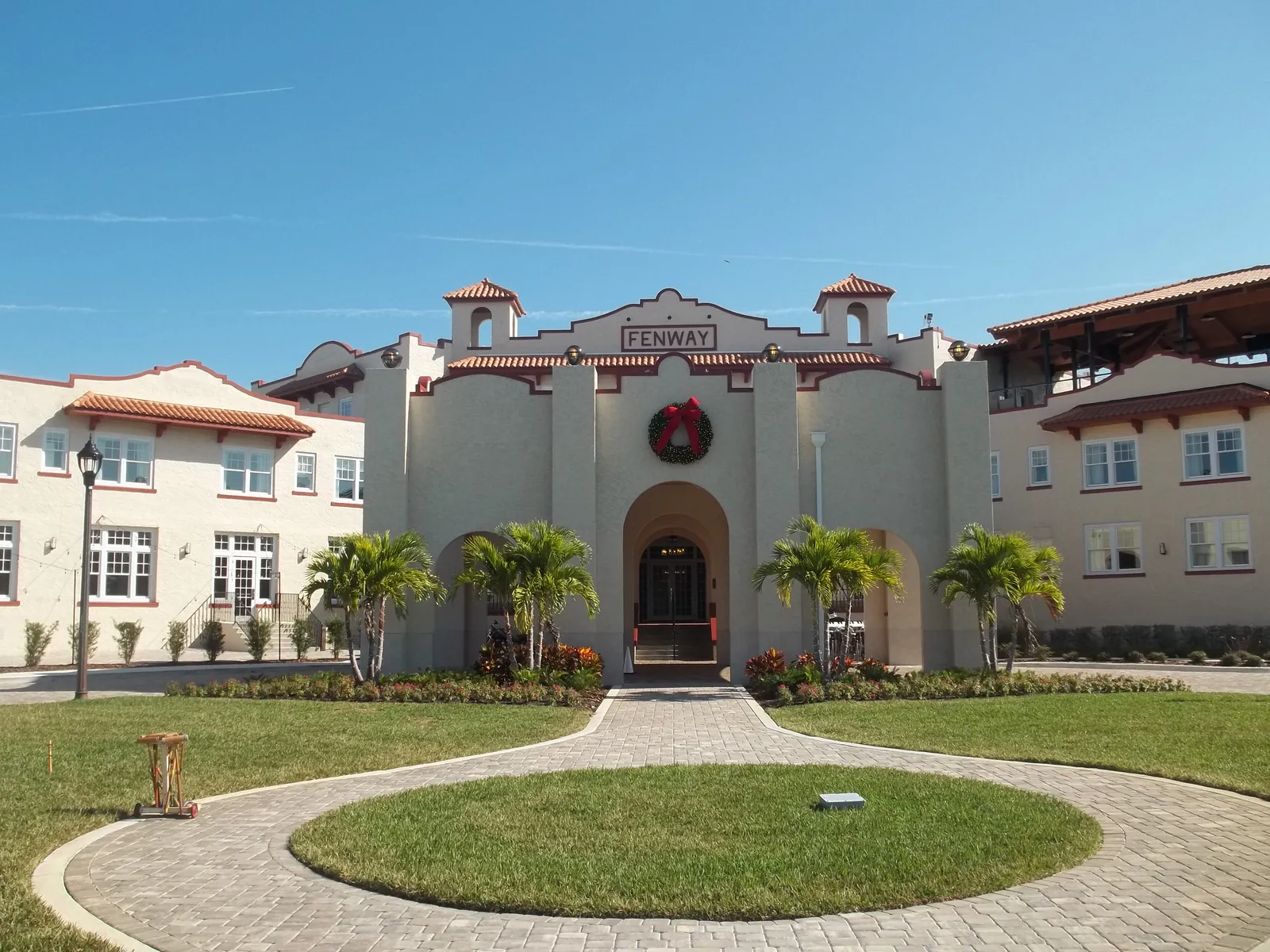
And then, in 1927, Dunedin built the finest advertisement for that deal it ever had: the Fenway Hotel. A three-story Mediterranean palace on the bluff above the water, barrel-tile roof, arches, a long veranda aimed straight at the Gulf. Two years earlier the owner had already bolted a radio station to the roof — WGHB, the first in all of Pinellas County, its call letters simply his own initials, George H. Bowes, broadcast out over the bay. Clarence Darrow stayed. So did Kenesaw Mountain Landis, the first commissioner of baseball.
And here is the detail that tells you everything about living in Florida back then. For its first thirty-four years, the Fenway operated seasonally. The grandest building in Dunedin — the one with the famous guests and the radio tower — locked its doors every single summer and sat dark, because there was no way on earth to make a hundred-plus rooms bearable in July, and nobody who could afford to leave was going to try.

So the guests did what everyone did. They sat on that long veranda in the shade, caught whatever moved off the water, and ran a ceiling fan to push the thick air around. That was the whole system. A porch, a breeze, and a fan — the most money could buy you in 1930 was a nicer spot to wait out the heat.

The guest whose own labs were ending all this
Which is where one more name on the Fenway’s guest list turns almost funny. Among the winter regulars was Charles Kettering, the man who ran the research arm of General Motors. He came down to Dunedin for the breeze like everyone else — while, in those exact years, the lab he was in charge of was perfecting the thing that would someday make the breeze beside the point.
His people were working out a new, safe refrigerant — the chemistry that would finally let cool air be pumped out of a box cheaply enough to sit in an ordinary window. He was sitting on a Florida porch fanning himself, waiting out the heat the old way, at the precise moment his own division was inventing the end of the old way.
The breeze, sold one last time
Right at that hinge, Dunedin got to watch the old idea make its final, grandest pitch — just offshore. At the end of the 1930s a New York advertising man bought the island across the water, a spit of sand that a 1921 hurricane had split clean off its neighbor. Its name until then had been Hog Island. He rechristened it Honeymoon Island, threw up a cluster of palm-thatched bungalows, and ran a contest in Life magazine handing newlyweds from all over the country a honeymoon on the Gulf, on the house.
There was no machine in those cottages. The entire product was the breeze, the beach, and the water — the same thing Dunedin had been selling since the Scots named it. It was one of the last times anyone sold Florida cool as a place you traveled to, right before cool stopped being a place at all.

When the season finally ended
After the war, the machine came down out of the grand buildings and landed in the windows of regular houses, and the whole rhythm Dunedin had lived by quietly came apart. You no longer had to leave in June. A family could move in and simply stay — through July, through August, through the worst of it — and the half-year town turned into a year-round one.
The Fenway felt it too. In 1961 it finally stopped being a seasonal hotel and became a college; later it sat empty for years and came close to being lost altogether. Then it was bought, restored, and reopened in 2018. And for the first time in its long life, the Grand Lady doesn’t close for the summer. Cool inside, all twelve months.

The old Scottish street names are still down there if you go looking — Scotland Street, Aberdeen Avenue — little flags left by men who were plainly a bit homesick for the cold. And it turns out they were onto something. They just couldn’t finish the job.
You can live in Dunedin now, straight through the heaviest August the Gulf can throw at it, and the reason has almost nothing to do with the breeze off the Sound the Scots fell for, or the shaded veranda the Fenway’s guests waited on. The cool finally stopped being a season you traveled to. It became a machine, humming quietly behind the wall, running while everyone sleeps.