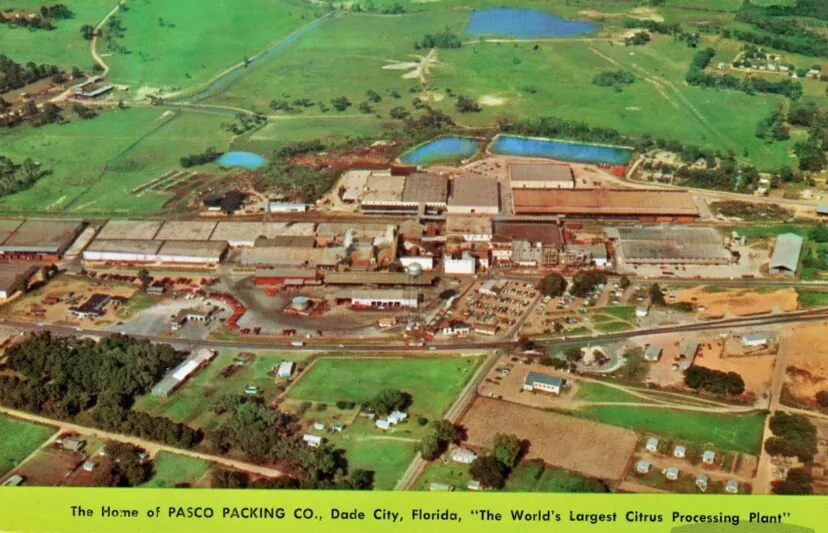
For a good stretch of the last century, a small town in the hills east of Tampa made cold for the entire country. Not as a figure of speech. Actual cold — orange juice frozen so hard it came out of the can like a brick, boxed up and shipped to freezers in Boston and Buffalo and just about every grocery store in between. The sign on the plant said it right out loud: the world’s largest citrus processing plant.
And then the people who made all that cold clocked out, drove home, and sat on the porch in the dark, waiting for a breeze — because there was no cold waiting for them inside the house.
That’s Dade City. For years it was one of the great cold-making places in America and one of the hot ones to actually live in, both at the same time. So how does a town end up on both sides of that? Start with the heat, because in Florida you always do.
Before the machine, cool was a place you went
Picture a Pasco County summer with no air conditioning anywhere. Not in a house, not in a store, not in the courthouse, not in one single room in town. It comes down thick and wet in May and pretty much sits on you until October. That was ordinary life here for generations, and people got good at the only thing that worked.
You didn’t make cool air. You went and found it. Dade City has one small advantage most of the peninsula doesn’t — it sits up in the low rolling hills of the ridge, about as much elevation as Florida ever offers — and for a long time that was the whole cooling plan. Get up where the air moves. Find shade. And wait for the evening.

Houses here were built around that hope. Deep wraparound porches to throw shade on the walls before the sun could cook them. And out back, on a lot of the older places, a sleeping porch — a screened room where you dragged the beds in July so the whole family could sleep in moving air instead of a closed-up bedroom. Cool wasn’t a setting on a wall. It was a place you went, and a time of day you waited for.
The town itself grew in under the live oaks, because the shade was worth more than the view. You can still read it in the old postcards: Spanish moss over the main street, awnings down over every storefront, everybody keeping to the shady side.

The hills were made for oranges
What those same hills were really good for was citrus. Cold air slides downhill on a freezing night and pools in the low spots, so the high ground stays a hair warmer — which, in the orange business, is the whole ballgame. Groves climbed all over the ridges around Dade City, and by the early 1900s this was serious fruit country.

For a long time all that fruit went out the way fruit always had — picked, graded by hand, packed into wooden crates, and loaded onto a train before it could spoil. The whole race was against the clock and the heat. An orange is a short-lived thing. Get it north fast or lose it.
Then, in 1936, a handful of local growers did the math and decided they’d stop racing the clock and start beating it. They pooled their groves and put up a packing house north of town. That building is where the whole story turns.
How a packing house learned to make winter

It started simple enough: a place to clean, size and pack fresh oranges. But fresh fruit still spoiled, and there was only so much of it a town could sell before it went soft. So the men running the plant started tinkering with the juice instead.
During the war they were among the outfits canning single-strength juice for the troops — they even got a commendation from the government for it. But canned juice was heavy and it tasted like the can. The thing that changed everything came right after the war, out of Florida’s citrus labs, and the plant at Dade City jumped on it hard: frozen concentrate.
The idea is almost too simple. Boil most of the water out of fresh orange juice, so a whole tree’s worth shrinks down to a little slug of syrup. Then freeze that slug solid and keep it frozen all the way to somebody’s kitchen, where they’d stir the water back in. Suddenly a Florida orange could sit in a freezer in Minnesota in February and taste like it was picked that morning. The whole country wanted it.

And that is when a small town quietly became a cold-making giant. The plant swelled across the fields north of Dade City. At its peak somewhere around two thousand people — in a town this size — spent their days there, turning oranges into frozen gold and loading it onto trains. In 1961 the Lykes family in Tampa bought it, and it carried their name for the rest of its life.
Now think about what that actually took. To freeze juice that hard, and keep it frozen through a warehouse, a boxcar, a truck and a grocery freezer a thousand miles away, you need cold on a scale that’s hard to even picture — whole rooms colder than any winter Dade City has ever had, running around the clock, in the middle of the Florida heat.
Here’s a detail that sticks with you. The plant grew so fast, and so many local men were off at the war, that for a couple of years some of the hands building its warehouses were German prisoners of war — veterans of Rommel’s Afrika Korps, held in a camp right at the edge of town. One of them, an artist, painted a sweeping aerial mural of the whole plant on an office wall. The company thought enough of it to keep it, and to fly him back for the fiftieth anniversary decades later.

The crates and cans that rolled out carried the one thing the town was proudest of — where the fruit came from. Right on the label: from the hills of Pasco.

And then the cold finally came home
The strange gap — cold for everyone else, heat for the people making it — didn’t last forever. The very same science the plant ran on, the business of pulling heat out of a sealed space and pushing it outside, kept getting smaller and cheaper until it could fit in a window.

By the 1950s and ’60s a family on a regular Dade City street could buy a unit, set it in the wall, close the windows, and be cooler on a July afternoon than the finest shaded sleeping porch in town had ever managed. The cold Dade City had been shipping to everybody else’s kitchens had finally shown up in its own.
And the porches went quiet. The beds came back indoors. Nobody had to go up the hill, or out to the screened porch, or down to the shady side of the street to find relief anymore. It was just there, in the room, humming, waiting for you — whether you were home or not.
What stayed, and what didn’t
The plant didn’t make it. The frozen-juice business that built it slowly moved away and got cheaper somewhere else, and in 2004 the great cold-making works north of town shut down for good and became a business park. If you want to feel how far it’s all drifted: the frozen concentrate can itself — the little brick of cold that put Dade City on the map — is being discontinued nationwide right about now, after some eighty years. The thing the town helped make famous is quietly being retired.

But the town is still here, and most of it stayed. The 1909 courthouse still stands at the center of it with its white dome — a building that sweated through its first forty summers and now stays cool inside without anyone thinking twice about it. The old oaks still shade the main street. The wraparound porches are still on the bungalows, lovely and mostly empty in August, because nobody needs to sit out there to breathe anymore.

For a little while, this was the place that made cold for the whole country and couldn’t keep any for itself. That gap is closed now. The cold finally came home to Dade City — not up off the hills or in off the evening air, but out of a machine, the same as everywhere else.