Crystal Beach · Pinellas County, Florida  ·  A Local History

The Town That Named Itself After Cold Water


A tiny Gulf-of-Mexico town borrowed its name from a cold bathing beach on a lake a thousand miles to the north. It sounds like a mix-up. It was really the whole point — back when the water was the only air conditioning Florida had.

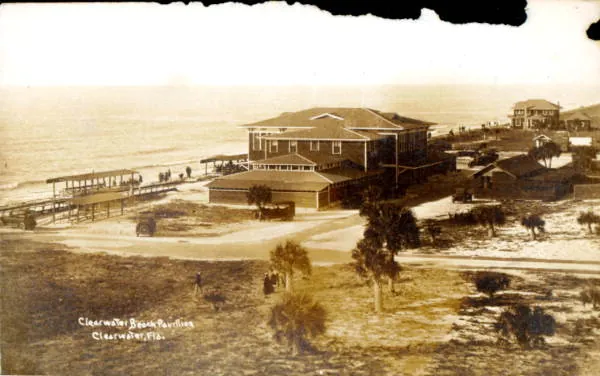
An early-twentieth-century sepia postcard of the Clearwater Beach pavilion on the Gulf of Mexico, with a long wooden boardwalk and pier running out over the sand and shallow water.
The Gulf coast’s idea of comfort — a pavilion and a pier on the water
The beach pavilion and pier at Clearwater, on the Pinellas Gulf coast, early 1900s. For most of this coast’s history, beating the heat meant getting yourself to the water. Shown as a representative west-central Florida Gulf-coast scene. State Archives of Florida, Florida Memory.

There is a little town on the Gulf of Mexico, up the Pinellas coast past Dunedin, that is named after a beach on Lake Erie. The lake is in Canada. It is more than a thousand miles north, and in winter it freezes over. And a Florida town looked at that cold northern shoreline and thought: yes, name us after that.

It sounds like somebody’s idea of a joke. A sweltering subtropical town borrowing the name of a place people went to escape the cold. But the longer you sit with it, the more it stops being funny and starts being the most revealing thing a Florida town ever admitted about itself.

Because the Canadian Crystal Beach got its name from one thing: the water was clear and it was cold. And in the Florida of a hundred years ago, before anyone could make a cold room out of thin air, that was the single most valuable thing a place could sell. Not oranges. Not sunshine. Relief.

What cool meant when you couldn’t make it

Picture a Florida summer with no air conditioning anywhere. Not in the house, not in the store, not in the church you sat through on Sunday. That was every summer here until almost living memory. So the question that ran a person’s whole day was simple and constant: where is it cooler than right here, and how do I get to it?

The answer, on this coast, was almost always the water. You went to the Gulf. You stood in it up to your waist where the breeze came in off the open water and the temperature dropped the second your feet left the sand. A shaded porch helped. A deep hallway with the windows open at both ends helped. But the real relief, the kind worth building a town around, was out there in the shallows.

A 1914 panoramic photograph of Crystal Beach, Ontario, on Lake Erie: a long shoreline packed with bathers, a crowded pier reaching into the lake, and resort buildings behind the beach.
The namesake — Crystal Beach, Ontario, packed onto cold Lake Erie. 1914
Crystal Beach, Ontario, 1914. The Lake Erie bathing resort the Florida town took its name from — christened for its clear, cold water, and drawing whole crowds who came to get into it. Shown as the namesake. Lake Erie Excursion Co.; Library of Congress Panoramic Photographs (LCCN 2007663117), via Wikimedia Commons (public domain).

Up north, people had the same instinct. On the far side of Lake Erie, a man named Rebstock had opened a beach resort in the late 1880s and called it Crystal Beach, for water so clear and cold you could see your feet on the bottom. Buffalo emptied out onto it every summer. It became, people said, Buffalo’s Coney Island — a whole town built on the simple pull of cold water on a hot day.

So when developers went looking for a name to sell a stretch of the Gulf coast, they didn’t reach for something tropical. They reached north, to the coldest, clearest water they could think of, and they pinned that name on Florida. The promise was the same in both places. The water will fix the heat.

The town was called Seaside first

It wasn’t always Crystal Beach. The first homesteaders here, back around the middle of the 1800s, lived in a settlement called Seaside — which tells you the same thing the later name does, just plainer. These people organized their lives around the shore.

What put Seaside on the map was a railroad, and the railroad has one of the stranger backstories in the county. It was built by a Russian immigrant named Peter Demens, a man who had left St. Petersburg and somehow ended up laying narrow-gauge track across the Florida scrub. His Orange Belt Railway reached this coast in 1888, and it was built to haul two things north to the rest of the country: pine lumber, and oranges.

A nineteenth-century portrait photograph of Peter Demens, a bearded man in a light suit and straw hat, who built the Orange Belt Railway.
Peter Demens — the Russian who laid the track
Peter Demens (Pyotr Dementyev), the St. Petersburg emigre who finished building the narrow-gauge Orange Belt Railway to the Pinellas coast in 1888. Public domain, via Wikimedia Commons.

That railroad is the reason any of this coast grew at all. It gave the orange groves a way to get their fruit to a northern breakfast table before it spoiled, and it gave northern people a way to come down and see the place for themselves. Both of those things happened in the cool half of the year. Oranges ripen in winter. And winter was the only season a sane visitor wanted to be here.

A nineteenth-century photograph of an Orange Belt Railway steam locomotive and tender lettered ‘ORANGE BELT,’ with its crew, on the tracks in Florida.
The Orange Belt Railway — it came for the oranges. 1880s
An Orange Belt Railway locomotive and crew, Pinellas Peninsula, late 1880s. Demens’ line hauled citrus and pine out, and brought the first winter visitors in. State Archives of Florida, Florida Memory / via railroad history collections.

For a few years the whole scheme worked. Groves spread across the sandy ridges, the little depots filled with crates, and the future of the coast looked like citrus as far as anyone could see.

An 1898 hand-colored photochrom of a Florida orange grove, trees heavy with ripe fruit and a worker standing among them.
The whole future, as everyone pictured it — oranges. 1898
A Florida orange grove, 1898. Citrus was supposed to be the permanent fortune of this coast — a winter crop for a winter economy. Detroit Photographic Co.; Library of Congress Prints & Photographs (public domain). Shown as representative of the era’s groves.

The winter the oranges froze

Then the thing happened that nobody building a citrus empire in Florida ever lets themselves believe can happen. It got cold.

Over a few nights across the winter of 1894 and 1895, the temperature on this peninsula fell to nineteen degrees. In Florida. The groves that were the whole point of the railroad froze in the ground. Trees that had taken twenty years to grow split open in a single night, and the ones that struggled back to life that spring were killed off by a second freeze that February.

A photograph of an orange grove after a hard freeze: bare, leafless trees with the entire crop of oranges fallen and carpeting the ground beneath them.
After the freeze — the whole crop on the ground, the trees stripped bare
A Florida orange grove after a hard freeze, 1890s. The Great Freeze stripped the trees and dropped the entire crop — and broke the idea that this coast’s fortune was fruit. State Archives of Florida, Florida Memory (“The Great Freeze”). Shown as representative of the 1894–95 freeze.

The Great Freeze, they called it, and it did more than ruin a harvest. It ruined Peter Demens, who lost his railroad to a bigger operator. It scattered growers who had bet everything on the groves. And it quietly forced a question on every little settlement along the line, Seaside included: if the fortune isn’t going to be oranges, what is it going to be?

A circa-1908 postcard of workers on ladders picking oranges in the Crosby-Wartmann grove at Citra, Florida, with crates of fruit on the ground.
Citrus did come back — farther south and inland. A Florida grove, around 1908
Picking oranges in the Crosby-Wartmann grove, Citra, Florida, circa 1908. Citrus eventually recovered elsewhere in the state, but not as this coast’s whole reason to exist. State Archives of Florida, Florida Memory. Shown as representative of the era’s citrus economy (Citra is in Marion County, not Pinellas).

The answer, for this particular stretch of shore, was the water it had always had.

Selling the shore on purpose

In 1912 a development company platted the old Seaside area fresh, laid out a grid of streets, and gave it the name it carries now. They borrowed it, clear and cold, from the Rebstock resort up on Lake Erie. And then they did the thing that tells you exactly what they thought they were selling.

They set aside the Gulf front as a park. Not lots. Not a hotel row squeezing every foot of waterfront into something to sell. A park, held open, right on the water — the cool edge of town kept as the town’s whole reason to come. Later plats spelled it out in the name on the map: Gulf Shore Park, the place you went to be beside the water.

They weren’t selling land with a view of the water. They were selling the water itself — the one thing on a hot afternoon that money could actually cool you with.

And that is how comfort worked here, right up to the edge of living memory. You couldn’t buy cool and carry it home. You could only go to where it already was. The shore did the job a thermostat does now. The breeze off the Gulf was the fan. The town was, in the most literal sense, an air conditioner you had to drive to.

The machine that moved the cool indoors

What changed everything was small enough to carry. A box.

The same trick the cold Gulf water had always done by accident — pulling the heat out of the air around you — got shrunk down, decade by decade, until by the 1950s it fit in a window. You could buy a unit, set it in the wall, shut the house up tight against the very heat the whole town had been built to flee, and sit in a cool room on the worst afternoon in July.

A 1959 Westinghouse advertisement for room and window air conditioners, headlined ‘Enjoy a big cooling bonus,’ showing several air-conditioner units.
The cool, boxed up and brought indoors — 1959
A 1959 Westinghouse room air-conditioner advertisement. By the end of the 1950s the relief this coast had always driven to the shore to find could be bought in a box and set in a wall. Westinghouse, 1959; public domain, via Wikimedia Commons. Shown to mark the arrival of home cooling.

For the first time in the history of the place, you didn’t have to go anywhere to find the cool. It came to you, and it stayed all night, and it didn’t care what month it was. The thing Crystal Beach had been named for — cold water you traveled to — was suddenly something humming in your own window.

That is the quiet turn under the whole story. The machine didn’t empty the town out. It did the opposite. It let people who could only ever have wintered here actually stay through August, and the little seasonal shore settlement filled in and became the year-round neighborhood it is now. Air conditioning didn’t compete with the shore. It freed people from needing it to survive.

What’s still on the water

The park is still there. The town still keeps its Gulf front open the way the 1912 plat intended, and there’s still a pier out over the water where people fish and watch the sun drop into the Gulf. The storms of 2024 tore the pier up, and the town rebuilt it, because a Gulf town without a way to get out onto the Gulf isn’t quite itself.

A present-day photograph of the Gulf of Mexico waterfront at Crystal Beach, Palm Harbor, with cormorants perched on a weathered sailboat anchored just off the beach.
Crystal Beach today — the Gulf still right there, now just for the looking
The Gulf front at Crystal Beach, present day, Palm Harbor, Pinellas County — cormorants on a boat anchored off the beach. The waterfront the town was platted around in 1912 is still its center. Photo: Xrzt, CC BY-SA 4.0, via Wikimedia Commons.

But stand on that shore on an August evening now and you’ll notice something the people who named this place never got to feel. Nobody out there is desperate. Nobody’s wading in because the house is unbearable. A boat sits at anchor, a few birds ride it, somebody fishes off the pier for the pleasure of it — and then everybody walks back to a cool car and a cool house, because the real cooling moved indoors two generations ago.

The town is still named after cold water. It’s just that the cold water finally stopped being the only cool it had — and that’s the thing that let everyone stay.

A present-day note · I Know A Guy AC

Crystal Beach was named after cold water because, for a long time, the water was the only cool there was. Keeping a Florida home cool is still the whole job.

That’s the thread that runs the length of this place — from a cold Lake Erie beach the town borrowed its name from, to the open Gulf front the 1912 plat set aside, to the first window unit humming in a Pinellas living room. The entire story of Crystal Beach is one long argument with the Florida heat, and for most of it the best anyone could do was go stand in the water until it passed.

Keeping a Tampa Bay home cool is still exactly that job — just handed to a machine instead of a shoreline. We do it with real equipment now — a system sized and set up for your actual house, so a Florida August turns into something you only feel in the few steps between the car and the front door. When it’s working, you forget it’s there, the same way the neighborhood forgot it ever had to wade into the Gulf to cool off.

Right up until the afternoon it quits — and it always picks the hottest one. When that happens, you’ve got an easier move than any of those early settlers walking down to the shore ever did. You don’t have to go anywhere to find the cool. You make one call, because for keeping a home cool through a Florida summer… we know a guy.

See what a new system costs→
Sources & Photo Credits

On the history

Photographs

  1. Beach pavilion and pier at Clearwater, Florida (HERO, early 1900s postcard) — State Archives of Florida, Florida Memory (postcard PC0589). Clearwater Beach, Pinellas County — shown as a representative west-central Florida Gulf-coast scene, not Crystal Beach specifically. File: florida-gulf-coast-bathers-historic.
  2. Crystal Beach, Ontario, on Lake Erie (panoramic photograph, 1914) — the Canadian bathing resort the Florida town was named after. Lake Erie Excursion Co.; Library of Congress Panoramic Photographs, LCCN 2007663117, via Wikimedia Commons (public domain). Shown as the namesake. File: crystal-beach-ontario-lake-erie-namesake.
  3. Peter Demens (portrait) — builder of the Orange Belt Railway. Public domain, via Wikimedia Commons (Demens_1.jpg). File: peter-demens-portrait.
  4. Orange Belt Railway locomotive and crew (late 1880s–1890s; tender lettered “ORANGE BELT”) — via Wikimedia Commons (Orange_Belt_Locomotive.jpg). File: orange-belt-railway-locomotive.
  5. An Indian River Orange Grove, Florida (1898, hand-colored photochrom) — Detroit Photographic Co., Library of Congress Prints & Photographs Division (digital id ppmsca.56974, public domain). Shown as representative of the era’s citrus groves; not Crystal Beach specifically. File: indian-river-orange-grove-1898.
  6. A Florida orange grove after a hard freeze (1890s) — State Archives of Florida, Florida Memory (“The Great Freeze” feature). Shown as representative of the 1894–95 Great Freeze; not Crystal Beach specifically. File: great-freeze-citrus-1890s.
  7. Picking oranges in the Crosby-Wartmann grove, Citra, Florida (circa 1908 postcard) — State Archives of Florida, Florida Memory (postcard PC13715). Citra is in Marion County; shown as representative of the era’s citrus economy, not Crystal Beach. File: florida-orange-pickers-grove-c1910.
  8. Westinghouse room air-conditioner advertisement (1959) — Westinghouse; public domain, via Wikimedia Commons. Shown to mark the arrival of home air conditioning; not Crystal Beach specifically. File: room-air-conditioner-ad-vintage.
  9. The Gulf front at Crystal Beach, present day (2019; cormorants on a boat anchored off the beach) — Palm Harbor, Pinellas County, Florida (GPS-confirmed to the correct Crystal Beach). Photo by Wikimedia user “Xrzt,” CC BY-SA 4.0, via Wikimedia Commons. File: crystal-beach-pier-palm-harbor-today.

Present-day photographs are identified as modern; period images carry their known or approximate dates. Where an image is representative of the era rather than of Crystal Beach itself — the Clearwater pavilion, the orange groves, the Great-Freeze grove, and the 1959 air-conditioner advertisement — this record says so rather than implying a false location. There are other places named Crystal Beach (in the Florida panhandle near Destin, and in Ontario, Canada); images here are either verified to the correct subject (the present-day Gulf front is GPS-confirmed to the Pinellas Crystal Beach) or clearly labeled as the Ontario namesake. The present-day photograph is used under CC BY-SA 4.0 with attribution; all others are public domain. Untouched original downloads are kept alongside this page in assets/images/originals/ with a full research record in source-record.md. No image’s factual content was altered; the print frames and handwritten notes are CSS added around the photographs, never onto them. Any owner who would like an image removed need only ask.