The whole pitch was two words. When a group of Tampa men laid out a new neighborhood on the far western edge of town in the 1920s, wrapped it in bay water, cut canals back through it, and curled the streets so the houses all leaned toward the breeze, they gave the place a slogan that fit on a sign: “Nothing More.” Not a description. A promise. Get here, they were telling you, and you’ll want for nothing you don’t already have.
It’s a bold thing to promise anyone in Florida. Because for half the year, this was a place that was genuinely hard to sit still in — the sun parked overhead, the air thick enough to lean on — and nobody on earth had yet figured out how to sell a person a cool room. So how do you promise comfort, finished and complete, in a climate like that, with nothing to cool a house but the weather itself?
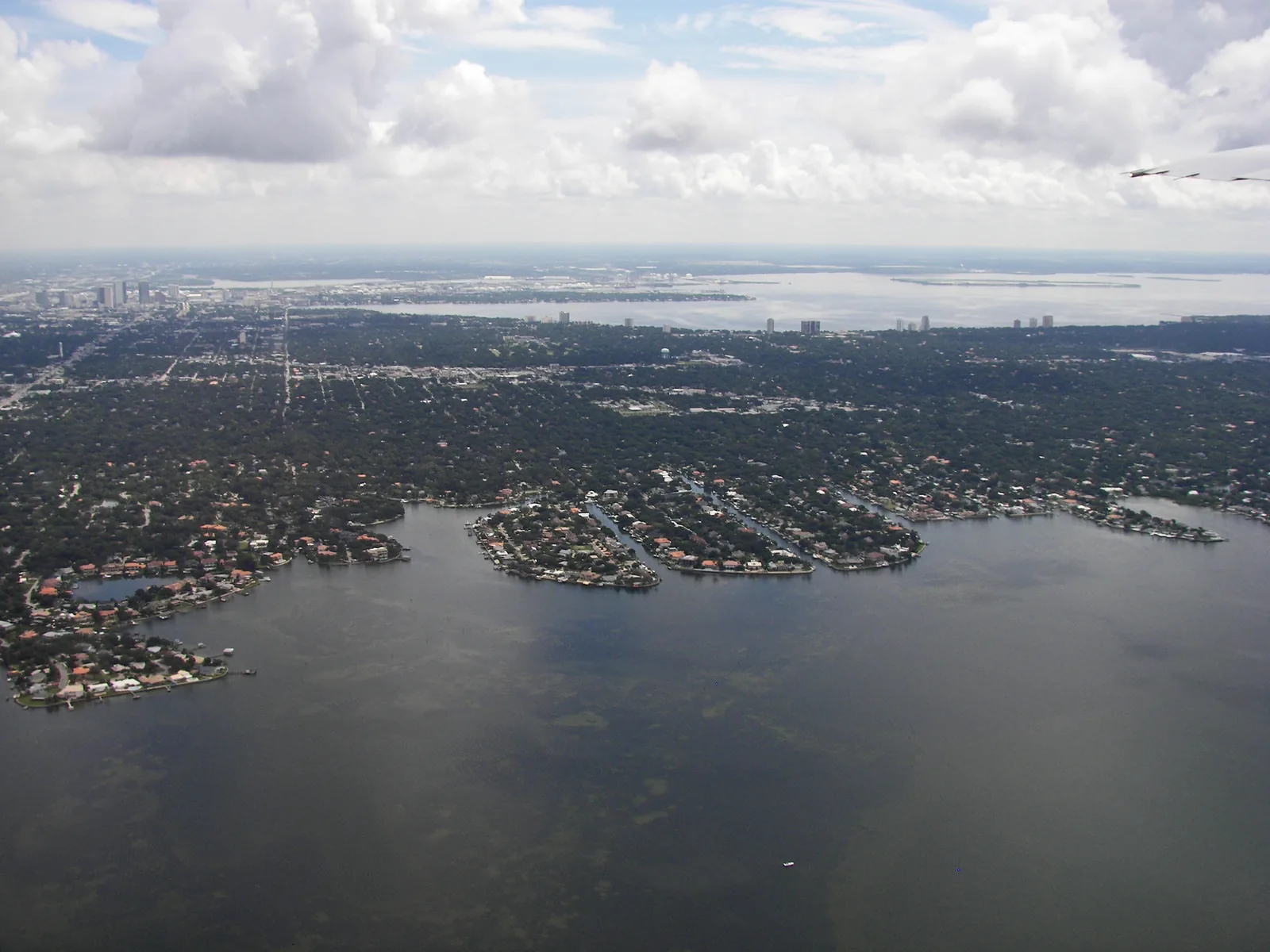
Before it was anything, it was a grove
Start with what was here, which was almost nothing. A colonel named Harry Culbreath bought this stretch of the peninsula not long after the Civil War for a dollar and a quarter an acre — and planted the first orange grove anyone had put on the Interbay shore. For decades that’s what the land was: groves, scrub, palm and oak, a long way from downtown Tampa and not really worth the trip.

People tried to sell it before the boom and mostly couldn’t. Too far out. You’d want a whole day just to get your family down from the city, and another to get back. The land wasn’t the problem. The distance was. And then, almost overnight, the distance went away.
The bridge that made it reachable
In November 1924 a man named George Gandy finished driving a bridge straight across the open water of Tampa Bay. What had been a half-day’s haul around the shoreline to St. Petersburg dropped to about an hour. A new road, West Shore Boulevard, pushed south through the pines. Suddenly this far, forgotten western edge of Tampa was a place you could actually live and still get to town.

That was the opening the developers had been waiting for. A group led by T. Roy Young bought the old grove land, formed the Beach Park Company, and platted a subdivision they first called Beach Park on the Bay. By 1926 the lots were selling and the houses were going up fast. And the thing they were really selling wasn’t the lots. It was cool.
How you sell cool before you can make it
Here’s the part that’s easy to miss from inside a chilled living room. There was no air conditioning. Not in the houses, not in the shops, not anywhere a regular family spent an ordinary day. So if you were going to sell comfort in Tampa, you had exactly one tool to work with — moving air — and the Beach Park Company built the whole neighborhood around catching it.
They cut man-made canals and bayous back in from the shore, so the bay water (and the breeze that rides off it) reached the lots that didn’t touch the open bay. They bent the streets into long curves instead of a flat grid, so houses turned toward the water and the wind instead of baking in rows. The idea underneath the whole plan was that the breeze, caught right, was enough. Nothing more required.
A neighborhood engineered to stay comfortable on moving air alone — finished a few years before the thing that made moving air optional.
And the houses were cooling machines in their own right. The style of the moment was Mediterranean Revival — which, underneath the pretty arches, was a catalog of answers to heat. Pale stucco walls that threw the sun back instead of soaking it up. Deep arched loggias and porches that kept the rooms in shade. Tile roofs and high ceilings so the hot air had somewhere to climb, away from you. Windows set across from one another so a cross-breeze had a path straight through the house.

The company sold all of it as refinement — stucco and archways and decorative tile “meant to evoke both the exotic locale and a certain refined comfort.” But strip off the marble and the tile, and what they’d really built was a comfort system made of shade, orientation, and water. One of the architects drawing these houses was a woman named Susie Warlick, which was almost unheard of for the time. The work was serious. The whole neighborhood was a careful answer to a hard question: how do you make Florida livable with no machine at all?
What people actually did with the heat
The answer, for everyone, was to go where the air was. You didn’t fight the heat indoors, because indoors was the worst of it. You went outside and found the breeze. You sat on the porch into the night. You slept on a screened sleeping porch when the bedroom was hopeless. And on the worst afternoons you did the oldest thing there is — you got in the water.

That was the life Beach Park was selling into — a city that cooled itself outdoors, by the water, in the shade. It made perfect sense to promise that the right lot, on the right curve, catching the right breeze, was comfort enough. Nothing more. For a little while, with nothing better on offer, it almost was.
Then the whole promise fell apart twice
The first collapse was the money. Late in 1926 the Florida boom that had floated all of this simply stopped. Buyers vanished. By the end of the decade the few finished houses were renting for next to nothing, and when the Depression hit, nearly nine out of ten homes in the neighborhood went into foreclosure. Beach Park got so empty and so quiet that people came out to the half-built, overgrown lots to hunt the alligators that had moved back in. The place that promised you’d want for nothing nearly became nothing at all.
The second collapse took longer, and it’s the one that really ended the pitch. Because the breeze, if we’re going to be straight about it, was never quite enough. Everybody out on those porches knew it. They just didn’t have a choice — until, a generation later, a choice showed up small enough to carry in from the truck.

By the 1950s you could buy a box that sat in a window and made cold air on demand. The ads didn’t bother being subtle about what they were replacing. “Why swelter,” one asked, “when you can switch from hot, humid misery to cool, cool comfort?” One picture of a man sweating under a tree, one picture of a family cool indoors, and the whole case for catching the breeze was over. You could choose your own weather now, in one room, with a knob.
What the machine quietly undid
You can watch it unwind everything the neighborhood was built around. The canals that were cut to carry the breeze inland became just a pretty place to keep a boat. The streets kept their graceful curves, but the reason for the curve — turning every house toward the wind — stopped mattering. The sleeping porches got glassed in and cooled. The cross-breeze windows got shut and sealed so the cold wouldn’t leak away. A neighborhood designed to breathe learned, like everywhere else, to close itself up and hum.
Beach Park itself came back around — it’s one of the most sought-after addresses in Tampa today. A handful of the 1920s originals are still standing, tile roofs and arched loggias and all. The old Beach Park Company office, down on South West Shore Boulevard, is still there too, where somebody once decided the right words for the place were “Nothing More.” It’s a women’s club now.
And the breeze still comes off the bay every afternoon, the same as it did when that was the entire selling point — curling up the canals, bending around the curved streets, reaching for the porches. It’s just that nobody needs it anymore. Behind every pretty shutter on those streets, the house is kept cool by the one thing the slogan swore you’d never want — a machine — which turned out to be exactly the “more” that everyone, quietly, had wanted all along.