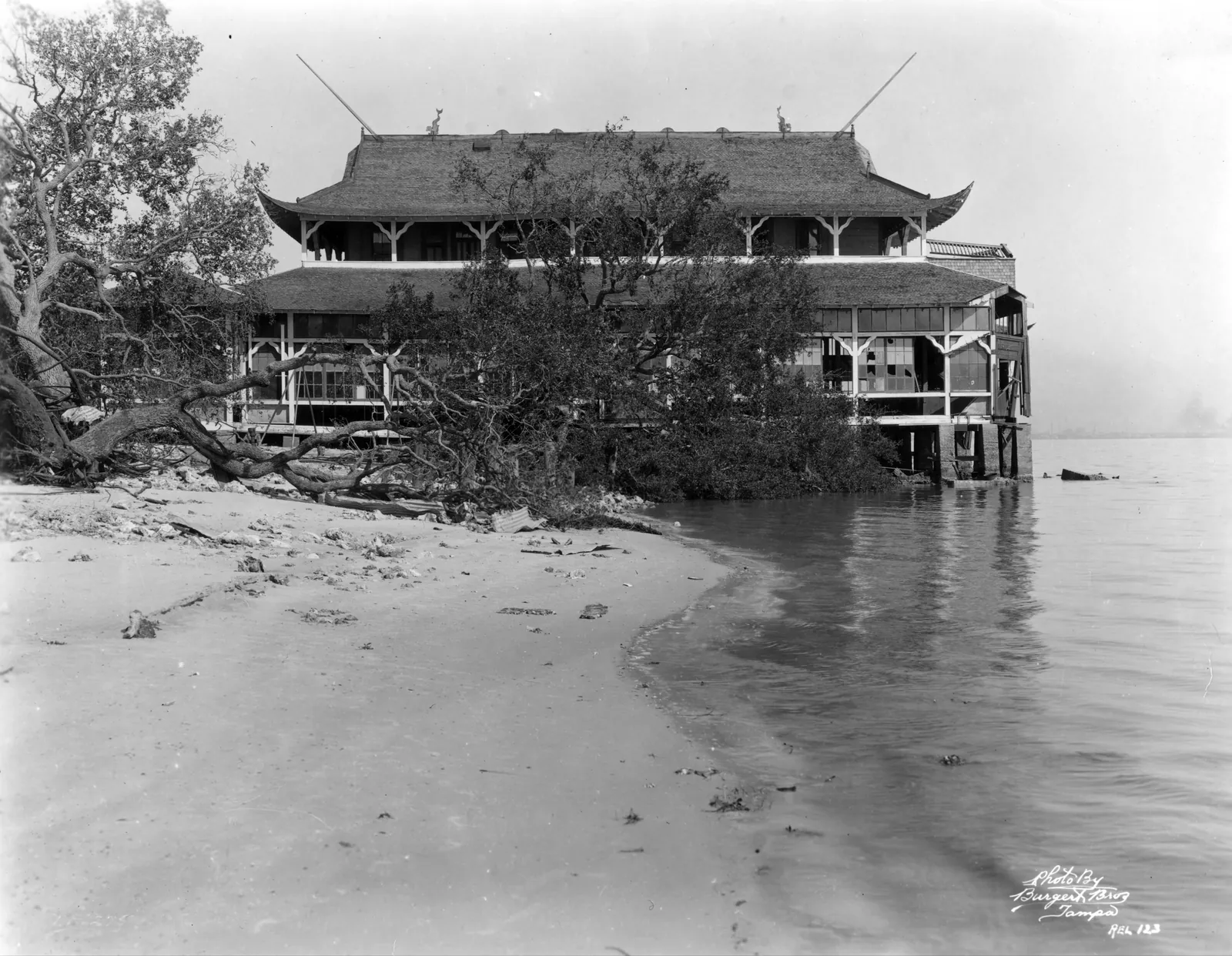
For about thirty years there was a Japanese pagoda standing out in the water at the south end of Bayshore. Two stories of it, pagoda roof and all, up on pilings over the bay, with a dance floor inside and a pier running out to meet it. It is one of the stranger things Tampa ever built, and the reason it existed is the same reason the whole neighborhood beside it exists. People were trying to get cool.
Which raises the obvious question. Why would a city build its grandest party out on stilts in the middle of the bay, a long ride from downtown, when there was perfectly good dry land everywhere?
Because the dry land, half the year, was almost unlivable — and the water was the only relief anybody had.
Before the machine, you chased the breeze
Picture a Tampa summer with no air conditioning anywhere. Not in the houses, not in the shops, not in a single room in the city. The heat comes down wet and heavy and just sits on everything, day and night, for months. That was ordinary life here for generations, and people got good at one particular trick for surviving it.
You went to the cool. You didn’t make it — you couldn’t — so you moved toward it. You found shade, and you found moving air, and the best moving air in Tampa came off the bay in the evening. A porch facing the water beat a parlor facing the street. And the edge of Hillsborough Bay, where the breeze came in off all that water, was the most comfortable ground in the whole city.
So the city built a way to get there.

The nickel ride to the end of the breeze
In 1893 an electric streetcar line was pushed all the way down the bayfront to a point of land called Ballast Point, and for one nickel you could ride the whole length of the water’s edge to get there. The woman behind it was Emelia Chapin, whose family ran the electric and streetcar company, and she did not build a plain trolley stop at the end of it. She built a park.
She named it Jules Verne Park, after the novelist who had once set a story about a trip to the moon in Tampa and, as far as anyone can tell, never actually came to see the place. And at the heart of it she put that pagoda out over the water.
The whole point was the breeze and the water, dressed up as a night out. There was a dance floor and a dining room. Bathers went in off the beach. Later a Ferris wheel went up beside it, seventy feet tall, turning right there at the lip of the bay. On a hot evening you paid your nickel, rode out past the last of the houses, and spent the night where the air actually moved.

It became the thing to do in Tampa for a generation. The land right around it got its own name and still carries it — Ballast Point — and the bigger stretch of fine homes that grew up along the water to the north got a name that says the whole idea out loud: Bayshore Beautiful.
A boulevard built to catch the wind
The road out to the pavilion mattered as much as the pavilion. In 1914 two developers, Alfred Swann and Eugene Holtsinger, laid a brick drive along the bluff above the bay and called it Bayshore Drive, part of a development they pitched as the “Suburb Beautiful.” They built a seawall to hold the bay back, and they wrote a rule into the deeds: nobody could build on the water side of the road. The view and the breeze belonged to everyone driving past.
And drive past they did — slowly, in the evening, with the windows down, because that was another way to catch moving air before anyone could manufacture it. A turn down Bayshore at dusk was its own kind of cooling. The homes that went up on the land side through the 1920s and ’30s — the Mediterranean ones with the barrel-tile roofs, the Colonial ones with the deep porches — were all built to do the same job the pavilion did: give the heat fewer places to land, and keep a family near the water until the machine age caught up.
The night it all came apart
Then, in October 1921, a major hurricane came straight up Tampa Bay — the worst the city had seen in a generation — and it went after the waterfront first. The storm surge tore up the brick road, ripped out long runs of the seawall, buckled the streetcar tracks, and buried stretches of Bayshore under nearly two feet of sand. It battered the pavilion out at Ballast Point badly enough that the place never fully recovered; within a few years the old pavilion was gone for good, finished off by fire.

A city that had bet its comfort on the water’s edge had just watched the water come take it back. So here is the thing they decided to do about it. They built it again, bigger.
The Boulevard of Dreams
Through the next decade and a half, Tampa rebuilt Bayshore into the version people still walk today. Federal work crews in the 1930s widened the road, paved it in concrete, added the medians and the landscaping, and set down the low white balustrade that runs along the seawall like a railing on a very long ship. By the mid-1930s you could drive a smooth, pale ribbon of road for miles along the open bay, and a sidewalk ran beside it the whole way — roughly four and a half miles of it, long enough that people took to calling it the longest continuous sidewalk anywhere.

It was gorgeous, and it was still the same old idea underneath. All that money and concrete, and what Bayshore was selling was exactly what the pagoda had sold thirty years earlier: come stand at the edge of the water, where the air moves. It was the grandest version of chasing the breeze that Tampa would ever build. It was also, though nobody driving it in 1936 knew it, about the last one.
The machine comes to the house
Because somewhere in those same years, the real answer was arriving — quietly, and not on the bay at all. After the Second World War, air conditioning finally climbed down out of the movie theaters and the department stores and into the windows of ordinary Tampa houses. And it changed everything the city had organized itself around.
You no longer had to go to the cool. The cool came to you, humming in a box behind the wall, in July, at two in the afternoon, with the windows shut. A family on a quiet street three blocks inland could now be more comfortable than the finest porch on the water had ever been. The breeze off the bay stopped being survival and became, simply, a nice view.
You can almost put a date on the end of the old way. On the morning of August 4, 1946, the very last streetcar in Tampa made its final run — and the route it rolled down, on its way out of the city’s life, was Bayshore. The nickel ride to the breeze carried its last passengers along the water and then stopped forever. Nobody needed to ride out to the cool anymore.
What’s still standing
The pagoda is long gone; there’s a public park at Ballast Point now, with a fishing pier where the pleasure pier used to run. But one small piece held on. The Chapins’ old gazebo still stands there on the point, restored, looking out at the same water the whole thing was built for.

And Bayshore itself is all still there — the seawall, the balustrade, the long pale sidewalk, the stately homes of Bayshore Beautiful set back on the land side exactly as the deeds required a century ago. People are out on it every evening. But look at what they’re doing now. They’re running, walking the dog, pushing a stroller, watching the sun go down over the bay. They come for the view and the exercise.

Not one of them is out there because it’s the only cool air they can get. That part is over. They’ll walk the whole breezy length of it and then go home to a house that’s cooler than the water ever made anything — because the breeze the entire neighborhood was built to chase finally got replaced by a machine that does the job better, on the hottest afternoon of the year, without anybody having to go anywhere at all.